
Key Takeaways
- The new QIS cluster tool at the Molecular Foundry lets researchers experiment with dozens of materials and methods for making qubit components in a single automated system, accelerating discoveries for long-lived quantum devices.
- By combining fabrication and analysis tools in one connected, clean environment under vacuum, the QIS cluster tool helps researchers grow diverse materials in ways they couldn't before.
- Automation through the cluster tool will produce enormous datasets that can train AI models on what makes a successful qubit, improving future designs.
Quantum computers could revolutionize how we design materials, secure information, and discover new drugs - but only if we can make their fragile building blocks, qubits, more stable, reliable, and controllable. To quickly figure out the best recipes for qubits, researchers at the Department of Energy's Lawrence Berkeley National Laboratory (Berkeley Lab) are putting a new robotic system to work.
The quantum information science (QIS) cluster tool sits within a cleanroom at the Molecular Foundry, a DOE user facility dedicated to nanoscience that supports around a thousand researchers from around the world each year - many of whom will bring their unique ideas for how to design better qubits. But given how exquisitely sensitive quantum components are to their environment, building and testing individual designs (and moving the sample from one tool to another) is slow and error-prone.
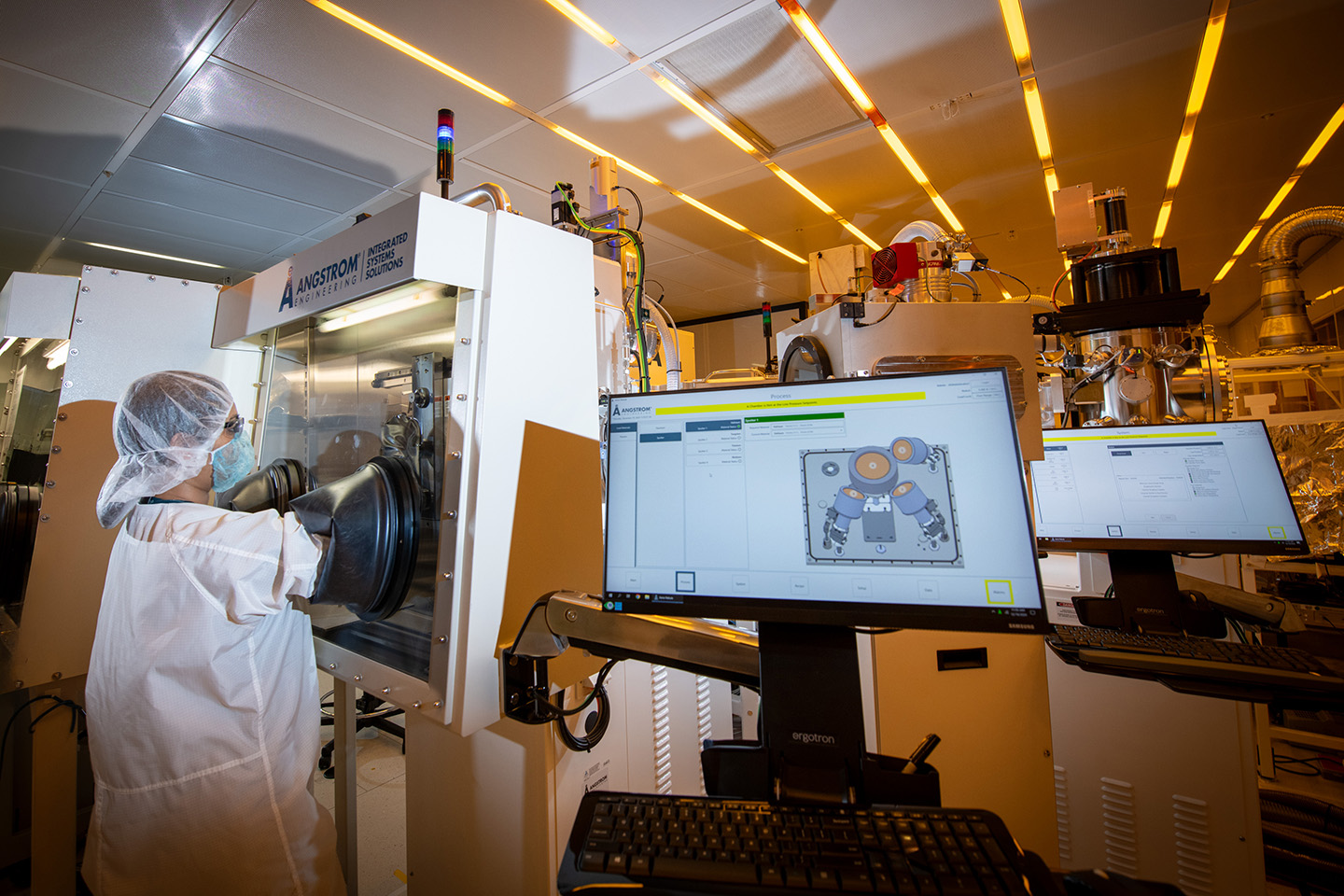
The QIS cluster tool dramatically speeds up and standardizes the process by combining multiple instruments for fabrication and analysis into one closed vacuum system. That means researchers can grow many types of materials using different techniques, one on top of another, without ever leaving the system, resulting in pristine interfaces. This is not possible with conventional fabrication methods, and drastically reduces the chance that quantum components are contaminated during production.
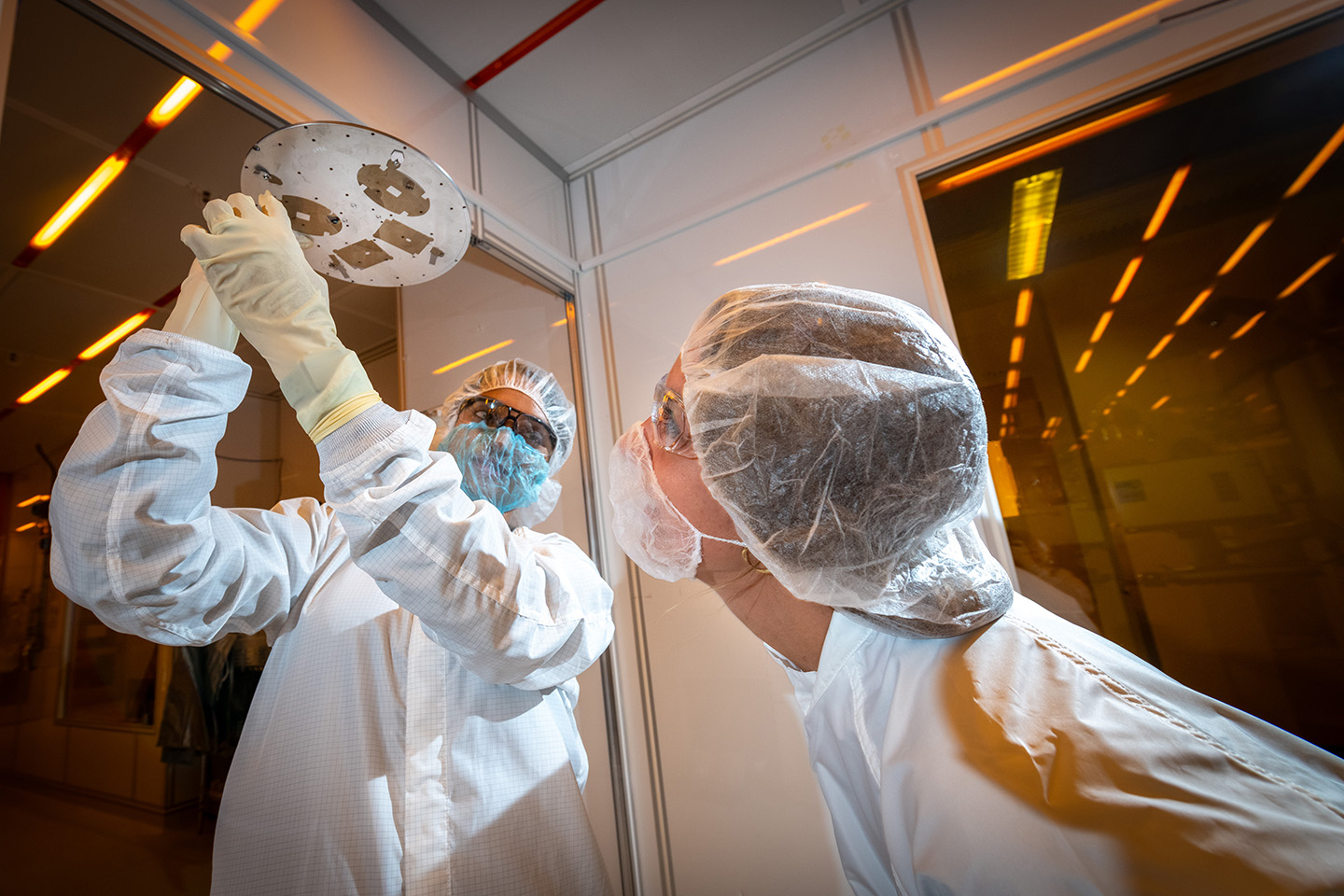
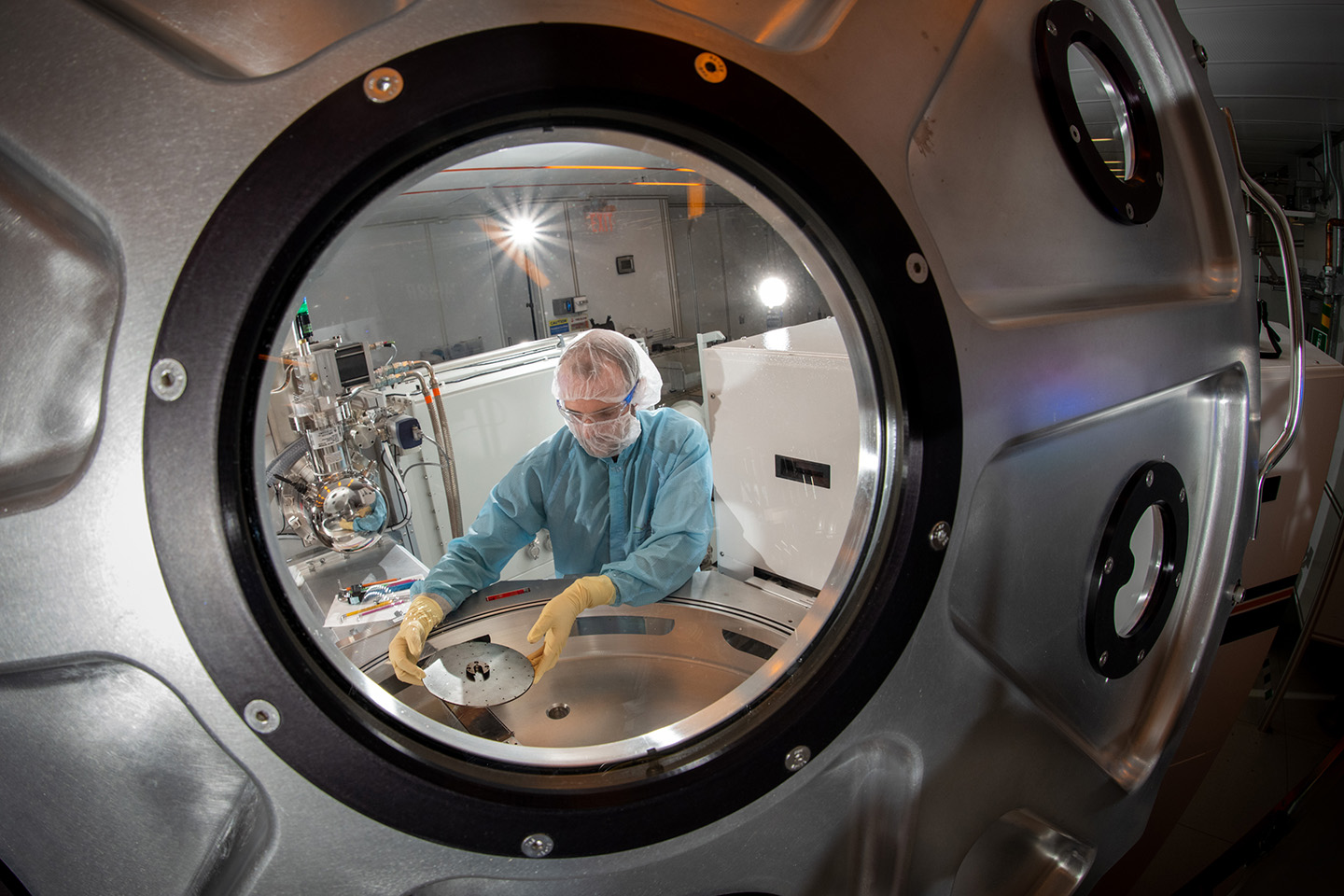
At the cluster tool's hub, a robotic arm shuttles an 8-inch disc called a wafer in and out of the surrounding ring of stations. Some deposit atom-thin layers of material, while others check each step for quality.
"It's like a robot pizza chef sitting in the middle with a spatula," said Aeron Tynes Hammack, a Berkeley Lab scientist who works on the cluster tool. "The exciting thing is that it automates processes in a fully clean environment to make complex materials. You can do it very reliably, very reproducibly, and fine-tune the recipes. It gives you insights you would never have if you were human-in-the-loop limited, making one sample at a time."
By automatically collecting AI-compatible data during quantum device fabrication and linking it to which qubits perform the best, researchers can then apply artificial intelligence to accelerate the search for the best materials, device design, and production methods for the next generation of quantum components.
Made to order
The QIS cluster tool excels at developing a tiny device at the heart of most quantum computers: the Josephson junction, a sandwich of two superconductors separated by an ultrathin insulating layer. This structure taps into the strange rules of the quantum world: pairs of electrons can "tunnel" through the barrier, even though they don't have the energy to cross over it in the classical sense.
Josephson junctions are combined with other components to form circuits that act as qubits, the basic units of quantum information. By sending carefully tuned microwave pulses into the circuit, qubits can then be manipulated to perform operations, similar to the bits in classic computers. But because they exploit quantum effects, they are not restricted to a binary set of states, opening the door to new types of computation. As the technology matures, quantum computers could tackle problems that are far too large or complex for today's machines, such as simulating molecules and optimizing massive networks (like the electric grid, supply chains, or traffic flow).
It's fitting that a cluster tool specializing in Josephson junctions is now at Berkeley Lab; John Clarke and his fellow laureates conducted their Nobel-Prize winning work on the technology at the lab, building the predecessors of today's superconducting qubits and paving the way for quantum computing.
Cooking with gas
Tiny changes to the materials, how they are layered and deposited, or accidental impurities can vastly change how a Josephson junction performs and how long a qubit can perform useful calculations.
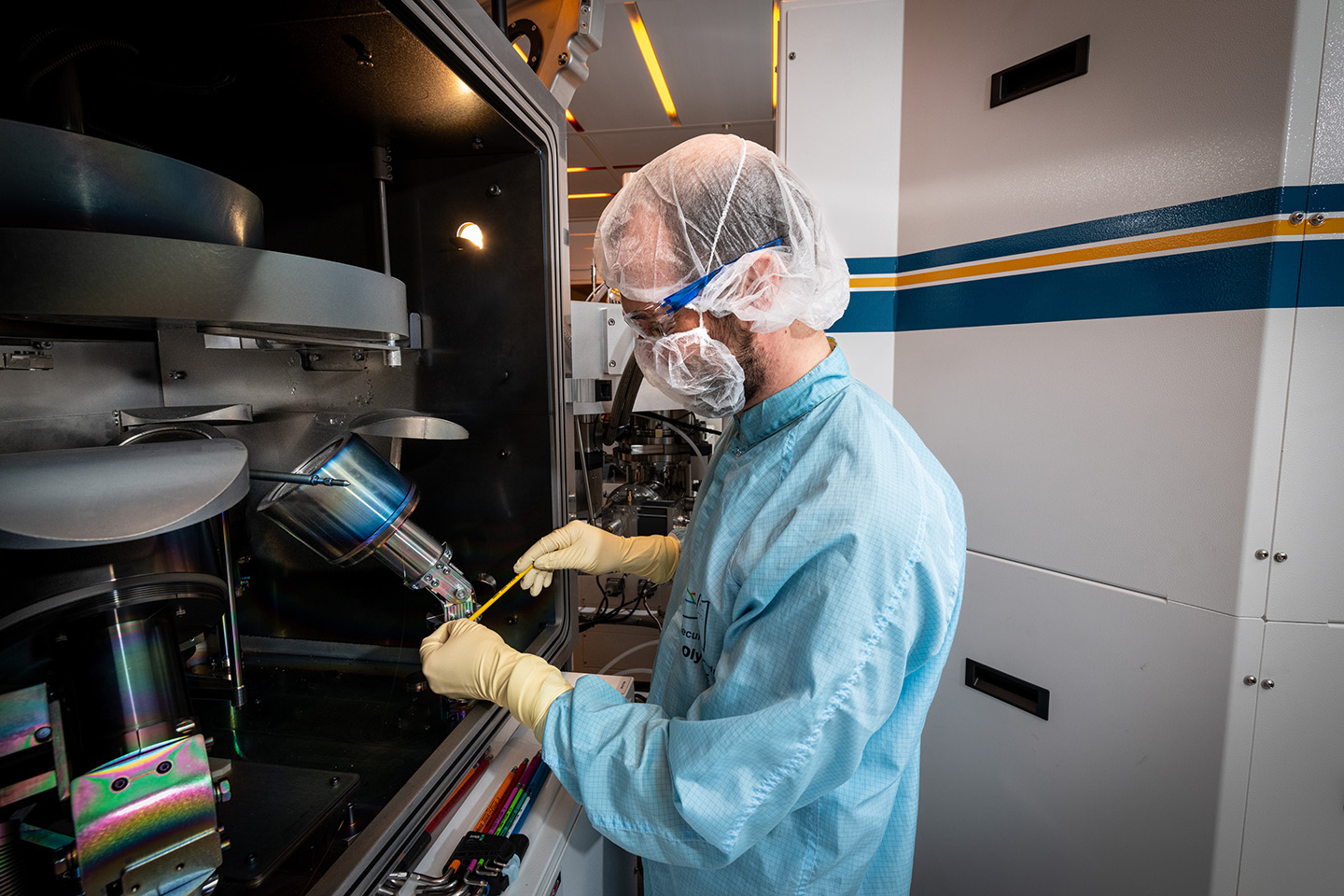
With the QIS cluster tool, experimenters can choose from multiple different materials (such as aluminum, niobium, titanium, or compounds of those metals combined with oxygen or nitrogen) and methods to fabricate their quantum components. Those techniques include painting atoms on layer by layer, sputtering atoms from a target, evaporating and condensing materials, and etching the surface with a beam of ions. The tool is extremely precise, able to make features that are just a few atoms wide. Specialized software optimizes the workflow so multiple samples can move through the cluster tool simultaneously.
The cluster tool also has several ways to analyze the materials, using electrons, x-rays, lasers, and infrared light. These can identify what (and how many) molecules were deposited and any impurities. If something goes wrong, researchers can stop the run early on, rather than wasting weeks or months of effort only to find the final qubit is damaged.
"Slight imperfections on the atomic level can destroy the delicate coordinated dance of electrons that give rise to special quantum properties," said Jim Ciston, deputy director of the Molecular Foundry. "There are so many different variables, from materials to temperatures to patterns, that you could possibly try. We need a tool that will autonomously explore and refine recipes for making these interfaces that lead to high-reliability, long-lived qubits."
A recipe for success
While bringing the cluster tool online, researchers at the Molecular Foundry have focused on making high-quality versions of traditional aluminum Josephson junctions. They've also collaborated with experts in Berkeley Lab's physics division to try different materials and test what happens at the quantum level in a junction made with two different kinds of metals. And in a recent study, researchers showed they could make high-quality Josephson junctions out of the element hafnium, carried out the first in-depth tests of the devices, and found they could be useful for supersensitive qubit-based particle detectors (capable of searching for low-energy signals expected from dark matter).
"We're exploring the different types of materials that we can deposit and how the processes influence their grain structure, composition, superconducting temperature transitions, and tolerance to magnetic fields…the 'boring' material science stuff," Hammack said. "But, you know, modern life is made out of really basic material science stuff, and the really basic material science stuff is what we have full carte blanche to explore in a way that you just tend to not have the bandwidth for in industry."
Some Molecular Foundry researchers who use the cluster tool are members of the Quantum Systems Accelerator (QSA), a DOE National Quantum Information Science Research Center led by Berkeley Lab since 2020. After fabricating Josephson junctions for quantum computers at the cluster tool, they'll assemble and test the final qubits in QSA's new dilution refrigerator in the Molecular Foundry. This setup will create a fast feedback loop that links how the components are made to the final qubit performance, speeding progress toward more reliable quantum computers.
Every experiment adds to a growing dataset that can train artificial intelligence models on what makes a successful qubit. Right now, the cluster tool can flag if one of the fabrication steps goes wrong, but the goal is smart, autonomous, AI-advised operation, "so that the machine can tell us from a recipe whether it is likely to produce high-quality qubits," Hammack said.
Secret sauce
Cluster tools are common in industry, but typically focus on production rather than exploration.
"I'm coming back to the Foundry from industry, and one of the challenges in industry is you wind up locked to the processes in your past that have been successful," Hammack said. "There are a lot of different materials that exhibit superconducting behavior that you can make Josephson junctions and resonators out of. What the national lab ecosystem and the user science facilities offer to the global community is that we have a mandate and writ to explore the basic science and which materials have different properties that might be compelling."
Those discoveries will then be shared publicly, enabling others to adopt successful recipes on their own systems and giving industry new options to pursue.
Josephson junctions are the first order up at the QIS cluster tool, but it can also develop precision pieces for microelectronics or other parts of a quantum computer, such as resonators and capacitors. The same devices underlying quantum computers can also serve as extraordinarily sensitive sensors in other fields.
"When you're building quantum logic gates or other computational interfaces, you're also getting really, really good sensors for free," Hammack said.
Such sensors could aid the search for dark matter, detect single molecules, or even help scientists identify and track new viruses, improving how we respond to future health challenges.


