
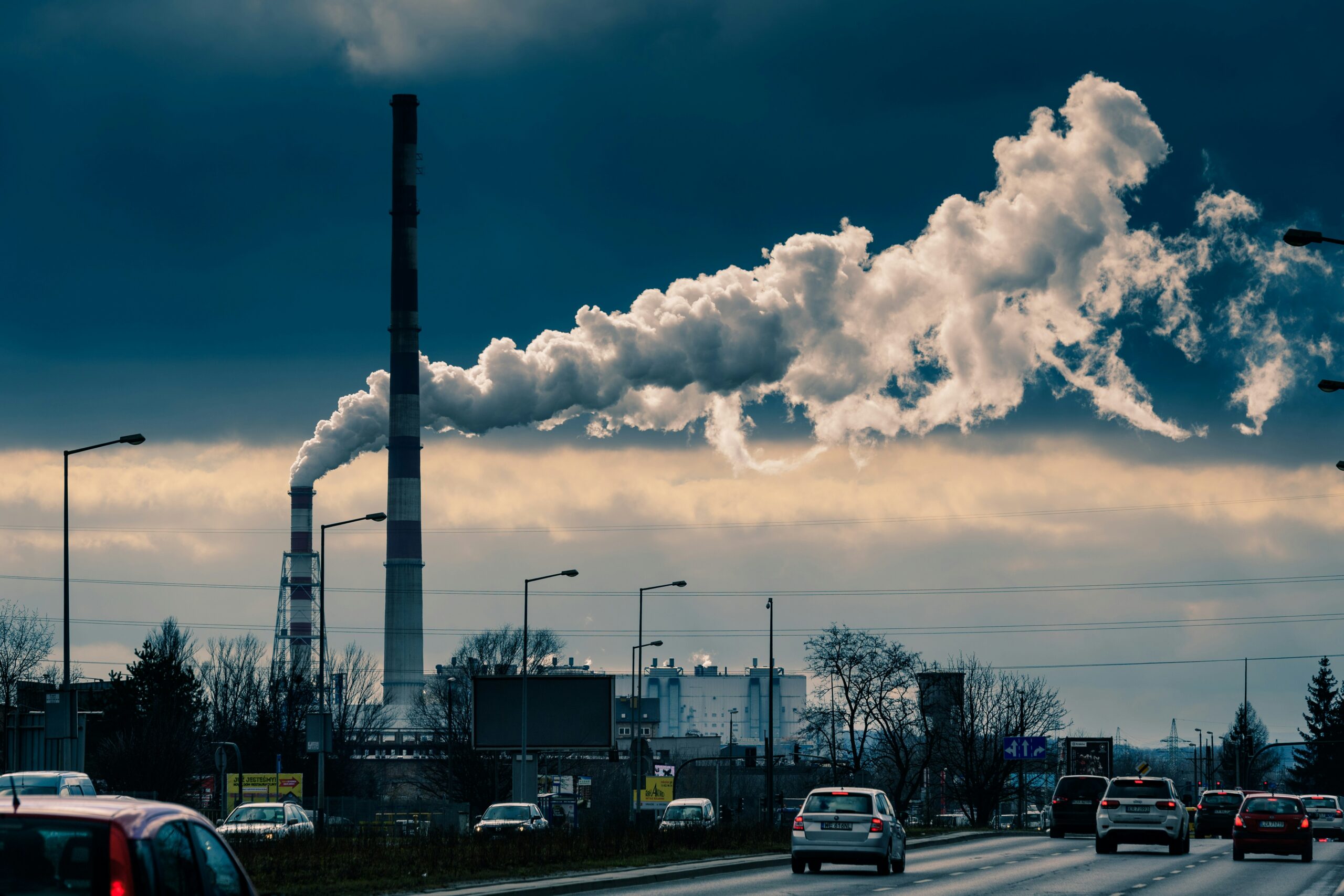
Cars driving past steaming smokestacks, both human activities that introduce greenhouse gases into the atmosphere. A new review summarizes over three decades of "incontrovertible" evidence for human influence on global climate. Credit: Jacek Dylag on Unsplash.
Prof Santer and colleagues - from UEA, the Massachusetts Institute of Technology (MIT), Colorado State University and the University of Edinburgh - say fingerprinting techniques have evolved to the point where human influence can now be identified throughout Earth's climate system and is "increasingly affecting the ability of societies and ecosystems to thrive".
They note that in addition to advances in climate fingerprinting, global warming has also advanced: the post-2009 period included the 10 warmest years in instrumental surface temperature records, enhancing the signal of human-caused warming relative to the 'noise' of natural variability.
"The climate science that's been published since the 2009 Endangerment Finding is now stronger than in 2009, the evidence is incontrovertible" said Prof Santer, of UEA's School of Environmental Sciences.
"Our review suggests that the growing body of evidence linking human activity to observed climate changes reinforces the need for policies aimed at limiting greenhouse gas emissions and addressing climate-related risks.
"A different kind of 'Endangerment Finding' is that the continuation of rigorous attribution science is endangered. It's inconvenient science for those who seek a fossil fuel intensive future, because it connects the dots between fossil fuel burning and harms to our personal health, to the health of our planet, and to the health of our societies and economies."
Over more than 30 years, Prof Santer has collaborated with colleagues around the world to identify human fingerprints in many different aspects of the climate system. His early research contributed to the historic 1995 conclusion of the Intergovernmental Panel on Climate Change: that "the balance of evidence suggests a discernible human influence on global climate."
This new review focused on fingerprint studies that deal with annual, decadal and seasonal changes in climate. It also touched on the extensive body of scientific evidence that addresses the impact of human-caused climate change on the properties of extreme events.
Extreme events affect human and ecosystem health and welfare through such impacts as heat stress, flooding, wildfires, and crop damage. Fingerprint studies build a direct link between human-caused increases in greenhouse gases and such threats.
"Many rigorous fingerprint studies by multiple research groups worldwide have enhanced confidence in the reality and seriousness of human-caused climate change," said Prof Susan Solomon, the Lee and Geraldine Martin Professor of Environmental Studies at MIT
"These studies reveal that many independently monitored aspects of Earth's climate have all been altered by global warming in physically consistent ways, just as we expect - from the top of the stratosphere to the depths of the world's oceans."
Dr Gabi Hegerl, of the University of Edinburgh, added: "Methods have also been developed to understand how greenhouse gases have changed the frequency and intensity of extreme events and how a weather event we observe today has been changed due to greenhouse gas emissions."
'Fingerprint Evidence for Human Effects on Climate: Advances after the 2009 Endangerment Finding', Benjamin D Santer, Susan Solomon, David WJ Thompson, Qiang Fu and Gabriele C Hegerl, is published in Earth's Future, AGU's journal for research on the state of the planet and its inhabitants, sustainable and resilient societies, the science of the Anthropocene and predictions of our common future.
Notes for journalists:
This study is published in Earth's Future, an AGU journal and is available to view and download at this link: https://agupubs.onlinelibrary.wiley.com/doi/10.1029/2026EF009129
An earlier Earth's Future commentary fact-checking the July 2025 DOE report is freely available here: https://agupubs.onlinelibrary.wiley.com/doi/10.1029/2026EF008831
A recent review of cost attribution methods for extreme weather events under human-caused climate change is freely available in AGU Advances: https://agupubs.onlinelibrary.wiley.com/doi/10.1029/2026AV002546
Paper title:
"Fingerprint Evidence for Human Effects on Climate: Advances after the 2009 Endangerment Finding"
Authors:
- Benjamin Santer, School of Environmental Sciences, University of East Anglia, Norwich, UK.
- Susan Solomon, Department of Earth, Atmospheric, and Planetary Sciences, Massachusetts Institute of Technology, Cambridge, MA, USA.
- David W. J. Thompson, School of Environmental Sciences, University of East Anglia, Norwich, UK; Department of Atmospheric Sciences, Colorado State University, Fort Collins, CO, USA.
- Qiang Fu, Department of Atmospheric and Climate Science, University of Washington, Seattle, WA, USA.
- Gabriele C. Hergerl, School of GeoSciences, University of Edinburgh, Edinburgh, UK.
AGU (www.agu.org) is a global community supporting more than half a million professionals and advocates in Earth and space sciences. Through broad and inclusive partnerships, AGU aims to advance discovery and solution science that accelerate knowledge and create solutions that are ethical, unbiased and respectful of communities and their values. Our programs include serving as a scholarly publisher, convening virtual and in-person events and providing career support. We live our values in everything we do, such as our net zero energy renovated building in Washington, D.C. and our Ethics and Equity Center, which fosters a diverse and inclusive geoscience community to ensure responsible conduct.
Subscribe or change your emailing preferences for the AGU Newsroom


