
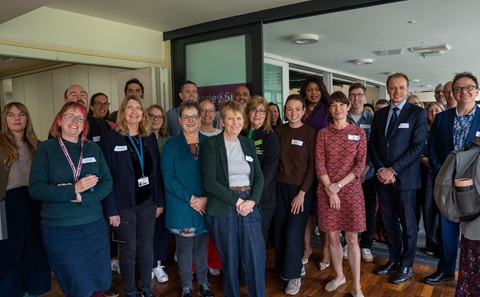
Organisations from across Southampton joined forces to address equal and fair access to healthy and sustainable food across the city.
The Food Summit event, organised by the Southampton Food Partnership , was held at the University of Southampton.
Representatives from schools, universities, supermarkets, community groups, local farms and food producers, caterers and charities attended the session to discuss how to tackle food inequality and access to healthy, sustainable food across Southampton.
Dr Jenny Baverstock, Principal Enterprise Fellow at the University of Southampton and co-lead of the Southampton Food Partnership, said: "Our goal is simple but powerful: to strengthen collaborations across our local and regional food system at a pivotal moment. With 2026 marking the start of devolution and a new strategic authority, this is a unique opportunity to ensure that food - whether it's tackling food insecurity and poverty, improving public health, supporting local supply chains, or driving sustainability - is firmly embedded in our regional priorities. The Southampton Food Partnership is aiming to make our community a better, fairer and healthier place to live in line with growth for our economy."
Opening the Food Summit, Sue Littlemore, Director of Civic University at the University of Southampton, said: "Access to healthy and sustainable food is a problem that affects people's lives, and it cannot be down to one organisation to solve it. If we come together and pool our strengths we have a much better chance."
Darren Paffey, MP for Southampton Itchen, told the meeting: "Food is not just about what happens in kitchens. It's about health and education and poverty and choice and climate and economic resilience, and it's about dignity."
He highlighted that food prices rose by 36 per cent between 2021 and 2025.
"Resilience is about whether a family can afford good nutritious food at the end of the month as well as at the start," said Dr Paffey. "It's about whether a community food pantry can meet demand, and whether schools can provide good meals.
"The most important shift we need to make is from emergency response to prevention. I am really heartened by knowing that we can be the sort of place that leads on this. Let's make Southampton a city where good food and nutrition is not a privilege but a part of everyday life."
The summit also heard from Duncan House, Chair of the Southampton Food Partnership, who commented on the regrettable need for food aid in our society.
Joseph Davies, Head of Food and Health at Upper Shirley High School, was the keynote speaker.
He said: "The state of the food nation is well and truly broken. Poor diet is the number one cause of death in the UK, particularly implicated in non-communicable disease. One-third of young people are overweight or obese, and in Southampton more than 44 per cent of children are overweight or obese. Instead of choice, we are bombarded with heavily marketed ultra-processed foods."
Mr Davies has tackled this head-on at Upper Shirley High School, overhauling the food and nutrition curriculum, and redesigning the school menu.
The event also heard from Chris McWilliams, Community Champion at ASDA Southampton, who outlined her work in communities to teach people how to cook nutritious meals and Richard Pitt from Aldermoor Community Farm, who outlined the farm's mission to enable more people to experience growing their own food. He wants Southampton to be the first UK city to have a municipal acorns production line, harvesting acorns and soaking them to remove the tannins so they can be consumed.
Other speakers included Gary Smith from Southampton University Students' Union, Ben Fishlock from SORoast and Victoria Ugwoeme from the Feed the Community project in Southampton.


