
Key takeaways
- UCLA scientists used portions of dinosaur teeth to pin down Tyrannosaurus rex's temperature for the first time, placing it at 97 degrees Fahrenheit, comparable to a human.
- A warm-blooded T. rex would have been an energetic predator or scavenger, not a sun-basking slowpoke.
- UCLA researchers perfected the method of measuring temperature from fossils, and partnered to use T. rex teeth from the Natural History Museum of Los Angeles County.
When picturing a scaled, toothy Tyrannosaurus rex stomping across North America, building nests and eating other dinosaurs, it's easy to forget that scientists have gleaned everything we know about T. rex from clues left more than 60 million years ago. While the presence of fossils in Alaska suggested that this prehistoric ancestor of birds was already on the evolutionary path from cold-blooded reptile to warm-blooded avian, there wasn't a way to take T. rex's temperature — until now.
UCLA scientists have perfected a method to measure a dinosaur's temperature from its teeth and found that T. rex was a relatable 97 degrees Fahrenheit — almost the same as humans. The finding, using fossils from the Natural History Museum of Los Angeles County, confirms the "King of the Tyrant Lizards" would have been a fast-moving predator or scavenger — not a sun-basking slowpoke — that was able to survive in chilly climates deadly to other reptiles.
UCLA researchers developed their prehistoric thermometer method a decade ago, using bones to measure whether extinct animals were warm-blooded or cold-blooded. Testing it on a T. rex, however, required more bone than any museum would part with. Over that decade, however, the UCLA team refined the process, cutting the amount of material needed for ancient dental testing by roughly 90%. It was enough to convince LA's Natural History Museum to provide portions of two teeth from Thomas the T. rex, the most complete of the towering tyrannosaur skeletons inside the museum's dinosaur hall.
Though scientists have found increasing evidence that T. rex was warm-blooded in recent years, the study published Sept. 16 in Science Advances marks the first time scientists have an actual number.
"No one's been able to make a temperature measurement like this before," UCLA geobiologist and study co-author Robert Eagle said. "We found T. rex was 36 Celsius (97 Fahrenheit), about the same as humans. The temperature is about what I would have guessed — higher than a reptile or a slow mammal like a sloth, but lower than an avian."
Though still a scaly, egg-laying reptile, T. rex's 36 C body temperature is comparable to a furry, warm-blooded mammal's. Modern, cold-blooded reptiles run about 28–30 C (82–86 F), while most birds — T. rex's evolutionary descendants — often run much warmer at 40–43 C (104–109 F), Eagle said.
How the body temperature of Tyrannosaurus rex was determined
The key to taking T. rex's temperature lies in a chemical bond, Eagle said. Inside tooth enamel, rare isotopes of carbon and oxygen form bonds together. The number of those bonds between those isotopes increases in cooler temperatures and decreases in warmer temperatures. A warm-blooded animal will have fewer of these chemical bonds in their teeth than a cold-blooded animal.
"That's the basis of using the isotopes as a thermometer," Eagle said. "In theory, we can make measurements using any part of the skeleton, but the bones in our body are constantly being remodeled and dissolved and replaced. Tooth enamel has large crystalline structures that are extremely durable, making it the part of the skeleton that most resists chemical alteration by the environment over the eons."
Eagle and lead author Randy Flores used a dental drill to remove the enamel from the fossils and dissolved the resulting powder in phosphoric acid to release carbon dioxide gas containing the isotope bonds. Measuring the gas with a mass spectrometer revealed the isotope ratios, Eagle explained. Pressurizing the gas allowed them to create a denser jet of CO2, providing a large enough sample for the mass spectrometer from a smaller amount of material.
What the T. rex's body temperature tells us about the dinosaur
A thermoregulated T. rex supports theories that tyrannosaurs were active animals, chasing or scavenging food to fuel their fast metabolisms, Eagle said. It also adds to the timeline, showing how much this ancestor of modern, very warm-blooded birds had already diverged from cold-blooded dinosaurs.
A toasty T. rex also was able to survive in a cooler habitable range, stretching into territory where cold-blooded animals would have faltered, said study co-author Alessandro Chiarenza, a paleontologist at University College London. The warm-blooded reptile would have adapted over millions of years to the hot-house conditions of the Cretaceous Period, one of the warmest periods in Earth's history, approximately 11–25 F warmer than today.
But even in the baking heat of the Cretaceous Period, winter in Alaska would have been too frigid for a cold-blooded dinosaur, Chiarenza said. And sure enough, paleontologists haven't found fossils of lizards, turtles, crocodiles or other reptiles from Cretaceous Alaska, but they have uncovered Tyrannosaurus fossils there.
"Now we have empirical evidence using this geologic thermometer," Chiarenza said. "Using paleoclimate models of the past, we were able to reconstruct a range in North America 66 million years ago that stretched from Mexico to Alaska, based on where T. rex could have survived with a 97 F body temperature."
"For an animal this famous, it is remarkable how little we actually knew," said senior author Aradhna Tripati, a UCLA isotope geochemist and climate scientist. "Thermal physiology drives behavior, range, energy budget and how a species responds to a changing climate. Without it, you don't really have an understanding of the animal. The teeth tell us T. rex was warmer than the environment around it. A warm-blooded T. rex can go almost anywhere on the continent, including the Arctic."
Eagle and Tripati had discussed the project for 15 years, inspired by a mentor at Caltech, John Eiler, but the necessary sample sizes were too large. Over time, working in Tripati's lab, they developed the new method with Flores, a fellow in Tripati's Center for Developing Leadership in Science.
"This has taken more than a decade of work in my lab — from standardization to method development to proof of concept — and now this breakthrough discovery," Tripati said. "Nobody hands you a T. rex tooth unless you can show them you only need a few milligrams."
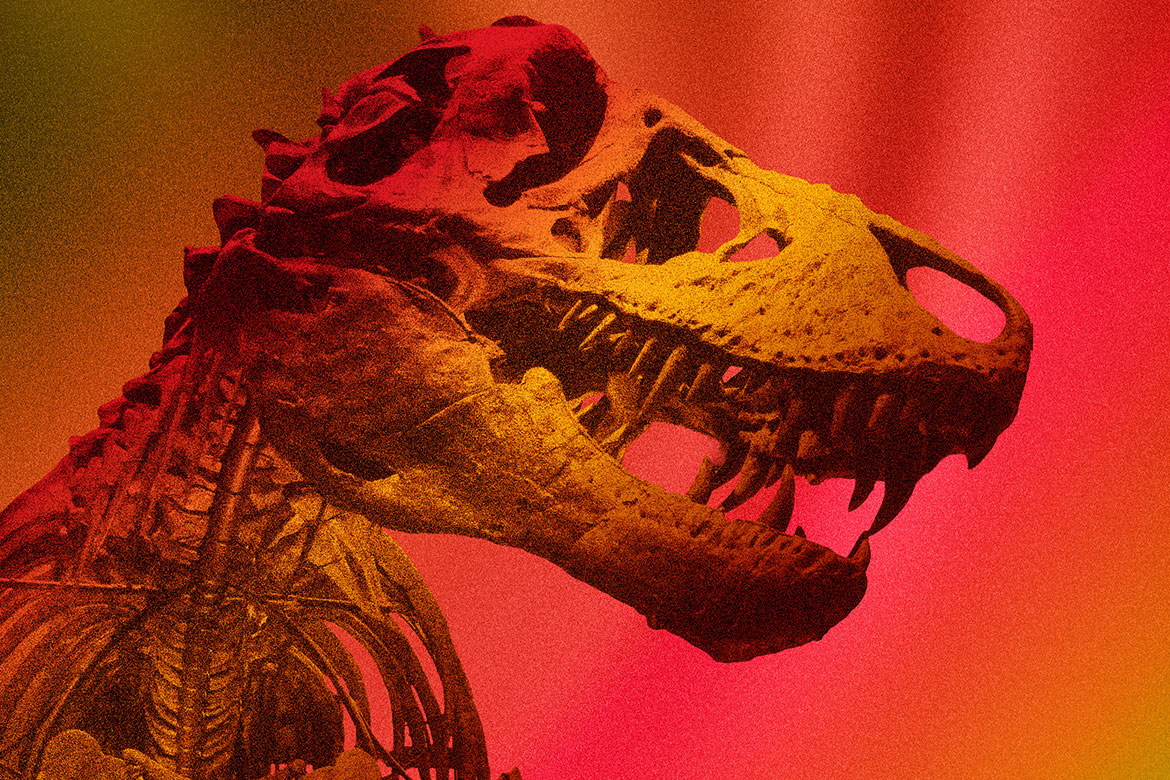
Why it was the right time to test the fossils
After years of collaborating with Eagle and UCLA, the Natural History Museum agreed the technology had advanced enough for the institution to provide small portions of Thomas the T. rex's teeth that aren't on display, said Luis Chiappe, curator of the museum's Dinosaur Institute and head of research and collections.
"We're asked for fossils for use in destructive analysis all the time," Chiappe said. "The museum contains tens of millions of specimens of minerals, animals and fossils that are irreplaceable. We have to make decisions that balance the damage to the specimen against gaining knowledge about the natural world. Sacrificing small portions of two teeth to learn about T. rex's body temperature is definitely worth the trade-off."
Thomas the T. rex's bones come from a dig site at Hell Creek in Montana, the same place as ancient crocodilian fossils also measured by the research team. By comparing their findings of the crocodilian's 30 C (86 F) body temperature to the 36 C (97 F) of the T. rex, the researchers showed that the results weren't reflecting a fluke of geology changing the fossils' molecular composition, which would have resulted in similar temperature readings for both species, Eagle said.
The research was supported in part by grants from the National Science Foundation.


