
A new silatrane-based hydraulic polymer developed by researchers at Institute of Science Tokyo, can be shaped with water and can harden spontaneously, much like cement. When mixed with water, the material transforms from a soft, workable putty into a hard, water-resistant solid through a water-triggered chemical reaction. The discovery opens new possibilities for underwater repair, bonding, and development of organic materials that can combine easy shaping with reliable hardening.
A Water-Curable Polymer That Hardens Like Cement
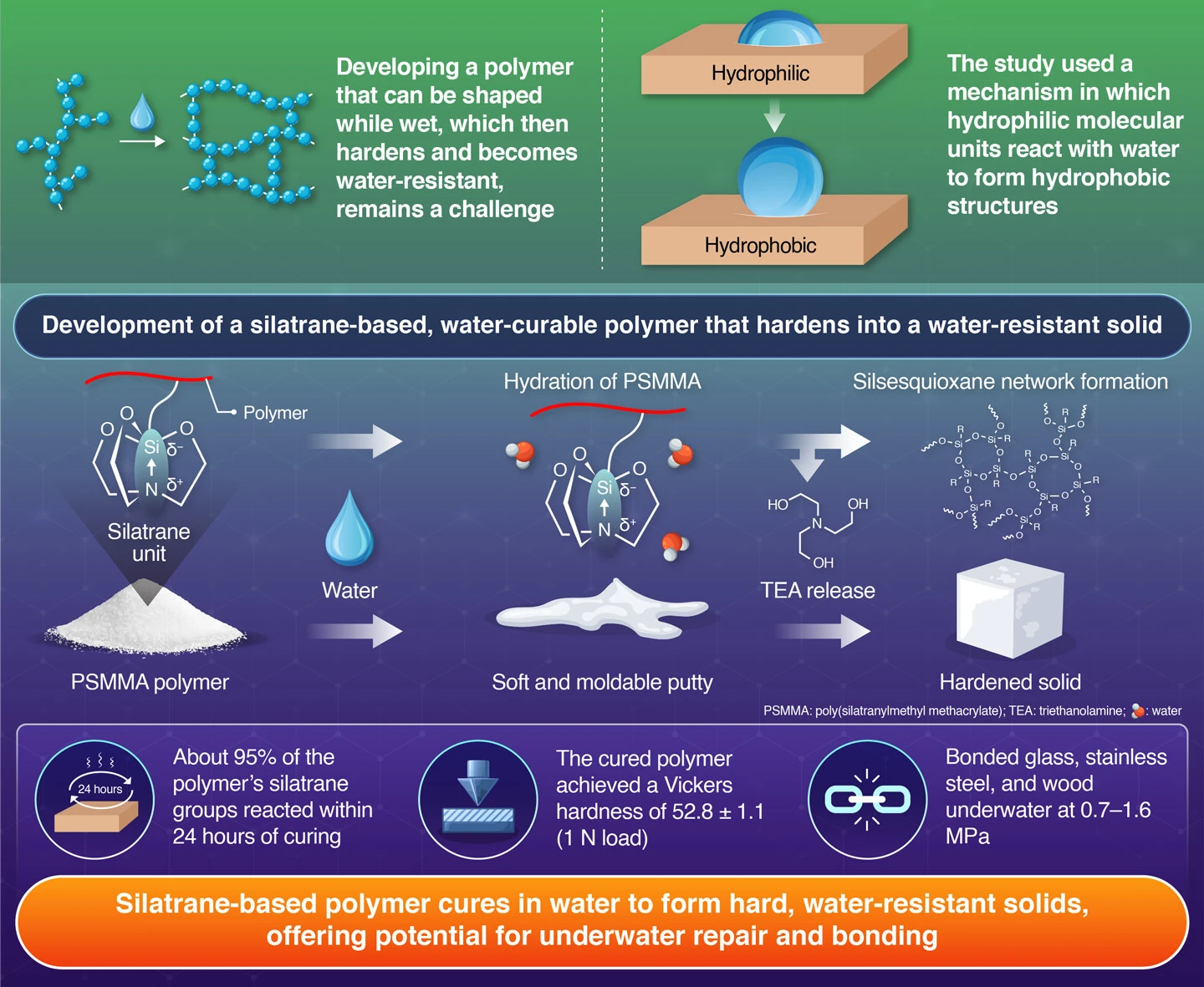
Cement hardens when mixed with water, allowing it to form solid structures even in wet environments. This property is known as hydraulicity. Reproducing this property in organic polymers has been challenging as polymer materials that react with moisture, often lack the combination of bulk curing and water resistance, which needs to harden reliably in wet conditions.
Addressing this challenge, researchers led by Assistant Professor Akira Takahashi, graduate student Rei Tokumitsu, and Professor Hideyuki Otsuka, from the Department of Chemical Science and Engineering, Institute of Science Tokyo (Science Tokyo), Japan, developed an organic polymer called poly(silatranylmethyl methacrylate), or PSMMA, which exhibits hydraulicity. Published online in Angewandte Chemie International Edition on September 10, 2026, the study offers a strategy for developing organic materials that can be shaped and bonded underwater.
"When PSMMA powder is mixed with water, the polymer turns into a soft, sticky putty, which gradually develops into a gel and then turns into a rigid solid," explains Takahashi.
The unique properties of the material stem from a chemical group called silatrane. Silatrane groups have an internal interaction between silicon and nitrogen that makes them water-loving, allowing them to interact readily with water. When water is added, the silatrane groups undergo hydrolysis, a chemical reaction in which water helps break chemical bonds, followed by condensation, in which the resulting groups link together to form a three-dimensional, crosslinked silsesquioxane network. This network strengthens and hardens the material, transforming it from a soft, workable putty into a rigid solid.
This process changes the material's chemical character. Initially, the silatrane-containing polymer interacts readily with water. As the reaction progresses, the formation of the silsesquioxane network makes the material less hydrophilic and more water-resistant. In other words, water first helps soften and shape the material, then triggers the chemical transformation that hardens it.
Researchers investigated the water-triggered reaction using a small silatrane-containing molecule. They found that triethanolamine released during the reaction helps to catalyze the further reactions, which accelerates the process. Then, they prepared PSMMA by polymerizing a silatrane-containing monomer and studied how the polymer reacted upon addition of water.
The results confirmed the formation of the crosslinked network, showing that almost 95% of the silatrane groups had reacted within 24 hours of curing. The curing material also showed substantial hardness, although it was brittle. The team explored whether the material's changing properties could be used in practical demonstrations. After mixing with water, they shaped the putty into rods using molds before allowing them to cure underwater. The cured polymer retained the intended shape including cubic and spiral forms.
"Water plays two roles in this material: it makes the polymer workable and triggers the reaction that turns it into a solid. This gives us a new way to approach the design of organic materials that can be shaped and cured in wet environments," says Takahashi.
The team also used PSMMA to join fragments of a broken glass vial. When the repaired vial was filled with water, it showed no leakage in the reported tests. In other experiments, they also bonded different substrates underwater and measured tensile shear strengths of approximately 0.7-1.6 MPa after curing.
These results demonstrate the material's potential for underwater adhesion, establishing a proof of concept rather than a ready-to-use repair product. Future research will explore ways to improve its mechanical properties, including reducing brittleness through copolymerization, and investigate how the extent of curing influences adhesive strength.
Reference
- Authors:
- Rei Tokumitsu1, Shio Uebo1, Akira Takahashi1*, and Hideyuki Otsuka1,2*
*Corresponding authors
- Title:
- Hydraulicity in Organic Polymers Enabled by Hydrophobization Upon Water-Triggered Curing of Hydrophilic Chains
- Journal:
- Angewandte Chemie International Edition
- DOI:
- 10.1002/anie.1794764
- Affiliations:
- 1Department of Chemical Science and Engineering, Institute of Science Tokyo, Japan
2Research Center for Autonomous Systems Materialogy (AsMAT), Institute of Science Tokyo, Japan


