
Cardiac surgeon Amy Fiedler, MD, stares at the motionless heart below her in an operating room at UC San Francisco's Helen Diller Medical Center at Parnassus Heights.
She's nearly five hours into a heart transplant surgery. The procedure is one of medicine's most complicated, demanding some of surgery's longest operating times and a highly specialized team. It is also some heart failure patients' last hope.
With the donor heart now in place, Fiedler carefully removes a clamp on the heart's largest artery, the aorta. Within seconds, blood rushes down through the vessel, filling the organ.
The heart, silent and still seconds ago, begins to beat.
"No matter how many transplants I do, nothing will ever amaze me more than watching the donor heartbeat in the recipient after the clamp comes off," Fiedler would later say.
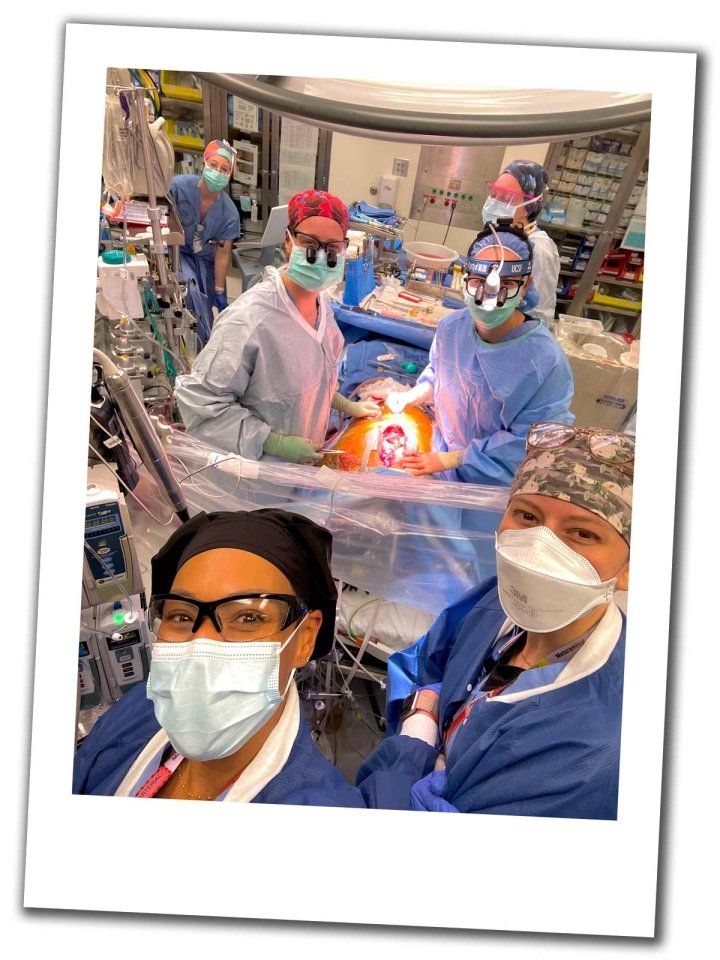
As the team prepares to shift the patient to the intensive care unit. Fiedler pauses, turning her head, taking in the room - a moment that UCSF Anesthesiology Professor Charlene Blake , MD, PhD, would later recount to television crews.
It dawns on Fiedler: "We're all women …" Click. The group takes a selfie.
A plane, a plot twist, and a legacy
As a young surgery resident, Fiedler imagined a future in pediatrics or oncology - until a birthday spent on call changed her life. A donor heart became available that day, and she joined her hospital's sole female heart-transplant surgeon, Jennifer D. Walker, MD, on a plane to retrieve the organ.
Women comprise less than 6% of U.S. heart transplant surgeons, making it one of medicine's most male-dominated specialties. The gender imbalance is perpetuated by gaps in pay, mentorship, leadership opportunities, and even patient referrals. Women must also balance long hours and intense training with decisions about family-building, particularly early in their careers. But it's not just women who lose in this equation: When health care workers reflect society, patient care improves - as do institutions' innovation, productivity, and financial health, research shows.
But Walker, at 30,000 feet in the air, still managed to convince Fiedler that she, too, could become a transplant surgeon. Walker backed her promise with action, training her like an athlete, Fiedler says.
Fiedler would become the second female heart transplant surgeon to graduate from Massachusetts General Hospital's residency program. "I remember as a resident, sitting in the conference room, and on the walls, there were rows of headshots of the graduated residents. It was all men - and then there was Dr. Walker's photo," she says. "Twenty-five years later, there was mine."
In 2023, Fiedler led what is likely the world's first all-female heart transplant at UCSF . The selfie immortalizing the historic moment went viral - inspiring other women to share their own on social media.
Today, Fiedler is UCSF's first female heart transplant surgeon and the Surgical Director of Heart Transplantation and Mechanical Circulatory Support. Together with UCSF's Advanced Heart Failure Comprehensive Care Center , she is pioneering the latest technology to ramp up life-saving care for heart failure patients. And all these years later, she is paying that plane ride forward, mentoring others, particularly women, as part of UCSF's work to transform the face and culture of surgery.
The mentorship multiplier
If someone wants to do this, by all means, I'd like to help them get there.
Amy Fiedler, MD
It's a chilly spring morning in April, and fog gathers around UCSF's Medical Sciences Building. On the third floor, Fiedler has just returned to her office after an emergency operation. Behind her on the wall are keepsakes: a framed copy of a news article detailing her 2023 all-female surgery, a memento from her work with the nonprofit Team Heart to improve access to cardiac surgery in Rwanda, and an Ironman Triathlon bib.
From the hallway, Division Chief of Adult Cardiac Surgery and Lung Transplantation Jason W. Smith , MD, pokes his head through her doorway. The two share a laugh with the easy cadence of people who've spent years trading ideas across hallways, coffees, and conference tables.
The pair met early in her career at the University of Wisconsin-Madison. Then, Smith provided mentorship in transplantation and circulatory support. The two worked so seamlessly together that when Smith was recruited by UCSF in 2022, he urged the university to consider her, too. Now, he says, she has become key in transforming the program he heads as UCSF expands access to life-saving transplants.
"Amy is a great surgeon and driven - other surgeons would feel intimidated by that, but I've been teaching a long time, so I always felt comfortable giving her space to grow," Smith says. "She knows I'm not going to step on her tail, and I feel very supported - we have a great partnership."


