
Researchers at the ctd.qmat Cluster of Excellence in Würzburg have developed a new type of electronic component. These open up new possibilities for energy-efficient hardware, such as for applications in artificial intelligence.
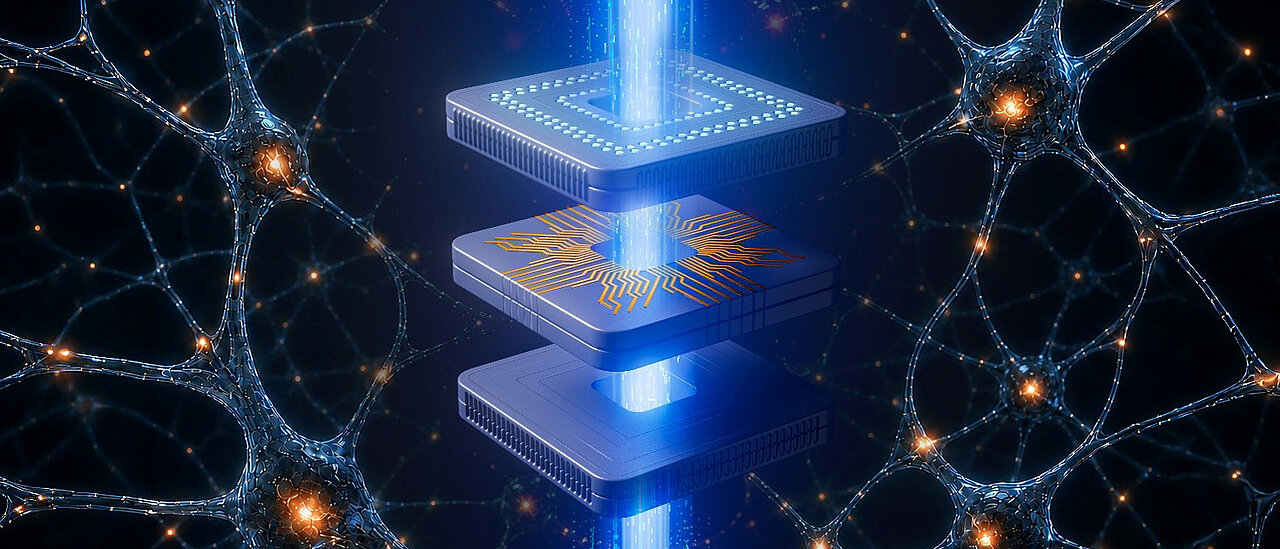
Artificial intelligence often requires enormous amounts of energy, especially when large models are being trained. While conventional computers usually keep computing and memory operations physically separate on a chip, the human brain links the two much more closely: neurons, or nerve cells, are connected by synapses and process signals directly at these points of connection. When signals occur frequently or with particular intensity, these connections change. This is a key mechanism of learning: the system stores past activity and adapts its behavior. Because the connections in the brain change in response, this process is known as neuroplasticity.
"Brain-inspired computing" aims to emulate this principle of learning from experience. The goal is computer hardware that not only processes information but can also remember states and adapt accordingly. A Würzburg-based research team from the Cluster of Excellence ctd.qmat - Complexity, Topology, and Dynamics in Quantum Matter - at the Universities of Würzburg and Dresden has now demonstrated that complex oxide materials are particularly well suited to this purpose. In its latest publication, the team presents components that can electronically reproduce key properties of biological nervous systems.
Complex oxides combine many functions
The new components are based on an interface between two oxide materials produced at the Würzburg Chair of Experimental Physics IV: lanthanum aluminate (LaAlO₃, or LAO for short) and strontium titanate (SrTiO₃, or STO for short). Although both materials are electrically insulating on their own, an extremely thin conductive region - known as a quasi-two-dimensional electron gas - forms at their shared interface.
Targeted microstructuring makes it possible to create tiny "electron highways" in which the flow of charge carriers - in other words, charge transport - can be precisely controlled. When current flows through the interface, oxygen atoms can be displaced. This changes the electrical resistance, allowing the conductivity of the structure to be adjusted in a targeted way. In this sense, the device can be "trained" - much like a neural network that learns through external stimuli.
The complex oxides used here are among the most promising material platforms for next-generation electronics. "Complex oxides are an especially exciting field for us because they combine many electronic properties in a single material platform. That is precisely what makes them so interesting for a new generation of energy-efficient and adaptable computer hardware," says Ralph Claessen, spokesperson at JMU Würzburg for the Würzburg-Dresden Cluster of Excellence ctd.qmat and a co-author of the study.
Components for an artificial neural network
The Würzburg team used the versatility of the oxide platform to develop components that can reproduce key functions of neurons and synapses. These include a transistor for switching current, a memristor as a resistance-based memory element, and a memcapacitor whose capacitance depends on its electrical history. What is particularly remarkable is that a single nanoscale component can perform different tasks depending on how it is wired. It can operate as a transistor, memristor, or memcapacitor - making it a kind of electronic all-rounder.
"What makes our platform so exciting is that we can realize very different functions using the same material system. This brings us closer to hardware that not only computes but can also learn directly within the component and temporarily store information," says Soumen Pradhan, a postdoctoral researcher at the Chair of Technical Physics in Würzburg.
Potential future applications for adaptive biosensors
One possible area in which the "self-learning" capabilities of the brain-inspired computing platform could be used is health monitoring and medical diagnostics.
In the long term, technologies of this kind could be used in wearable sensor systems or bioelectronic applications. They could continuously monitor key parameters such as heart rate, blood pressure, body temperature, oxygen saturation, or blood glucose and analyze them intelligently on the spot - quickly, energy-efficiently, and without additional computing units.
Although the latest results from the Würzburg physics team come from fundamental research, they clearly demonstrate the potential of this new generation of hardware. The study has been published in Nature Communications.
ctd.qmat
The Cluster of Excellence ctd.qmat - Complexity, Topology and Dynamics in Quantum Matter - at the University of Würzburg (JMU) and Technische Universität Dresden explores and develops novel quantum materials with tailored properties. Around 300 researchers from over 30 countries work at the interface of physics, chemistry, and materials science to lay the foundations for tomorrow's technologies. In 2026, the cluster entered the second funding period of the German Excellence Strategy of the Federal and State Governments - with an expanded focus on the dynamics of quantum processes.
Publication
Oxide Interface-Based Polymorphic Electronic Devices for Neuromorphic Computing; Pradhan, S., Miller, K., Hartmann, F. et al., Nat Commun 17, 3406 (2026), https://doi.org/10.1038/s41467-026-71642-2 .


