
To understand the universe as a whole, simulations on a cosmic scale are required. An international team of astrophysicists, led by Leiden University, is today making one of the largest cosmological datasets ever available for free. It comprises more than 2.5 petabytes of simulation data.
Cosmological simulations are essential tools in modern astronomy. They show how matter has evolved since the Big Bang, from small density fluctuations to galaxies and vast structures. On the largest scales, matter forms the so-called cosmic web: a network of filaments and nodes along which galaxies are distributed.
By comparing such simulations with observations, researchers can investigate fundamental questions, such as the nature of dark matter and dark energy - the invisible components that make up most of the Universe and drive its expansion.
From galaxies to cosmic structures
The FLAMINGO project was designed to bridge two regimes: highly detailed simulations of galaxy formation and the enormous cosmic volumes required for precision cosmology - mapping the Universe to percent-level accuracy in order to test theoretical models. While related projects such as COLIBRE, which is also led by Leiden researchers, focus on the physics within individual galaxies, FLAMINGO simulates volumes spanning billions of light-years. This allows researchers to study not only individual galaxies, but also galaxy clusters and the large-scale structure of the Universe.
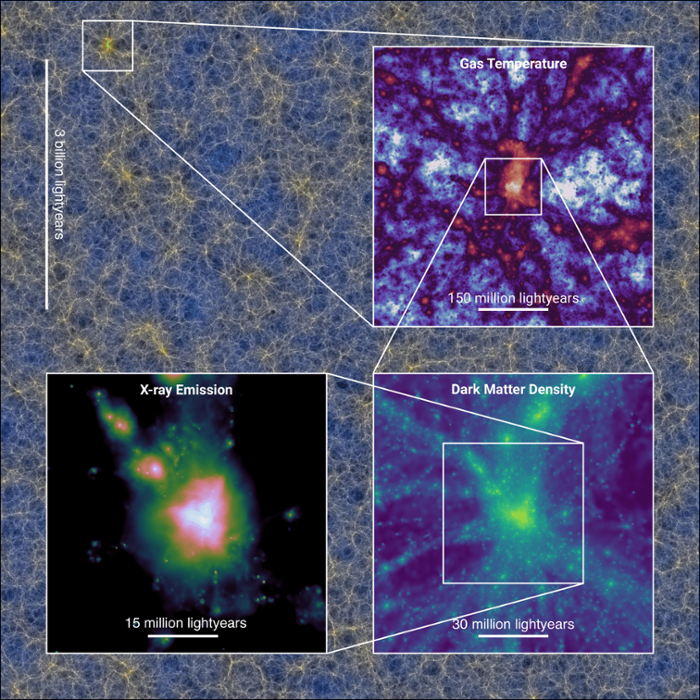
Supercomputer-scale simulations
'These simulations allow us to follow the growth of cosmic structure across vast regions of space, while still modelling the complex physics of galaxy formation,' says Joop Schaye (Leiden University), who leads the project. The data release is described in a paper submitted to Astronomy & Computing and published today on arXiv. 'By making the data publicly available, we hope researchers worldwide will use FLAMINGO to test new ideas about how the Universe works.'
'That is precisely why we believe it is important to make these data openly available. We want to lower the barrier to entry as much as possible.'
The simulations were carried out using the SWIFT cosmological simulation code on the COSMA8 supercomputer in the United Kingdom. Producing simulations of this scale requires exceptional computing infrastructure. 'Most researchers simply do not have access to facilities like this,' says Carlos Frenk (Durham University). 'That is precisely why we believe it is important to make these data openly available.'
To make the dataset usable, the team developed a dedicated online platform that allows researchers to explore and download only the subsets they need, without handling enormous files. 'We want to lower the barrier to entry as much as possible,' says John Helly (Durham University), who led the development of the system. 'This way, a much broader community can work with these simulations.'
'Open access to datasets of this scale can significantly accelerate scientific progress.'
New discoveries thanks to open cosmology
Since their introduction in 2023, the FLAMINGO simulations have already been used in dozens of studies, including research on galaxy formation and the distribution of matter in the Universe. With the full data release, the team expects to enable many more discoveries.
'Open access to datasets of this scale can significantly accelerate scientific progress,' says Matthieu Schaller (Leiden University). 'We aim to provide a resource that will support a wide range of astrophysical research.' The release marks an important step toward open, collaborative cosmology, offering researchers worldwide a new window on how the Universe has evolved.
FLAMINGO
FLAMINGO is a collaboration between scientists from the Virgo Consortium at Leiden University, Durham University, and Liverpool John Moores University.
The data release is described in the article: The FLAMINGO simulations data release, Helly et al. The FLAMINGO data and documentation can be found at https://dataweb.cosma.dur.ac.uk:8443/flamingo/introduction.html
This article appeared as a press release on NOVA's website.


