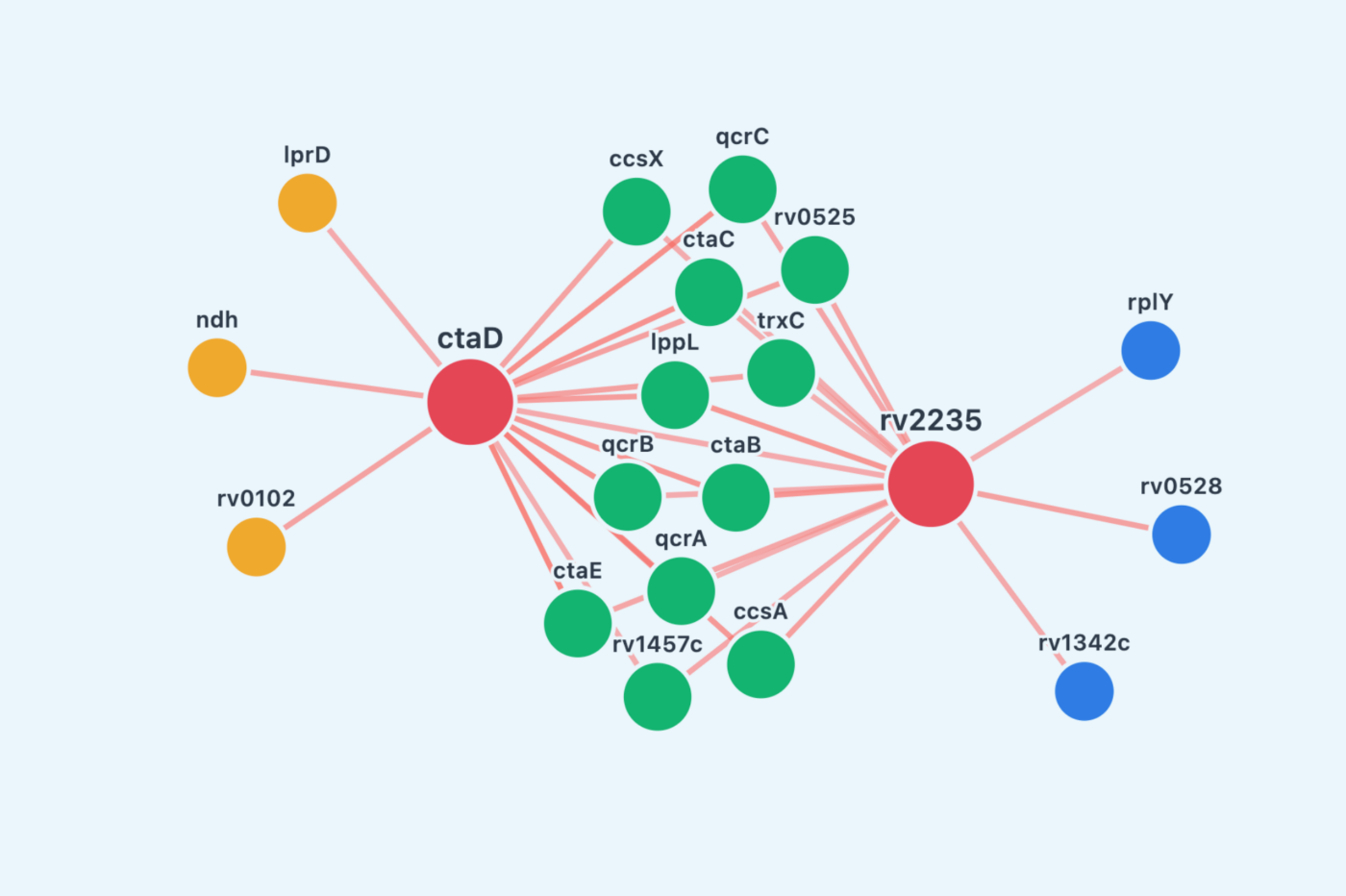
Genetic interaction networks, such as the one pictured here, allowed researchers to predict functions for previously uncharacterized genes. (Credit: Rock lab)
Rockefeller scientists have created the most comprehensive map to date of how essential genes interact in Mycobacterium tuberculosis (Mtb), the bacterium responsible for tuberculosis (TB). The unprecedented map reveals thousands of previously unknown genetic relationships, offering a new window into the inner workings of one of the world's deadliest pathogens.
The work, led by researchers in Jeremy Rock's Laboratory of Host-Pathogen Biology and published in Nature, sheds light on the functions of poorly understood genes and gene interactions. By revealing how genes essential to the bacterium's survival work together, the findings could help scientists identify promising new drug targets as well as develop more effective combinations of antibiotics to combat TB.
"Yeast geneticists have used a similar approach to transform our understanding of fundamental cell biology; ever since I started working on TB, I've dreamed of bringing this idea to the study of Mtb," says Rock. "Now, we have the first comprehensive map of interactions among essential genes in a pathogen. The potential impact for fighting this disease is enormous."
A notoriously stubborn pathogen
Tuberculosis has plagued humanity for thousands of years, and despite decades of medical advances, it remains one of the world's deadliest infectious diseases, claiming more than a million lives each year. That's largely because Mtb is notoriously difficult to eradicate. For one, the microorganism has a particularly sturdy cell wall that creates a barrier against antibiotics, and its ability to persist in the body makes infections especially stubborn.
"It's slow to grow, but it's also slow to die," says Isaac Kresse, a co-first author of the study and graduate fellow in the lab. "And the longer it takes to clear the infection, the more time bacteria has to gain resistance."
Treating tuberculosis typically requires multiple antibiotics taken over several months; drug-resistant infections can take even longer to clear from the body. Finding better treatments, however, requires a deeper understanding of the bacterium itself. Despite decades of research, scientists still don't fully understand the functions of many genes essential to its survival, much less how those genes work together.
"There are a lot of genes in the Mtb genome that are just completely uncharacterized," says Natalie Sayegh, a co-first author and Rock lab biomedical fellow. "We don't know what they do."
The researchers' new map takes a major step toward filling that gap. Their ambitious project required systematically studying how hundreds of genes affect one another; it uncovered thousands of previously unknown genetic relationships, offered new clues about gene function, and identified drug-target interactions that could point toward more effective therapeutic combinations.
Connecting the dots
Scientists had long known which genes are essential to the survival of Mtb. Understanding why they're essential has been considerably more difficult.
One major obstacle has been the limitations of traditional gene-editing techniques. CRISPR, for example, allows scientists to target and cut specific sections of DNA, effectively disabling individual genes so researchers can study their functions. But when a gene is essential to survival, knocking it out can kill the bacterium, making it difficult to investigate how that gene interacts with others, says Kresse.
To overcome this problem, Rock and his team modified a version of the gene-editing technology called CRISPR interference (CRISPRi). Rather than cutting DNA, CRISPRi allows scientists to dial down the expression of individual genes without permanently altering them. This gave researchers a way to study essential genes without killing the bacteria.
Building on a CRISPRi system previously developed in Rock's lab to study individual genes in mycobacteria, the team devised a new approach capable of suppressing two genes simultaneously. This allowed them to investigate how pairs of essential genes work together and how disrupting both affects bacterial growth.
The team then used the technology to perform what's known as genetic interaction (GI) mapping, a technique that helps scientists understand how genes work together. Researchers first reduce the activity of each gene individually, then suppress both simultaneously to see how the combined effect on bacterial growth compares with what they expected. If the bacteria grow better or worse than predicted, it suggests a genetic interaction that can offer clues about how the genes are functionally connected.
They first refined the technique in Mycobacterium smegmatis, a related model bacterium, before applying it to Mtb. In Mtb, they investigated interactions among 762 genes, identifying nearly 6,500 genetic interactions. The resulting map provides an unprecedented view of how genes essential to the bacterium's survival are functionally connected.
Uncovering hidden alliances
By comparing the interaction patterns of genes with known functions to those of mysterious genes, the team could identify previously unrecognized connections between biological pathways.
"We're using the pathways that we do understand to try and figure out which other genes fit within those pathways," Kresse says.
For example, the researchers discovered that several previously uncharacterized genes appear to play important roles in the electron transport chain, the cellular machinery that helps organisms generate energy. Follow-up experiments confirmed that these genes contribute to the function of a major respiratory protein complex.
The team also combined its genetic maps with AlphaFold 3, an artificial intelligence system that predicts molecular structures, to provide further insight into how some of these genes might work together at the molecular level.
A new approach to antibiotics
These findings are especially important for designing new therapeutics. "There's this large portion of the TB genome that has been off limits to drug discovery efforts," says Sayegh.
The maps offer a way to identify potentially effective antibiotic combinations without having to test every possible pairing from scratch. Traditionally, scientists have developed TB drug combinations largely through trial and error. But because the number of possible combinations is enormous, researchers have only explored a fraction of the possibilities.
The new maps provide a systematic way to narrow that search. For example, when simultaneously suppressing two genes causes a greater-than-expected reduction in bacterial growth, drugs targeting those genes may work especially well together, says Sayegh.
The researchers identified four synergistic drug combinations, including an experimental compound that enhanced the killing activity of ethambutol, an existing TB antibiotic. They also identified an antagonistic combination, in which two drugs interfered with each other's effectiveness.
"Having this systematic data informing the design of new regimens is potentially incredibly useful," says co-senior author and computational biology lead Michael DeJesus.
Beyond improving existing treatment combinations, the maps could also guide the development of entirely new antibiotics by revealing genes and biological processes that scientists haven't previously considered as promising targets. The researchers have made the maps publicly available, which will allow scientists around the world to build on the findings.
Meanwhile, Rock's team hopes to extend their current techniques to nonessential genes as well as investigate how genetic interactions change under conditions more closely resembling infections in the human body.
"What excites me most is that we're really just scratching the surface," says Rock. "We've uncovered thousands of genetic interactions, but we've only begun to explore what they tell us about how Mtb works. We're going to be learning from these maps for many years to come."