
In the early 1990s, the idea of building a kilometer-wide detector in the Antarctic ice to capture notoriously elusive particles seemed, to many, far-fetched. This October, it won the 2026 Nobel Prize in Physics.
Francis Halzen, a professor at the University of Wisconsin-Madison (which operates IceCube with support from the U.S. National Science Foundation), received the award for "decisive contributions to the IceCube Neutrino Observatory and the discovery of high-energy neutrinos of astrophysical origin." The innovative experiment detected neutrinos created by some of the most distant and violent phenomena in the cosmos, kicking off an era of neutrino astronomy that gives us another way to see and understand our universe.
To succeed, IceCube brought together some 450 collaborators from 58 institutions in 14 countries. Among them were experts from the Engineering, Nuclear Science, Physics, and Computing divisions of the U.S. Department of Energy's (DOE) Lawrence Berkeley National Laboratory (Berkeley Lab). They played crucial roles in cracking the main technical hurdles, scaling up the technology, and analyzing the data, turning IceCube from a dream into a reality.
"It was evident that the scale and technical challenges of installing thousands of detectors deep in the ice could benefit greatly from the expertise available at the DOE's national labs," said former Nuclear Science Division (NSD) Director James Symons. "The lab's Physics and Nuclear Science divisions had already created an Institute for Nuclear and Particle Astrophysics (INPA) precisely to support novel, interdisciplinary opportunities like this. INPA became the home base for our decade-long participation in IceCube construction."
Designing IceCube's eyes
Today, IceCube uses more than 5,000 pressure-resistant glass spheres, each a little bigger than a basketball, buried across a cubic-kilometer grid beneath a mile of ice. Each one holds a photomultiplier tube that can capture even a single particle of light, as well as electronics that can collect and digitize the data and transmit it to the surface.
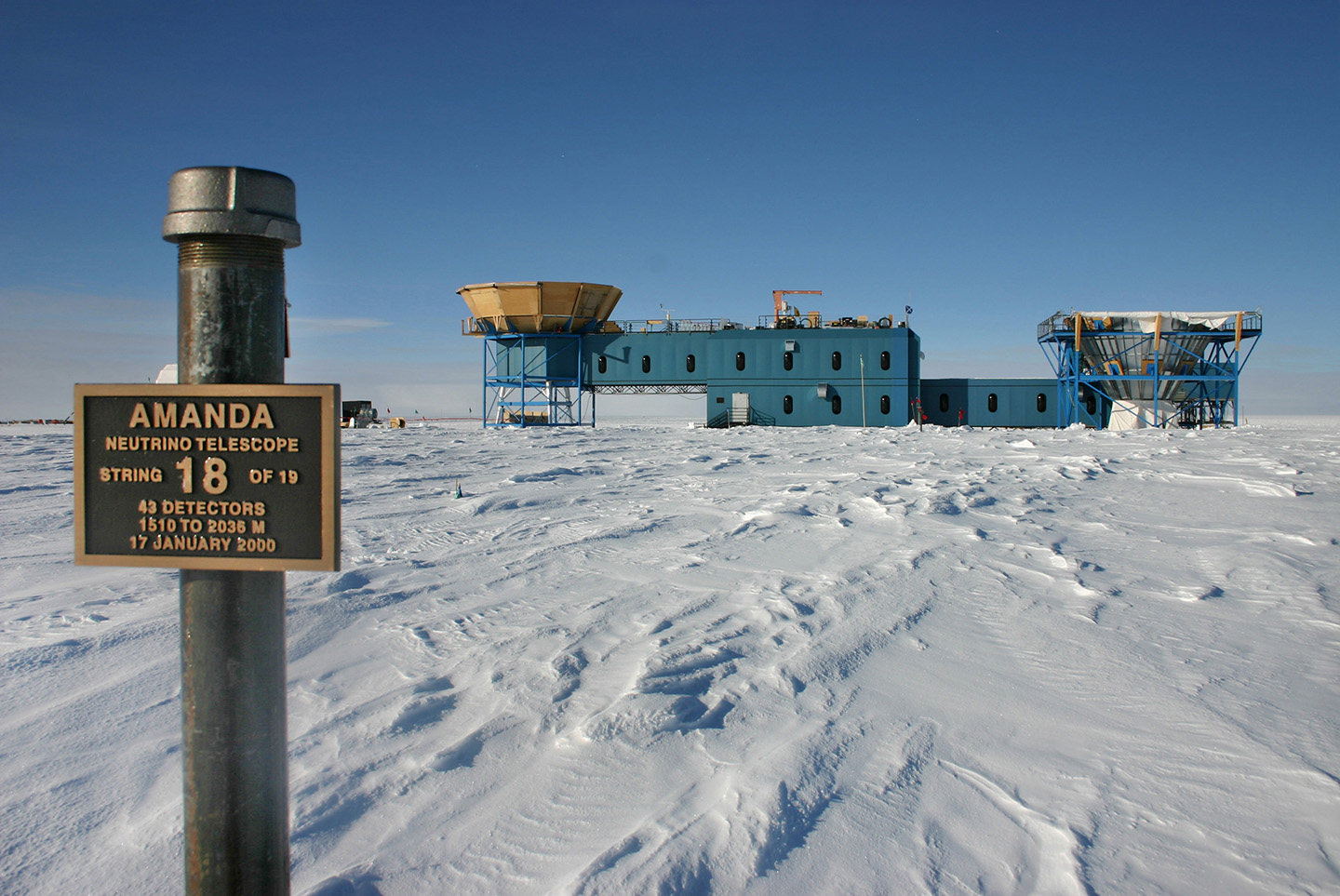
The approach evolved from testing different designs at AMANDA, the Antarctic Muon And Neutrino Detector Array. That was where a smaller collaboration, including Berkeley Lab researchers, first showed that using ice for neutrino astronomy could work: When a high-energy neutrino from space bumps into an atom, it releases a cascade of other fast-moving particles that then emit blue light (known as Cherenkov radiation). That light travels through the clear ice and is picked up by the photosensors, allowing scientists to reconstruct the neutrino interaction point and arrival direction. With that, they can build sky maps with hot spots that mark astrophysical neutrino sources.
Designing an experiment that could survive the harsh Antarctic environment and deliver the needed data was a major challenge. Any equipment needed to operate at -55 degrees Celsius and survive intense, uneven pressure from the ice. Researchers had to find a way to get the signal from the mile-deep sensors to the surface. And because the modules would freeze into the ice and be unreachable, everything had to be robust enough to survive for decades.
"One way to think about IceCube is as 5,160 satellites. You build these modules, deploy them, and you never see them again. There's no way to work on them, fix them, or swap them out," said Spencer Klein, who works on IceCube and leads Berkeley Lab's neutrino astronomy program.
Distributed electronics and nanosecond synchronization
In early designs, researchers thought about sending the signals to the surface for processing, but the idea didn't work well. Fiberoptic cables were too brittle and fragile to freeze into the ice, and copper cables degraded the signal too much by the time it was received and processed on the surface. Physics Division's David Nygren came up with a crucial solution: instead of putting the electronics on the surface, they would be contained within the modules themselves.
"It sounds simple, but it's not," Klein said. "It's a pretty crucial innovation required to make IceCube work, and it's one of the main things with a Berkeley Lab stamp on it."
To work, the electronics would need to be exceptionally low-power, using less than 5 watts (about half of what today's average LED light bulb uses). Commercial digitizers that ran quickly enough were too power-hungry. But Berkeley Lab engineer Stuart Kleinfelder had developed an application-specific integrated circuit (ASIC) called the "switched capacitor array," which stored information quickly and could digitize it more slowly, thus meeting the power budget. The general approach had already been used in a pioneering time-projection chamber (invented by Nygren) installed at SLAC, studies of heavy ions at Berkeley Lab's Bevalac, and in the STAR detector at Brookhaven Lab's Relativistic Heavy Ion Collider. The technique, using Kleinfelder's ASIC, turned out to be a perfect fit with burying modules in the South Pole ice.
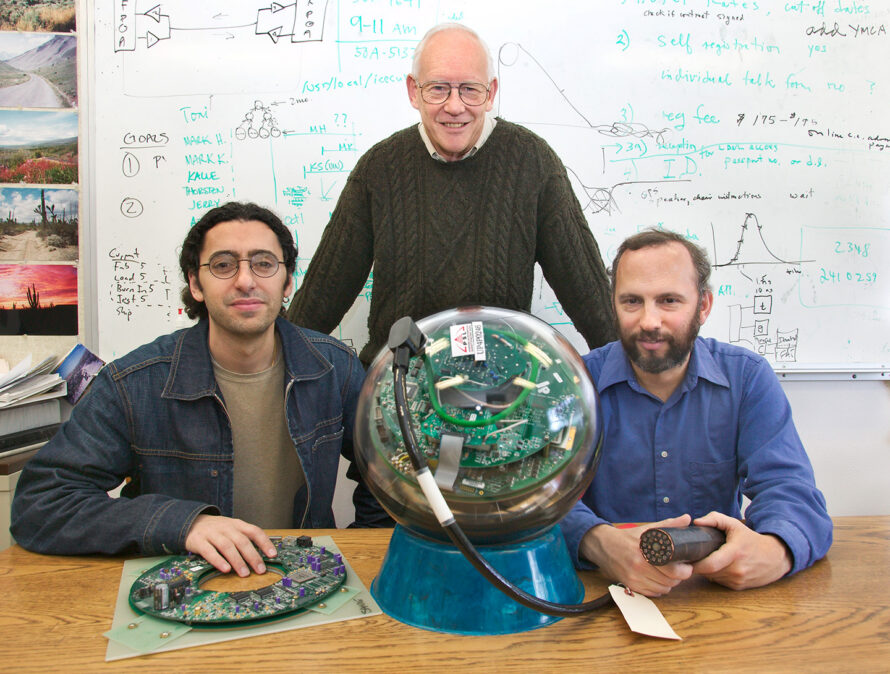
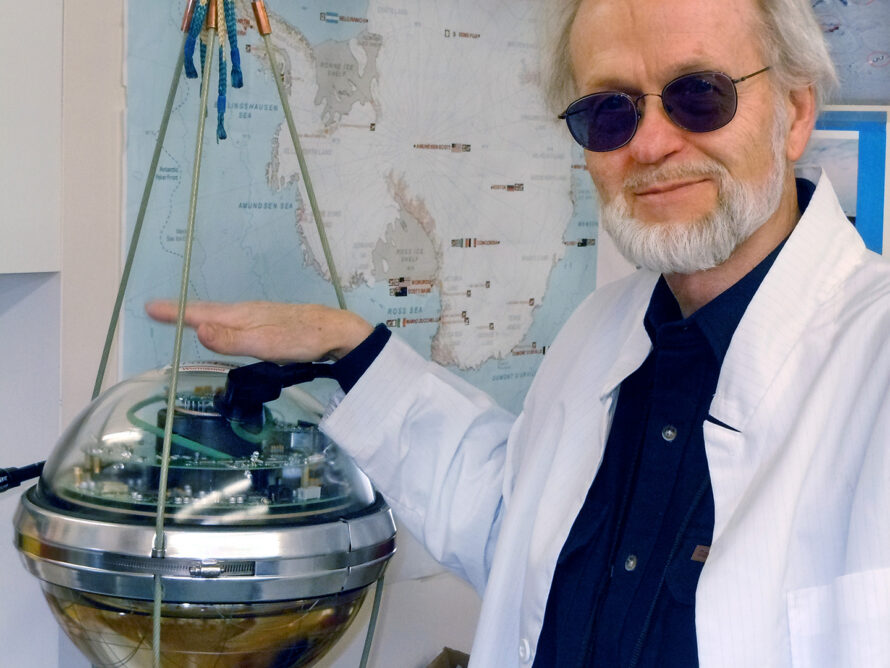
"The choice of putting the smarts in each module, as opposed to centrally on the surface, was key to the success, because it enabled the high system reliability," said Azriel Goldschmidt, a Berkeley Lab physicist who worked on "String 18," a set of 40 prototype digital optical modules (DOMs) tested at AMANDA in 2000. Stokstad and Nygren led String 18, and Physics Division engineer Jerry Przybylski did much of the hardware work. With excellent performance in AMANDA, DOMs became the technology of choice for IceCube.
Berkeley Lab engineers, technicians, and students were part of the team that designed, built, and tested the electronics for the modules. Ultimately, 5,160 DOMs on 86 strings were deployed in IceCube's original construction, completed from 2004 to 2010. The design proved incredibly resilient and reliable; more than 98% of the modules are still running today.
"Reliability was a key design driver," said Thorsten Stezelberger, a Berkeley Lab electronics engineer who worked on IceCube. "We looked at failure scenarios for electronic components and minimized components that could fail in a bad way. We made sure the DOMs were non-brickable, meaning we had a way for remote firmware updates while making sure we wouldn't permanently lose the communication link to the surface. We did environmental testing to make sure the electronics could survive the Antarctic environment and the shipping to get there. And we did extensive automated testing to catch as much of the infant mortality of the electronics as we could, before they were deployed."
To accurately recreate the path particles took through the ice, researchers also had to figure out how to calibrate and sync up the thousands of DOMs. Stokstad conceived "reciprocal active pulsing calibration," or RAPCal, the custom timing system and software that keeps everything synced to within two nanoseconds.
A fundamental new understanding of neutrinos
With IceCube up and running, Berkeley Lab physicists focused on analyzing the data coming out of the experiment, contributing to many of IceCube's key results - including the first recorded high-energy neutrinos from space.
To date, the collaboration has discovered neutrinos produced in our own Milky Way galaxy, and collected strong hints that high-energy neutrinos might originate in active galactic nuclei, galaxies with a black hole at their center. Researchers have been able to study how neutrinos interact when they have an energy far above what can be created in human-made particle accelerators, and found the first evidence that Earth absorbs high-energy neutrinos. They also put limits on high-energy neutrinos coming from our sun, which in turn informs models of dark matter (the matter that makes up most of the mass in the universe but has never been directly observed).
Other measurements have improved our understanding of how neutrinos change type, or oscillate, as they travel. This provides insight into how much mass the different "flavors" of neutrinos have, a longstanding problem in physics. Neutrinos are the only fundamental particle in the Standard Model that we don't know the exact mass of. IceCube is also working on comparing the fraction of high-energy neutrinos and their antimatter counterpart, antineutrinos, for clues on how our universe came to be made primarily of matter.
"When we built IceCube, we could not have envisioned many of the things we're doing now," Klein said. "And even if we had envisioned them, I don't think we would have dared put them in a proposal."
Berkeley Lab researchers have also had first eyes on momentous data from IceCube. Then a postdoc, Dmitry Chirkin saw the first neutrinos in the detector in 2005, when the Cherenkov light from a fortuitously angled neutrino went straight up the only installed string of detectors, hitting 53 of the 60 modules. In 2012, on her last day at IceCube (before transferring to Berkeley Lab's Computing Division), Lisa Gerhardt got the first look at "Big Bird," the highest-energy neutrino IceCube had seen to date - clocking in at approximately 2 petaelectronvolts (PeV), hundreds of times more energetic than particles produced at the Large Hadron Collider.
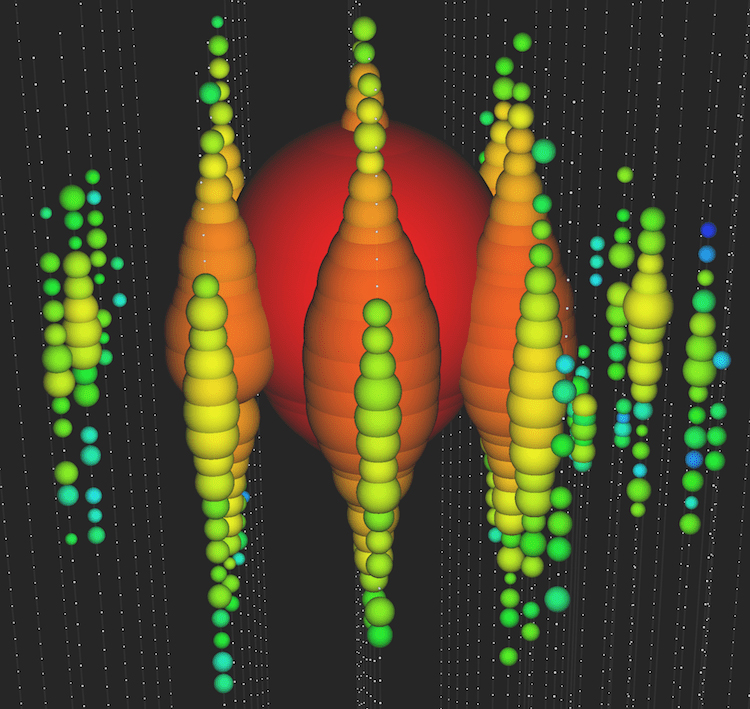
IceCube detected "Big Bird," a 2-PeV neutrino event, in December 2012. (Credit: IceCube collaboration)
Cool computing
To make its impressive measurements of neutrinos, the IceCube collaborators have to know their detector incredibly well. In their case, that means understanding the optical properties of ice and how light moves through it.
But the Antarctic ice is not uniform. Some layers contain more dust because of atmospheric conditions when the snow fell. The ice is also in motion, and the ice crystals can become oriented to that direction of movement, causing light to scatter differently depending on how it hits the crystal. All of this variation must be incorporated into IceCube models and simulations to get an accurate picture of neutrinos.
"For most IceCube analyses, this is probably the hardest problem we've had to solve, and we've been working on it for a long time," Klein said. "After 20 years of effort, we're still learning important things."
For IceCube's most interesting events, the collaboration simulates hundreds of variations of ice to find the best match for an actual event. Many of those simulations are run at the National Energy Research Scientific Computing Center (NERSC), a DOE Office of Science User Facility at Berkeley Lab. Over the years, researchers have used four different NERSC systems to simulate cosmic rays and neutrino events in the detector, reconstruct and analyze data, and simulate the detector's response.
NERSC's high-performance storage system (HPSS) also serves as one of two U.S. data repositories for the IceCube project. Data from IceCube is transmitted to the surface, processed, and sent by satellite to researchers. But every austral summer, a copy of the data also makes its way on tapes via plane to NERSC. The supercomputing facility currently stores 7.8 petabytes of raw IceCube data that researchers can use for analysis.
"High-performance computing and storage resources are key tools for learning about astrophysical neutrinos and their role in the universe," said Gerhardt, who is now the NERSC Division Deputy for Operations. "They enable complex data reconstruction algorithms and large-scale simulations, and provide reliable data access to researchers. NERSC has been a part of IceCube's workflow since before the detector was even completed, and we're proud to support neutrino astronomy through this pioneering project."
Expanding IceCube's reach
Over the past season at the South Pole, IceCube installed five more strings in their detector as part of an upgrade. This will help them better characterize the ice, look for lower-energy neutrinos, and study neutrino oscillations.
Researchers are also working on plans for IceCube-Gen2, a potential expansion of IceCube that would be roughly ten times the size of the current experiment. The array would space strings of detector modules farther apart, optimizing chances to see even higher-energy neutrinos.
The collaboration is considering egg-shaped DOMs that would pack 14 light sensors into each module, while keeping the holes for the detector strings narrow. (The two-mile-deep holes are drilled with hot water and are energy-intensive to create). The expansion proposed using 10,000 optical modules, meaning researchers would need to collect data from 140,000 photosensors. With expertise in creating ASICs, Berkeley Lab might reprise its electronics development role to design a chip that is lower power than commercial devices.
The IceCube Neutrino Observatory was funded and is operated primarily through an award from the U.S. National Science Foundation to the University of Wisconsin-Madison. IceCube's research efforts, including critical contributions to the detector operation, are funded by agencies in Australia, Belgium, Canada, Denmark, Germany, Italy, Japan, New Zealand, Republic of Korea, Sweden, Switzerland, Taiwan, the United Kingdom, and the United States.
NERSC is a DOE Office of Science User Facility.


