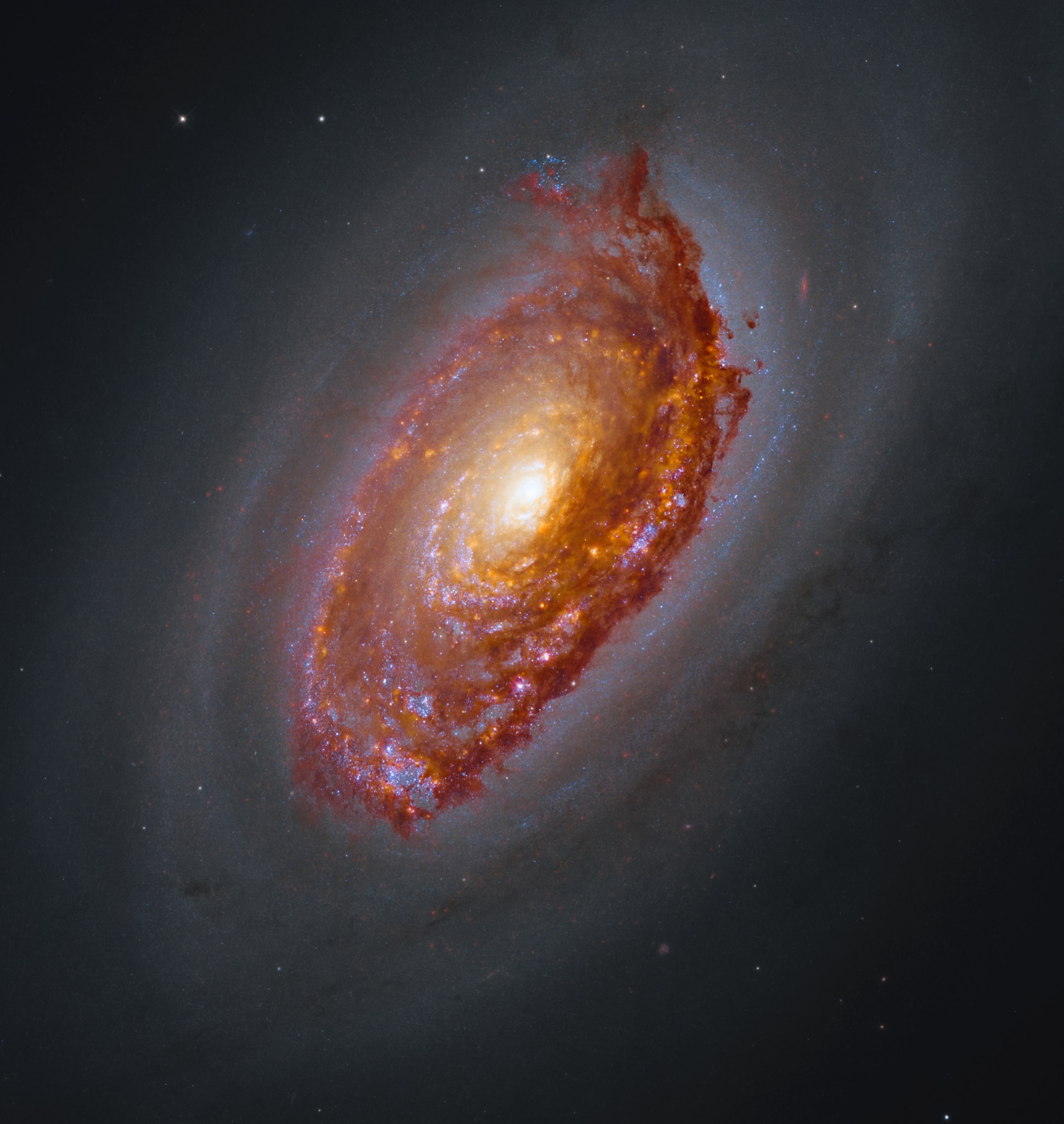
This March 20, 2026, image of Messier 64, or the Black Eye Galaxy, is a composite view from NASA's Hubble Space Telescope and James Webb Space Telescope. It shows Messier 64 captured at near- and mid-infrared wavelengths by Webb, while Hubble's image shows the galaxy in ultraviolet, visible, and near-infrared light.
Messier 64 is characterized by its bizarre internal motion. The gas in the outer regions of this spiral galaxy is rotating in the opposite direction from the gas and stars in its inner regions. This strange behavior may be the result of a merger between M64 and a satellite galaxy over a billion years ago.
Image credit: NASA, CSA, ESA, F. Belfiore (European Southern Observatory - Germany), J. Lee (Space Telescope Science Institute), A. Leroy (The Ohio State University), and D. Thilker (The Johns Hopkins University); Processing: Gladys Kober (NASA/Catholic University of America)