
The raw data from a cluster of ocean sensors came in at blazing speed. In the laboratory of a twin-hulled research catamaran, University of Miami student Ria Agrawal pored over the figures, measuring the levels of nitrogen present in microbes collected at different water depths.
She and her marine science classmates were seeking answers: How do microbes and nutrients interact, and how do microbial communities inside and outside the Gulf Stream differ from one another? "Answering those questions can tell us a lot about how the ocean ecosystem is functioning," Agrawal said.
Satellites and supercomputers couldn't furnish the information. "Weighing anchor, heading out to sea, and using sensors was the only way," Agrawal said.
She was one of 25 students from the University's Rosenstiel School of Marine, Atmospheric, and Earth Science—a new generation of Sylvia Earles and Robert Ballards—who conducted oceanographic research during a daylong expedition to the Gulf Stream.
Their day at sea was part of the school's Keymester program, an experiential learning initiative in which students not only put their noses to the grindstone in the classroom but also conduct research in the field—in this case, at sea.

"The ocean is fundamental to life on Earth. It regulates the climate, drives weather systems, sustains fisheries, and supports the global economy," said Kim Popendorf, a chemical oceanographer, associate professor in the Rosenstiel School's Department of Ocean Sciences, and Keymester instructor. "But to understand and learn more about the ocean, we need to continuously study and monitor it. And that all starts with gathering data, collecting the hard numbers that give us a true look at how it is functioning."
Keymester, Popendorf said, provides students a hands-on, academic portal to study the ocean—and it all starts with data.
While students regularly meet in labs and in the classroom, the one-day ocean expedition to the Gulf Stream—the swift, warm ocean current that originates in the Gulf of Mexico, flows through the Straits of Florida, and travels northward along the eastern coast of the United States—is Keymester's signature feature.
Heading out to sea
On the morning of the last cruise, taken in the spring, the sun had barely breached the horizon on Virginia Key when students from two of Keymester's core classes—Microbial Geochemistry and Observing Ocean—departed the Rosenstiel School docks aboard the research vessel F.G. Walton Smith.
Once the vessel reached the Gulf Stream, where the current is closest to Florida, the research started in earnest, with students deploying from the stern of the catamaran a platform teeming with "sensors that measure any kind of data you can imagine," said Mariana Bif, an assistant professor and marine biogeochemist in the Department of Ocean Sciences, who leads the Observing the Ocean class and has developed many types of sensors from scratch.
"Students have so much data available to them when they work in the classroom, but the data is already quality-controlled from websites and prepared by groups from other institutions," Bif said. "Observing the Ocean teaches students how to manipulate data in the computer, and by going on this cruise, it teaches them how to collect data but also shows them what that raw data looks like once it gets out of the sensors, which is not going to be as beautiful as the data that they download from the internet."
During the data-collecting process, a hydroacoustic instrument used sound waves to measure the speed and direction of water currents. A bio-optical sensor took readings of oceanic pigments, which allowed students to measure levels of phytoplankton in the water.
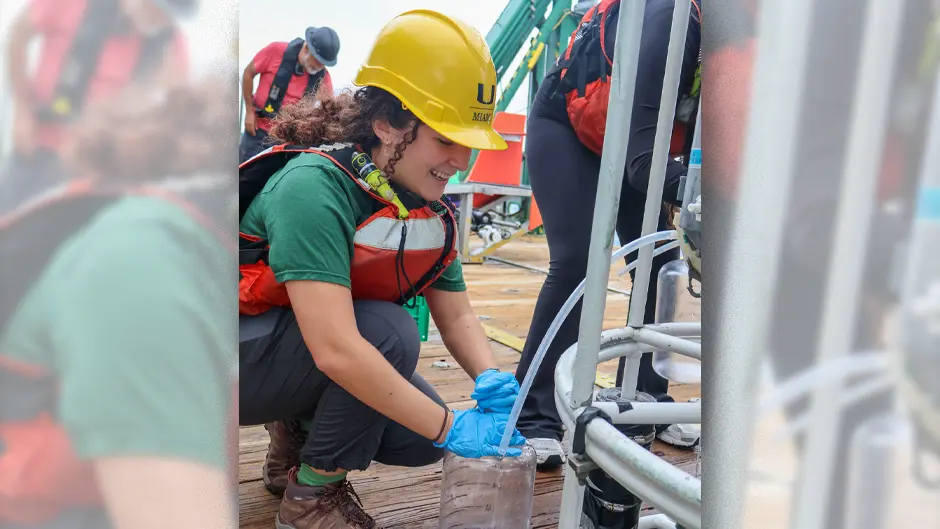
Designed and built at the Rosenstiel School, the platform deployed from the stern of the F.G. Walton Smith also contained a plankton imaging camera, an oxygen sensor, and a CTD (Conductivity, Temperature, and Depth) device consisting of small probes that allowed the young researchers to chart the distribution and variation of water temperature, salinity, and density to understand how Gulf Stream waters affect marine life.
"I also integrated professor Bif's nitrate sensor so that students could collect real-time nitrate data during the cruise," said Cedric Guigand, a Rosenstiel School technologist and engineer who was onboard for the cruise. "The goal was to help students learn how ocean conditions like temperature, salinity, and biology can change as you move through a front—in this case, the edge of the Florida Current."
As part of Keymester, Guigand co-taught the class Coastal Oceanography with professor of ocean sciences Maria Josefina Olascoaga, in which students conducted marine and atmospheric research using instruments they designed and built in the Rosenstiel School Makers Lab he directs.
Data analysis
Inside the F.G. Walton Smith's lab, students conducted preliminary analysis of the data in real time. But an extensive review of the information wouldn't begin until the students returned to laboratories at the Rosenstiel School, where they employed the data to answer questions related to their research—in the case of Popendorf's Microbial Geochemistry class, how microbes and nutrients interact.

The data will be used to study a plethora of other oceanographic topics as well. "The data has so many applications because of the area where we sampled," Popendorf said. "From a global perspective, the Gulf Stream is extremely important, as it's an essential component in a vast system of Atlantic currents that may be slowing down."
Popendorf is referring to the Atlantic Meridional Overturning Circulation, or AMOC, a massive system of ocean currents that acts as a global conveyor belt, carrying warm water from the tropics northward to Europe. As it cools, the water becomes dense and sinks, distributing heat and regulating Earth's climate.
A growing body of research suggests the AMOC is at risk of collapsing, "and that would have huge climate consequences," Popendorf said. "It's not that the data our students collected can answer that question by itself, but just having the temperature, salinity, and nutrient data they collected from the Gulf Stream can be added to the scientific inquiry being done on the AMOC."
She hopes the data collected from all Keymester cruises will become part of a repository housed at the Rosenstiel School library.
Keymester will expand next spring, when Paquita Zuidema's Atmospheric Observations and Instrumentation class is incorporated into the curriculum, giving meteorology students the chance to learn about the ocean from the experts who know most about it: oceanographers.
During the next Keymester expedition to the Gulf Stream, "our students will forecast the weather conditions prior to the cruise—in particular, wind speed and direction. And they'll evaluate their forecasts using observations made during the cruise," said Zuidema, professor and chair of the Department of Atmospheric Sciences.
She and her graduate assistant, Ph.D. student Michael Perez, sailed on the last Keymester cruise, launching radiosondes attached to helium-filled balloons that recorded relative humidity, air temperature, and wind speeds. Zuidema's students will take on the responsibility of deploying the radiosondes during the next cruise.
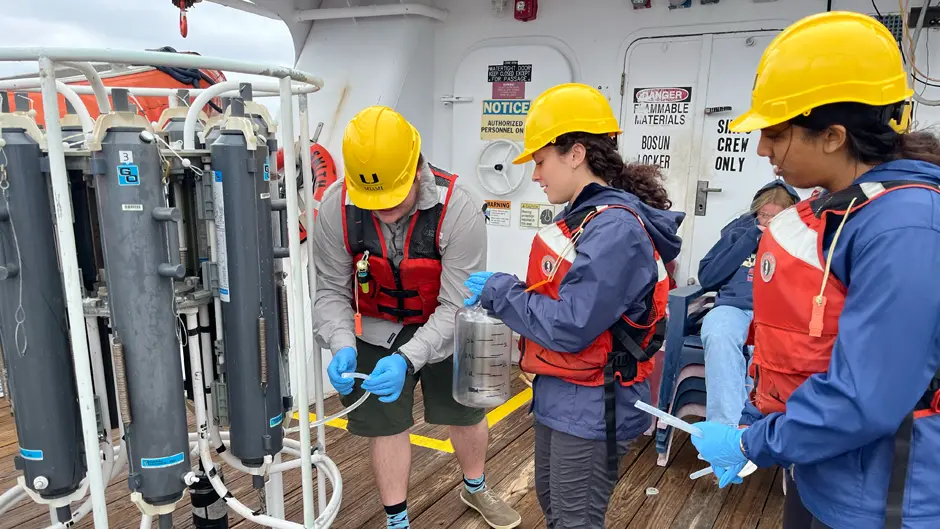
For Hannah Heath, who earned an undergraduate degree in marine science and geological sciences and sailed on the last Keymester cruise as a student in the Observing the Ocean class, the expedition has inspired her to learn new ways to monitor the health of the oceans.
"I'd like to develop and build sensors and perfect innovative techniques to sample our oceans," said Heath, who is now earning a degree in applied remote sensing through the Rosenstiel School's Master of Professional Science Program. "Our oceans cover about 71 percent of the Earth's surface, yet there's still so much we don't know about them."
Paige Fitzpatrick, who earned a degree in marine affairs, served as an assistant marine technician on last spring's Keymester cruise, helping to deploy and recover the platform on which the ocean sensors were mounted.
"Part of the lure of doing seagoing research like the Keymester cruise is exploration and discovering something that you may not have known before," said Fitzpatrick, who has sailed on several research cruises, including a Hawaii-Alaska cybersecurity-focused expedition aboard the 261-foot R/V Sikuliaq. "You never truly know what you'll discover."


