
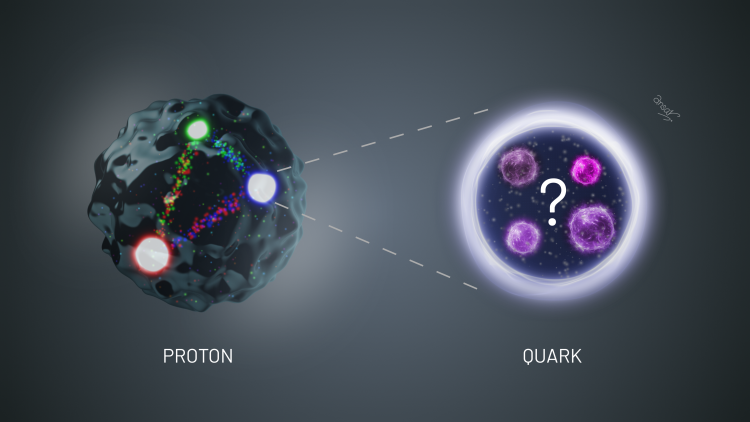
According to our current understanding of the Universe, quarks are fundamental, point-like particles: basic building blocks that are not made up of smaller particles. A recent paper from the CMS Collaboration describes how it probed quarks to the scale of 10-20 metres to test this premise.
At this scale, no evidence of constituent particles was identified, but history shows that structures once considered fundamental can reveal deeper layers: matter was found to consist of molecules, which were then found to be made of atoms, which were in turn found to consist of a dense nucleus surrounded by a cloud of electrons.
Rutherford discovered the nucleus by sending a beam of helium nuclei onto a gold-foil target. These nuclei scattered off the gold atoms of the foil at various angles, which Rutherford then measured. By studying the distribution of the scattering angles, he was able to prove that atoms contained a point-like nucleus at the centre. This was possible because the helium beam in the experimental set-up had enough energy to probe the inside of the atoms.
The nucleus was then shown to be made of protons and neutrons, which were themselves later found to consist of quarks. LHC experiments including CMS are now continuing this quest, colliding particles at extremely high energies to probe the potential inner structure of quarks.
When two beams of protons collide within CMS, they break apart into their constituent quarks. These outgoing quarks become two jets - sprays of particles - that can be measured and used to reconstruct the scattering angle between the quarks.
The distribution of the scattering angle between the two jets can be compared to the distribution that would be expected if the quark was indeed a point-like particle. The recent results from the CMS Collaboration, which were based on data from the second run of the LHC, showed no significant disagreement with the scattering distribution of a point-like quark. This means that quarks are not likely to be larger than 10-20 metres if they are composite structures.
This size estimate is derived from the constraints on the energy scale at which quark 'compositeness' reveals itself. For the benchmark model of the recent CMS paper, which assumed that quarks were composite, the recent results set the most stringent limit to date at 37 TeV.
Similarly to how Rutherford was able to identify the components of the atom only because his beam of particles had enough energy, studying particle collisions with higher energies could help us to identify smaller potential structures within quarks. Data from the third run of the LHC and the upcoming High-Luminosity LHC could help to reduce the uncertainties on the measurement of the scattering angle, allowing us to identify even smaller structures and continue the search for the smallest building blocks of matter.


