
Baby dinosaurs were likely fed more nutritious food than their adult counterparts, a finding that could offer insights into their social evolution, suggests a new study.
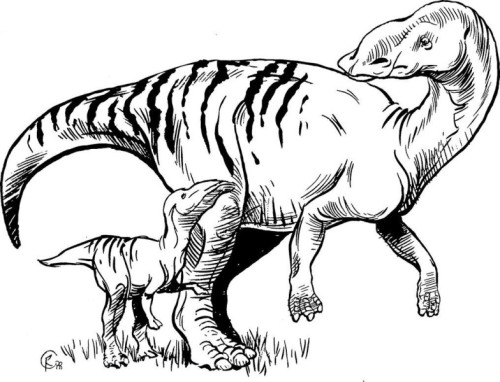
Paleontologists uncovered this finding by studying wear on the fossilized teeth of Maiasaura peeblesorum, a duck-billed dinosaur species that lived about 75 to 80 million years ago during the Late Cretaceous. First discovered in Montana, these large, herbivorous dinosaurs lived in herds and were thought to have been highly social creatures, especially in contrast to those that may have had different reproductive strategies.
Extensive fossil findings of preserved Maiasaura nests have since made them a key species for understanding the reproductive behaviors and ecology of many other types of duck-billed dinosaurs. Now, closer analysis of their dental wear patterns has revealed that while juvenile Maiasaura teeth had significantly more crushing wear, adults exhibited more shearing wear, suggesting parents could have been bringing softer, higher-protein food to their children than they themselves ate.
 Today, this behavior is typical of birds whose young are confined to the nest for a time after hatching, said John Hunter, lead author of the study and an associate professor in evolution, ecology and organismal biology at The Ohio State University, meaning that these dinosaurs could have exhibited a level of parental care unusual for most species on Earth at the time.
"The urge for a bird to feed a youngster is a very old behavior," said Hunter. "What we're providing is that evidence for that behavior probably goes much further than the origin of birds, perhaps to the origin of dinosaurs."
Learning more about which social behaviors may have endured throughout evolutionary history can give scientists a better glimpse into how organisms made a living tens of millions of years ago, as well as help predict traits modern animals might pass on to their descendants.
The study was recently published in the journal Palaeogeography, Palaeoclimatology, Palaeoecology.
Researchers specifically detail that juvenile Maiasaura likely ate more nutritious low-fiber foods like fruit while their caretakers consumed a greater proportion of tougher, nutritionally poor high-fiber plant parts. In mammals today, the same patterns of shearing wear would likely be present in grazers like horses, antelopes and cows, while low-fiber diet eaters like tapirs would have dental patterns similar to the young dinosaurs.
In comparing the types of wear on dinosaur teeth, researchers also suggested that shifts in diet may have also performed an important role in early growth and development. In this instance, their results show that the diet of juvenile Maiasaura may have caused them to grow particularly fast in their first year.
The study also considers other interpretations of their results. Instead of consuming completely different fare, dinosaur parents could have been feeding their young partially regurgitated food, yet another behavior now common in birds. Alternatively, juveniles could also have left the nest to forage for themselves, an activity now seen in modern herbivorous lizards.
While that solution is less likely as juveniles were helpless, and probably dependent on their parents to feed them during the first weeks after hatching, learning more about their remains can widen scientists' perspectives of what sophisticated biological and social systems dinosaurs may have had, said Hunter.
"The further back in time you go, the less of a fossil record you have, so paleontologists have to draw from different sources of inspiration from different parts of the living," he said. "So even among closely related dinosaurs, there is probably still quite a bit to learn about them."
If possible, future studies could examine other fossils of the very youngest dinosaurs for dental microwear to test other hypotheses regarding dinosaur embryos and hatchlings.
Christine Janis from the University of Bristol and the University of Brown was a co-author. This work was supported by Brown University.


