
People who smile empathically at someone's happiness or frown at their suffering become more attractive. Conversely, smiling out of schadenfreude does not make someone any less attractive. Roujia Feng will defend her PhD thesis on May 26, based on research into the social consequences of expressing (counter)empathic emotions.
A woman tells a story in a café about growing up in an abusive household. The waitress overhears this and looks sad as she walks back. Psychologist Roujia Feng had participants read 24 scenarios of this kind. They were asked, for example, to imagine a woman on the street smiling at someone looking at their burnt-out house. Or a shoe sales woman smiling at a customer who says she has recovered from a complicated leg fracture and can finally buy shoes again.
Feng investigated how people react to others who respond empathically - feeling happy for someone else's good fortune or showing sympathy for their misfortune. She also examined the social consequences of not responding empathically: taking pleasure in someone else's misfortune (schadenfreude) or feeling displeasure at someone else's happiness. There is no word in English for the latter: psychologists call it glückschmerz.
Women judge more harshly…
In total, she conducted fifteen experiments. 'In total around 2,300 participants from the United Kingdom took part in the research in my dissertation. In a series of experiments where people had to read short scenarios, I asked them whether they found the emotional expressions described to be appropriate.' Schadenfreude was found to be less appropriate than glückschmerz. Happy-for-ness was judged to be more appropriate than sympathy. Notably: 'Women judged more harshly than men. This applied both ways, so they rated empathic reactions more positively, and counter-empathic reactions more negatively than men did.'
…But are not measured to be judged more harshly
One sometimes hears that in our society women are judged more harshly for their social behaviour. But Feng found no 'robust effects' of the gender of the person expressing the emotion or of the person towards whom the emotional expression was directed. Feng: 'We did, however, find that the scale of the event makes a difference. A reaction was deemed more or less appropriate when it concerned, for example, recovery from major surgery than when someone had simply missed the bus.'
Social consequences
The researcher asked participants to assess the extent to which they found the (counter)empathic individuals trustworthy and attractive. Something stood out: 'There is a kind of positivity bias. Reacting empathically makes people more attractive in the eyes of the evaluator, but reacting with schadenfreude or glückschmerz does not make such a person any less attractive.'
Empathy makes people more attractive
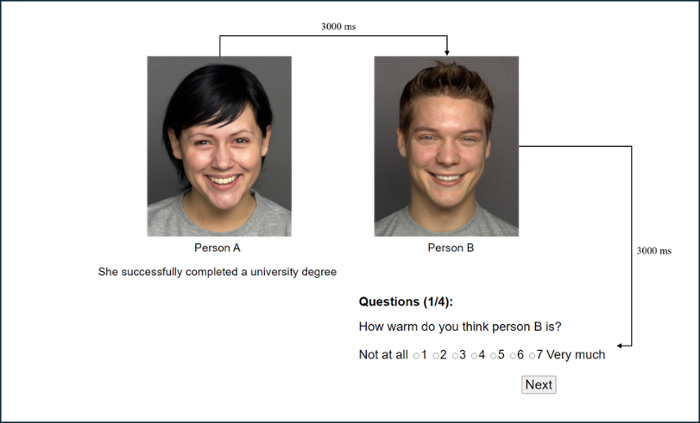
Feng found that out by showing participants photos of people smiling or frowning at someone else's situation. Prior to this, they had assessed the attractiveness of these people based on a photo in which they were neutrally looking at the camera. If such a person then reacted empathically, that person was suddenly found to be more attractive. This held true if the person in the photo was smiling when the other person had, for example, obtained a university degree. It also applied if they frowned at an unpleasant event and therefore did not look particularly attractive into the camera. Feng: 'If someone smiled out of schadenfreude or frowned out of glückschmerz, that person was not found to be any less attractive than with the neutral expression. That is the positivity bias I found.'
Deserved or undeserved maybe matters
Feng hopes to conduct further research into (counter)empathic emotions. 'My work raised many new questions that I find very interesting. For instance, I haven't yet looked at the role played by the relationship between the person reacting empathically (or not) and the person who has experienced something pleasant or unpleasant. Nor have we considered whether the unpleasant or pleasant event was deserved or undeserved.' Who knows, perhaps frowning after hearing someone telling about a totally undeserved promotion at work actually makes us more attractive.
Roujia Feng will defend her PhD thesis, The Social Consequences of Empathic and Counter-Empathic Emotions: Contextual Influences on Social Perception and Evaluation, on May 26.


