
Birds that put more energy into parenthood age faster and die younger, new research shows.
Scientists selectively bred Japanese quails into two groups: laying either relatively large or small eggs.
As the quails don't do much "parenting" after eggs hatch, mothers' main contribution is the resources they transfer to their eggs (chicks from larger eggs are more likely to survive).
After five to six generations of selective breeding, females bred to lay larger eggs aged faster and died about 20% younger than females bred for small eggs.
The findings of the study - led by the University of Exeter - support a fundamental evolutionary theory: that high "investment" in offspring unavoidably leads to faster ageing and a shorter life.
"All living things have limited energy and resources, and face trade-offs between competing priorities," said lead author Dr Barbara Tschirren, from the Centre for Ecology and Conservation at Exeter's Penryn Campus in Cornwall.
"Evolutionary theory suggests there's an intrinsic link between ageing and reproductive effort - but this is quite difficult to test.
"Our study does just that; it shows there is substantial genetic variation in reproductive effort and ageing, that this genetic variation is linked, and that it can evolve quickly."
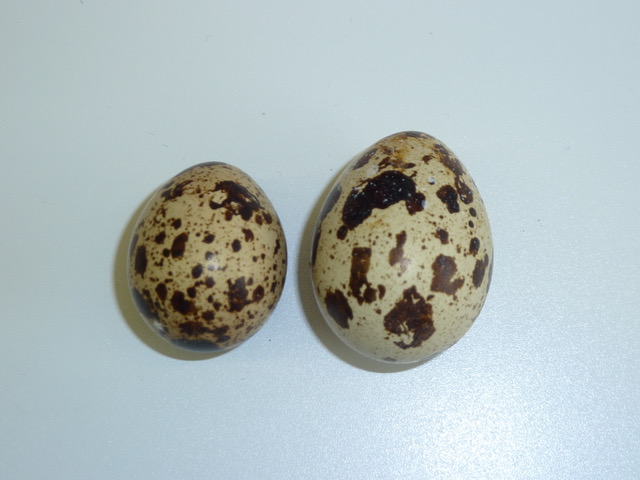
The study is the first to use an artificial selection approach in a vertebrate species to test this.
Dr Tschirren explained that the trade-off is whether to put energy into reproduction or "self-maintenance" - for example, previous research has showed that quails selected for high egg investment have lower rates of cell repair and immune function.
In the final (fifth/sixth) generation of the quail study, large-egg-laying females lived 595 days on average, compared to 770 days for females bred to lay small eggs.
Males live much longer, so the study was too short to reach firm conclusions about the impact of selective breeding on male lifespan.
The new study was funded by the Swiss National Science Foundation.


