
Prof. Javier Rodríguez-Viejo will lead the GLASSPIKE project, which explores the use of ultrastable organic glasses as a platform for information storage and processing. The project's goal is to demonstrate brain-inspired computing architectures in which memory and computation are intrinsically integrated, opening the door to highly energy-efficient hardware.
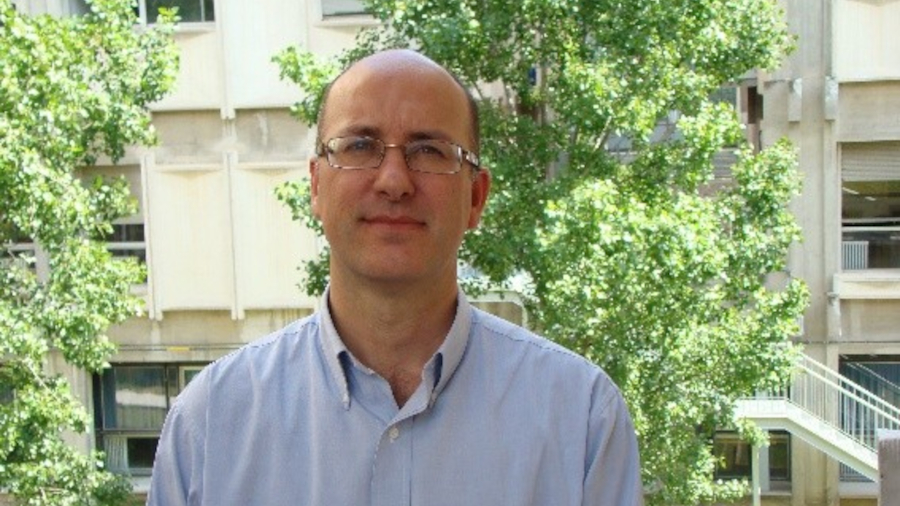
The European Research Council (ERC) has recently announced the results of the 2026 ERC Advanced Grant call. One of the selected projects is GLASSPIKE, which will be led by UAB Prof. Javier Rodríguez-Viejo, head of the ICN2/UAB Group of Thermal Properties of Nanoscale Materials. The project proposes an innovative approach to information storage and processing, inspired by neural networks.
Most electronic systems today rely on architectures that physically separate memory, where information is stored, from the processor, which performs calculations. This means that data must constantly be moved between the two, which increases energy consumption and creates a bottleneck for increasingly demanding applications, such as artificial intelligence. GLASSPIKE proposes an alternative inspired by the brain, in which information storage and processing are integrated. To achieve this, the project will focus on a class of organic materials known as molecular glasses. The idea is to exploit their electrical properties to store information at multiple levels and generate electrical signals similar to those used by neurons.
GLASSPIKE will explore the potential of these materials to create memory systems that can store information at multiple levels without requiring a continuous energy supply. The key lies in the ability of these molecules to orient their internal electric charges, forming stable physical configurations that can be modified by small electrical and thermal signals. This would enable information to be stored beyond the traditional binary system of zeros and ones in microscopic structures suitable for future electronic devices.
In addition, the material naturally generates small electrical signals known as spikes when it changes from one configuration to another. These spikes are similar to the impulses that neurons use to communicate. This feature could lead to the development of devices that can store and process information simultaneously, which is one of the main objectives of neuromorphic computing, a field that seeks to emulate the way the nervous system operates.
Javier Rodríguez-Viejo is a Full Professor of Applied Physics at the Universitat Autònoma de Barcelona (UAB) and leads the Group of Thermal Properties of Nanoscale Materials at UAB and ICN2. He obtained his PhD in Physics from UAB in 1992 after carrying out part of his doctoral research at the Institut des Matériaux et Procédés (CNRS, France), and later worked as a postdoctoral researcher at MIT. He currently lectures at UAB on Introductory Physics of Nanomaterials, Phase Transformations, and Quantum Physics. His research focuses on thermal properties at the nanoscale across diverse material systems, ranging from thin-film organic glasses to semiconductor nanowires.
About ERC Advanced Grants
ERC Advanced Grants support established researchers who are recognised leaders in their fields. These grants fund ambitious, high-risk projects with the potential to open new research directions and generate transformative advances. They are among the most competitive and prestigious funding schemes in Europe for frontier research.


