
A fundamental technique in the world of artificial intelligence (AI) is machine learning, which helps machines like computers learn from data to perform tasks or make predictions.
Machine learning (ML) powers many everyday technologies, from traffic predictions on our phones and streaming recommendations on our TVs to chatbots and autonomous vehicles. However, there are challenges such as security vulnerabilities, data manipulations and high energy costs.
But coupling ML with quantum computing's superior processing power could help make the technology more reliable and 'robust'.
Even just a couple of years ago, quantum robustness was little more than an idea. In work undertaken by CSIRO and others since then, this very new frontier of computing promises to make AI safer, faster and more trustworthy.
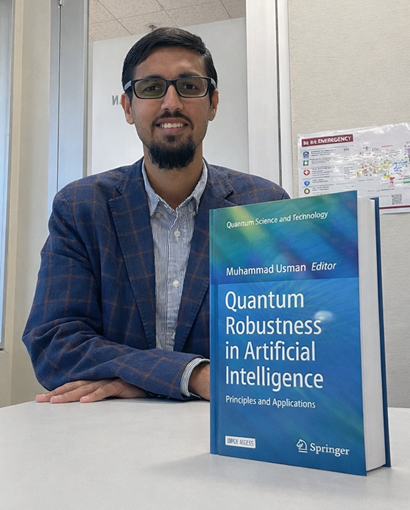
All quotes below are available for use by media. They can be attributed to Professor Muhammad Usman, Quantum Systems team leader at CSIRO and editor of Quantum Robustness in Artificial Intelligence , the first book focusing on quantum-enhanced reliability of machine learning systems.
Where do we use machine learning day-to-day?
ML focusses on learning patterns and improving its performance over time. By enabling systems to learn from experience, it can predict outcomes, understand speech and images, and support complex decision-making. These capabilities are increasingly shaping how organisations operate across sectors ranging from healthcare and energy to finance, transport and national security.
However, there are several challenges to wholesale adoption of machine learning in autonomous systems. It can make them vulnerable to cyber-attacks or manipulations in their training data. Their energy consumption is enormous. And there's a lack of trust in their reliability.
What is quantum machine learning and how does it work?
Let's take a step back for a moment and talk about quantum computing . Our everyday computers and smartphones use what's known as conventional or 'classical' computing. At their most basic level, they process information using bits with values of either 0 or 1 – much like a light switch that is either on or off. All calculations, no matter how complex, are ultimately broken down into long sequences of these values.
Quantum computing on the other hand, works very differently. Instead of bits, it processes quantum bits (or qubits) which can take advantage of special properties from the quantum world. Unlike a classical bit, a qubit can be in a state of 0, 1 or partly 0 and 1 or any combination in between.
This exclusively quantum property – known as superposition – enables quantum computers to store and process very large data sets with unprecedented speed. Imagine it like a coin spinning in the air rather than lying flat as heads or tails. While it's spinning, it isn't one or other but carries aspects of both. In a similar way, qubits can explore many possibilities at once before settling on an answer.
Quantum machine learning is about designing and developing new ML models that explicitly make use of the special properties of quantum computing.
What happens when machine learning is integrated with the superior processing power of quantum computing?
With quantum ML, new algorithms are designed and trained with the unique properties of quantum science and the added power of quantum computing. This is a huge paradigm shift.
At CSIRO, our aim is to design novel quantum ML systems which can offer faster training, lower energy consumption, better accuracy, robust decision making and immunity to cyber-attacks.
These quantum ML models promise to create solutions for humanity that just can't be achieved with today's classical computers.
Why is machine learning safety an issue?
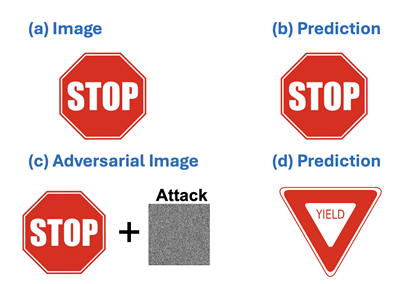
Unfortunately, machine learning is vulnerable to noise, data poisoning and spoofing attacks. Even a highly efficient, well-trained model can be easily tricked by making minute but clever modifications in datasets. This is highly risky for many applications such as in defence and national security, healthcare and self-driving vehicles, where robustness is of paramount importance.
For example, a self-driving car could potentially misinterpret a red light signal as a green light, causing serious accidents and road safety issues. In a healthcare system, a vulnerable machine learning model can miss the diagnosis of a lethal disease and lead to serious harm for patients.
The existing classical solutions rely on improving the training of machine learning models to make them robust, but these methods are expensive and often fall short in fully addressing their vulnerability. Without a better solution, science needs new approaches to help make AI safer. That's where quantum ML comes in.
What is the research showing about quantum machine learning and safer AI?
Quantum ML is poised to become a game changing technology. It brings an entirely different way of processing datasets and learning features to make decisions.
Let's take images as an example. Conventional machine learning processes image data at the pixel level. By virtue of quantum properties, quantum machine learning processes images at the feature level, in other words, many pixels at once. Therefore, any small, deliberate manipulations to data that could fool ordinary AI systems don't fool this quantum-based system.
At CSIRO, we've already shown that quantum ML models are extremely robust for a range of adversarial attacks which easily trick conventional models. We are now building a full pipeline of quantum ML models , which can be deployed in future autonomous systems, ensuring reliable and trustworthy decision making.
What is the future potential of quantum machine learning?
Quantum machine learning is a rapidly progressing field, and it could very well be the first use case for quantum computers with real-world impact.
Quantum machine learning, like other quantum applications, still faces major challenges before it's possible to use it in the real-world. Current quantum computers are small and noisy, require heavy resources for data and error correction, and are hard to train. As a result, most work in quantum ML remains theoretical or simulation-based, with only a few experimental demonstrations to date.
Nevertheless, with tremendous progress in both hardware and software as well as ambitious quantum computer roadmaps pursued by many developers around the world, there is strong reason to be optimistic about quantum ML transitioning from lab research to practical workflows in the near future.
What's CSIRO's role in this field?
CSIRO hosts a major national research and development program focussing on computing, sensing, communications and energy. Their work includes advancing quantum ML models and their applications for real-world problems.
In the last couple of years, CSIRO researchers have advanced the field of quantum ML in several areas including demonstrating superior robustness , optimising data encoding in quantum states, overcoming hardware noise by partial error correction , and reducing resource requirements for quantum ML models.
CSIRO's research program has expanded to explore new applications in medical diagnostics, finance and fraud detection, and transport and logistics optimisation.
CSIRO has also brought together leading international researchers for the first book on the topic of quantum robustness in machine learning models, published in April 2026.
Looking ahead, CSIRO's research continues to focus on pushing the boundaries of quantum ML models for real-world applications that are both practical and scalable, with the aim of supporting real-world applications as quantum technologies mature.


