
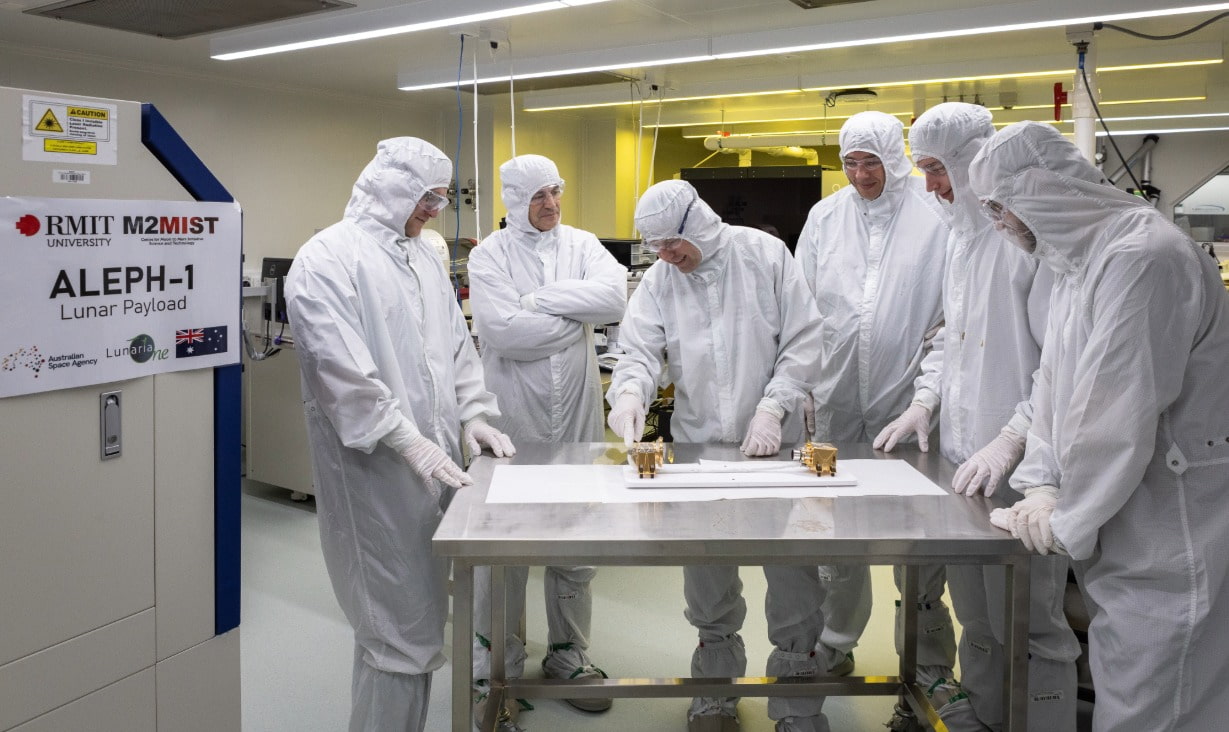
A small unit comprising an air-filled chamber and devices to transmit data on the environmental conditions inside has been designed and tested at RMIT University as part of a mission to eventually grow plants on the Moon.
The Australian Lunar Experiment Promoting Horticulture and Habitation project, or ALEPH-1, still has several steps to clear before plant seeds will be sent to the Moon.
Importantly though, the ALEPH-1 payload developed at RMIT has now received authorisation from the Australian Government to make its journey to the Moon, all else going well, aboard space company Intuitive Machines' third lunar mission currently scheduled for launch in late 2026.
The overseas payload permit granted today is the first authorisation by the Australian Government for a lunar payload under the Space (Launches and Returns) Act 2018.
Dr Graham Dorrington, Chief Primary Investigator on the project team in RMIT'S Centre for Moon to Mars Initiative Science and Technology (M2MIST), said the purpose of the mission is to demonstrate Australian technological capability by operating ALEPH-1 in space and on the lunar surface.
"The mission objective is to determine whether, or not, the necessary environmental conditions to permit biological metabolism can be maintained throughout," he explained.
"However, we are not carrying plants within ALEPH-1, on this first mission. Instead, we are carrying samples of lichen, since these can survive relatively severe conditions.
"The long-term aspiration is to realise sustainable off-world biological microcosms."
The Australian-led mission has the potential to shape significant scientific understanding and discovery about how plants could survive in the conditions of space.
It is led by Australian start-up Lunaria One and supported by research institutions, non-profits and industry partners, with funding through the Australian Space Agency's Moon to Mars Initiative (Demonstrator Mission program).
ALEPH-1 is Lunaria One's first payload and has a mass of just 500 grams.
It is designed to transmit data on the environmental conditions inside a small air-filled chamber for a period of 72 hours on the lunar surface.
All the electronics were designed and integrated within RMIT.
The mission's insights aim to drive advancements for both space and Earth-based applications.
With regulatory approval in place, the ALEPH-1 payload is now progressing through final qualification testing, led by RMIT as the primary technical partner for Lunaria One.
"The fight model of ALEPH-1 has been made and passed our own acceptance tests," said Dorrington. "It was a lot more work for our team than was originally anticipated."
Dr Glenn Matthews, who is responsible for the ALEPH-1 electronics architecture, said it had been a "formidable challenge" to develop RMIT's first lunar payload.
"But it provides a wonderful opportunity to inspire the next generation of engineers and scientists," he said.
Next, the ALEPH-1 payload will be shipped to the spacecraft provider Intuitive Machines in Houston Texas later this year, and - provided it passes the flight readiness review - it will fly on Intuitive Machines' mission to Reiner Gamma in the Sea of Storms, near the equator on the lunar surface.
In a separate space project, the M2MIST team is also helping to design, manufacture and test wheels for Roo-ver, the Australian-made rover that will go to the Moon with NASA.


