
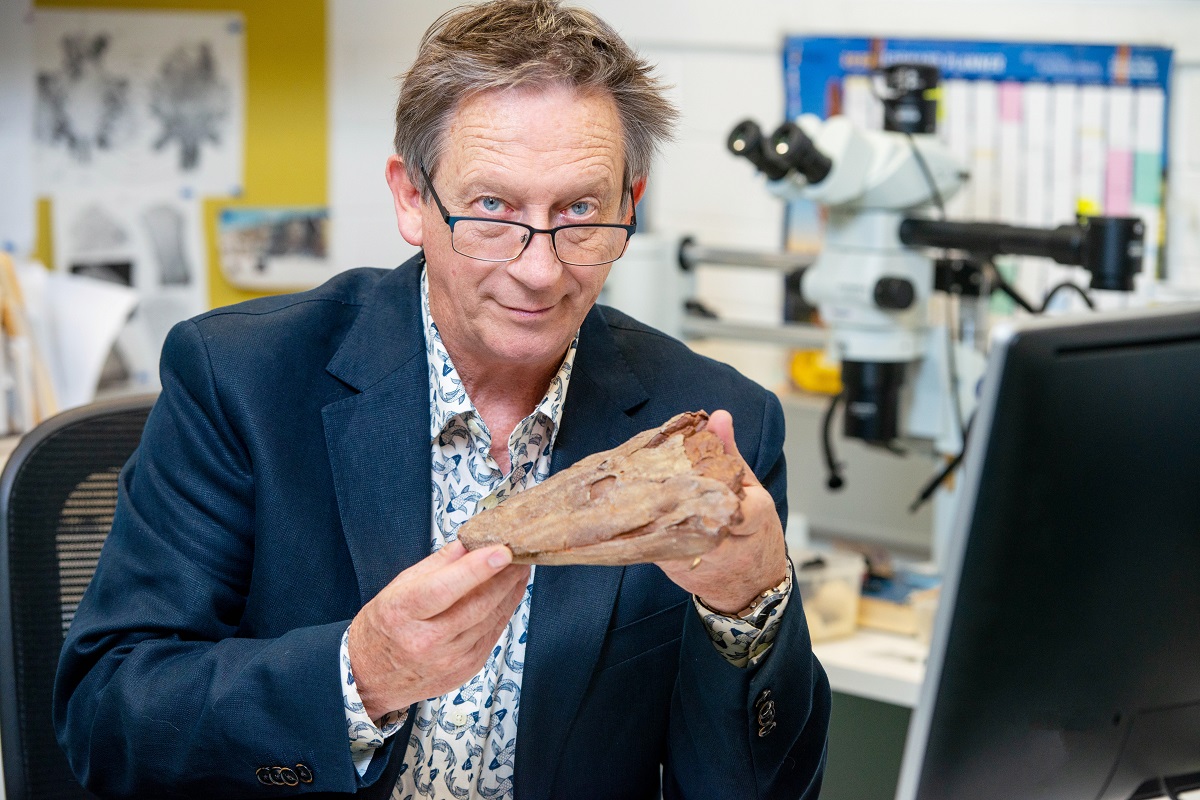
Digging deep for ancient life forms provides clues to climate change, the rise and fall of animal kingdoms and even civilisation collapse - while also paving intriguing international career paths for palaeontologists.

Among them is Flinders University Emeritus Professor in Palaeontology John Long who this year joins an eminent line of fellows admitted to the Australian Academy of Science.
Professor Long's research has helped shape our understanding of vertebrate evolution and established him as a global leader in palaeontological research, says Professor Chennupati Jagadish AC, the Academy's President.
"From Antarctica to Africa, Professor Long has discovered and formally identified 90 previously unknown prehistoric taxa, including new kinds of ancient fishes, the world's oldest reptile tracks, and Australia's oldest theropod dinosaur - thus "reshaping our understanding of vertebrate evolution."
"The work of all 26 new fellows (announced today), shows what Australia is capable of when its scientists are supported from fundamental discovery through to global application," says Professor Jagadish in a statement.

Strategic Professor Long, from the College of Science and Engineering, says his research into ancient fishes led to the much cited "origins of sex" study, explained in four Nature papers between 2008 and 2015.
In 2014, he became first Australian to hold the position of president of the world's largest palaeontology group, the Society of Vertebrate Palaeontology, and also supported other research organisations in Australia including museums and the Royal Society.
"I am most proud of the fact that I led teams doing fieldwork and lab research which discovered the origins of vertebrate sexual reproduction, through incredible fossil fishes around 380 million years old with the oldest known embryos in them, and some showing primeval sex organs evolving from limb-like structures," says Professor Long, who has still more research papers in the pipeline.
"I've also been working in the Gogo sites in northern Western Australia for the past 40 years collecting fossils, with the support of the local Gooniyandi community."
Other career highlights include:

Publication of more than 200 peer-reviewed papers (including 12 in Nature and Science, half of which are first authored), some 30 books for adults and children, and more than 160 popular science articles and book reviews. The 58 articles published in The Conversation (2013-2026) have been read by more than 3 million readers, mostly in the USA.
Led fieldwork in Antarctica, Africa, Iran, East Asia and Australia, including three expeditions to the Nullarbor Caves (2002-2004) where a diverse well-preserved fauna of fossil mammals and birds was recovered, dated at Mid Pleistocene age.
Contributions to research into the origin of vertebrate limbs, including recent new descriptions of the major transitional fossil Elpistostege from the Devonian of Canada
Work on shark evolution which showed that sharks evolved their specialised globular calcified cartilage from a bony ancestral condition.
Among a list of awards, Professor Long won the Eureka Prize for Promotion of Science in 2001, and in 2016 was on the team that won the Eureka Prize for Interdisciplinary Research.
Other Flinders University scientists to be admitted to the Academy are Professor Craig Simmons, Professor Colin Raston and Professor David Day.
The Australian Academy of Science is an independent organisation of distinguished Australian scientists, claiming to "championing science for the benefit of all".


