
A new study from the University of Copenhagen shows that marine heatwaves can disrupt microscopic moving structures on the surface of corals that support oxygen uptake. The findings may help guide local efforts to protect or restore coral reefs, even as global warming continues to increase the risk of coral death.
Tropical coral reefs support the highest levels of biodiversity in the ocean. This vital ecosystem depends on reef‑building corals, which form colonies of thousands of tiny coral animals that secrete calcium carbonate skeletons, creating the reef's complex structure. While corals are visually striking, they are also highly sensitive to environmental changes driven by global warming and other consequences of climate change.
Corals can actively regulate their oxygen supply
Corals were previously thought to take up oxygen passively from seawater because they lack a specialised respiratory system. The new research shows that corals can actively influence oxygen conditions near their surface by using cilia to generate micro‑scale water flows.
These processes occur within an extremely thin layer of water, from micrometre‑ to millimetre‑scale, directly adjacent to the coral surface and are therefore difficult to detect using conventional measurements. By applying advanced imaging techniques and novel measurement approaches, the researchers were able to visualise how ciliary motion affects both water flow and oxygen distribution around corals, and how these processes respond to increasing seawater temperatures.
Like all animals, corals require oxygen to survive. Rising ocean temperatures, however, make oxygen uptake increasingly difficult. A new study from the University of Copenhagen identifies a previously unrecognised biological consequence of warming seawater that can lead to acute oxygen stress in corals.
"Marine heatwaves are becoming more frequent and intense as a result of global warming, affecting coral reefs worldwide. At the same time, oxygen levels in the oceans are declining. Both changes are critical for marine life, and our study identifies a mechanism that directly links ocean warming and oxygen loss, which in the worst case can lead to rapid coral death," says Professor Michael Kühl from the Department of Biology at the University of Copenhagen, senior author of the study.
Microscopic structures perform a critical task
The researchers combined laboratory experiments with mathematical modelling to investigate how microscopic, hair‑like cellular structures, known as cilia, help corals acquire oxygen and how ciliary motion is affected by increasing seawater temperatures. Their results have now been published in Science Advances.
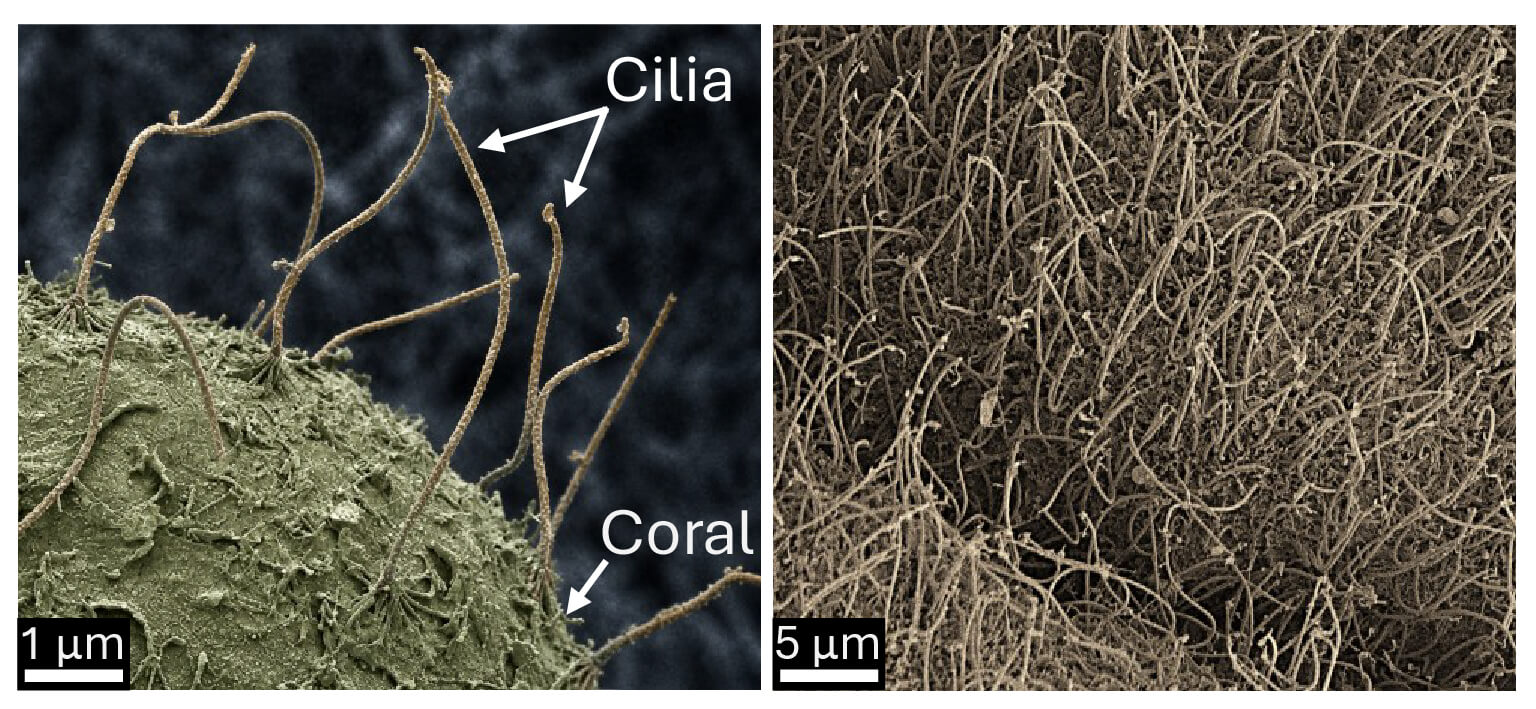
Electron microscopy images of cilia on the surface of corals. Note that the cilia are approximately 10-15 micrometres long and around 500 times thinner than a human hair. (Photo: Cesar Pacherres, University of Copenhagen)
The surface of a coral is covered by thousands of cilia. When these structures beat in a coordinated manner, they generate small water movements immediately above the coral surface. This enhances oxygen supply at night, when corals depend entirely on oxygen uptake from the surrounding seawater.
The study shows that, under moderately elevated temperatures, corals can meet their increased oxygen demand by accelerating ciliary motion and, in turn, intensifying water flow near the surface.
"In this temperature range, corals can compensate for higher oxygen demand by effectively increasing their 'breathing'. However, this compensatory mechanism does not persist at higher temperatures," says Assistant Professor Cesar Pacherres from the Department of Biology, first author of the study.
A critical thermal threshold
When temperatures increased further, ciliary motion and the resulting water flows were no longer sufficient to meet the coral's oxygen demand. At the same time, oxygen consumption by coral tissue continued to rise. As a result, the thin layer of water circulating directly above the coral surface became progressively depleted of oxygen.
Once seawater temperatures exceeded a critical threshold, ciliary motion collapsed. In the experiments, this occurred at approximately 37 degrees Celsius. At this point, the cilia slowed down, lost synchrony and eventually stopped moving altogether. Consequently, the oxygen supply to the coral dropped dramatically, causing tissue breakdown and, ultimately, coral death.
The researchers emphasise that this temperature threshold is not universal and may be lower, depending on local temperature conditions, long‑term adaptation and coral species composition at different reefs.
"Our mathematical model can predict how different environmental scenarios and metabolic traits affect the oxygen conditions in the coral. For example, we found that corals whose oxygen demand increases more rapidly with temperature could reach dangerous stress levels sooner during heatwaves," explains co-author Dr. Soeren Ahmerkamp from the Leibniz Institute for Baltic Sea Research.
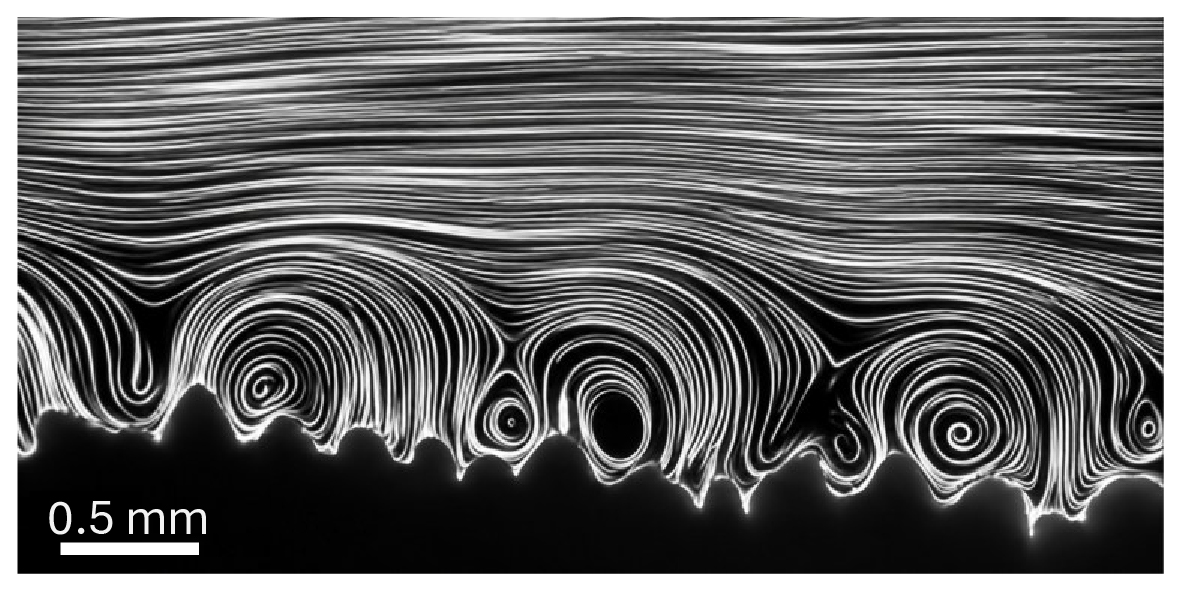
Synchronised movements of microscopic cellular structures (cilia) generate small vortices in the water above coral tissue surfaces. (Photo: Cesar Pacherres, University of Copenhagen)
New insight into coral bleaching and mortality
High temperatures also cause coral bleaching, a process in which corals lose the symbiotic algae that provide them with energy and colour. The new study indicates that oxygen stress and bleaching are closely interconnected.
"As temperatures rise, the coral's metabolism and oxygen demand increase. If the cilia's ability to transport oxygen is impaired at the same time, the coral experiences oxygen stress precisely when it is under the greatest physiological pressure," says Michael Kühl.
This oxygen stress may intensify the biological processes that lead to bleaching and, in some cases, cause severe damage or death before bleaching becomes visible. Coral bleaching is therefore not always the first observable sign that a coral is in distress.
Small‑scale processes with large‑scale consequences
Changes in ciliary motion may serve as an early warning sign of thermal stress in corals, long before damage becomes visible.
This knowledge can, for example, be applied in local conservation or reef restoration efforts
"It is now important to investigate this mechanism in different coral species and other reef organisms, to better understand where oxygen stress has the greatest impact and how these effects are likely to develop as climate change progresses," says Cesar Pacherres. He adds:
"This knowledge can, for example, be applied in local conservation or reef restoration efforts. However, there is no doubt that preventing large‑scale coral loss requires substantial reductions in greenhouse gas emissions. This is imminent, as coral reefs are already suffering on a global scale from climate change."
The implications extend beyond coral reefs alone. Many other marine organisms use cilia to regulate water movement and oxygen supply, including sponges, sea squirts and sea anemones. The newly identified mechanism may therefore be relevant to a wide range of species, both on tropical reefs and in other marine ecosystems already under pressure from ocean warming and deoxygenation.
"Our study demonstrates how small changes at the immediate surface of organisms can have major consequences for marine life as climate change intensifies," concludes Michael Kühl.
About the research
The study was conducted through an interdisciplinary collaboration involving biologists, physicists and mathematicians. In addition to Cesar Pacherres, Michael Kühl and their MSc students Mads Bilbo and Mikkel Hansen from the University of Copenhagen, the research involved:
Soeren Ahmerkamp, Leibniz Institute for Baltic Sea Research, Germany.
Douglas Brumley, University of Melbourne, Australia.
Max S. Dhillon and Manuel Aranda, King Abdullah University of Science and Technology (KAUST), Saudi Arabia.
The study has been published in Science Advances, and the research was supported by the Gordon and Betty Moore Foundation's Aquatic Symbiosis Initiative, with additional funding from the Novo Nordisk Foundation, the Leibniz Association, the Australian Research Council and an EU MSCA postdoctoral fellowship.


