
The first gene therapy for hearing loss was approved earlier this year, a milestone development aided in part by discoveries made decades ago in Lawrence Lustig's lab.
Lawrence Lustig
Those discoveries trace their roots to a few moments of serendipity, starting with a phone call about 20 years ago. Lustig, now chair of the Department of Otolaryngology-Head & Neck Surgery at Columbia University Vagelos College of Physicians and Surgeons, was at UCSF studying the ear's hair cells, which detect sound waves and relay them to the brain. The call came from a neurologist studying a mouse with a neural disorder-that was also surprisingly deaf.
In Lustig's lab, researcher Omar Akil set out to learn why the mice couldn't hear. The experiments were straightforward; the explanation was simple. The mouse was missing its VGLUT3 gene, and without it, the hair cells could not allow a neurotransmitter to signal the auditory nerve that sends sound signals into the brain. It was like snipping a landline between a house phone and the telephone pole: the messages never make it to the transmission wires.
But what grabbed Lustig's attention was the condition of the rest of the ear. "In other mice with genetic hearing loss, we saw hair cell degeneration, nerve degeneration, and the cochlea looking really sick," says Lustig.
"These mice were weird. Their ears looked perfect.""We basically pivoted the lab at that point and went all in on gene therapy."
Akil raised the idea of developing a gene therapy to see if they could rescue the animal's hearing. "I was like, 'yeah, good luck,' but meanwhile start working on things we can get funding for," Lustig recalls telling Akil.
After loading a functioning copy of the VGLUT3 gene into a virus, Akil injected the virus into the inner ears of the deaf mice. "And oh my God, these animals could hear," Lustig says.
It was the first time a gene therapy restored hearing to normal levels in a mouse model of deafness.
"We basically pivoted the lab at that point and went all in on gene therapy," Lustig says.
Moving gene therapy from deaf mice to patients
Hearing loss caused by VGLUT3 is rare, so Lustig's lab looked around for more common forms of congenital deafness. Deafness caused by mutations in OTOF, the gene that makes otoferlin, looked promising; like VGLUT3, otoferlin is involved in sending signals to the brain and when it's not working properly, the rest of the ear is unaffected.
But unlike VGLUT3, the otoferlin gene is too big to insert into the viruses that are thought to be best for the ear. "We chopped it up into several smaller versions, but nothing worked, so we moved on to other projects for a while," Lustig says.
Then Lustig read about researchers at the University of Florida who cut a gene in half and put each half into a separate virus. "They engineered sticky ends on each half, and when the two viruses entered the same ear cell, the sticky ends would come together and produce a full-length functional protein, and I thought, this could solve our problem."
Lustig and Akil joined up with the Florida researcher who was engineering the virus and a group in Paris at the Pasteur Institute who could evaluate the success of the treatment. The team's dual-vector approach worked, restoring almost-normal hearing to the animals, even in mice equivalent in age to infants. Suddenly, they had a treatment that could potentially work in children.
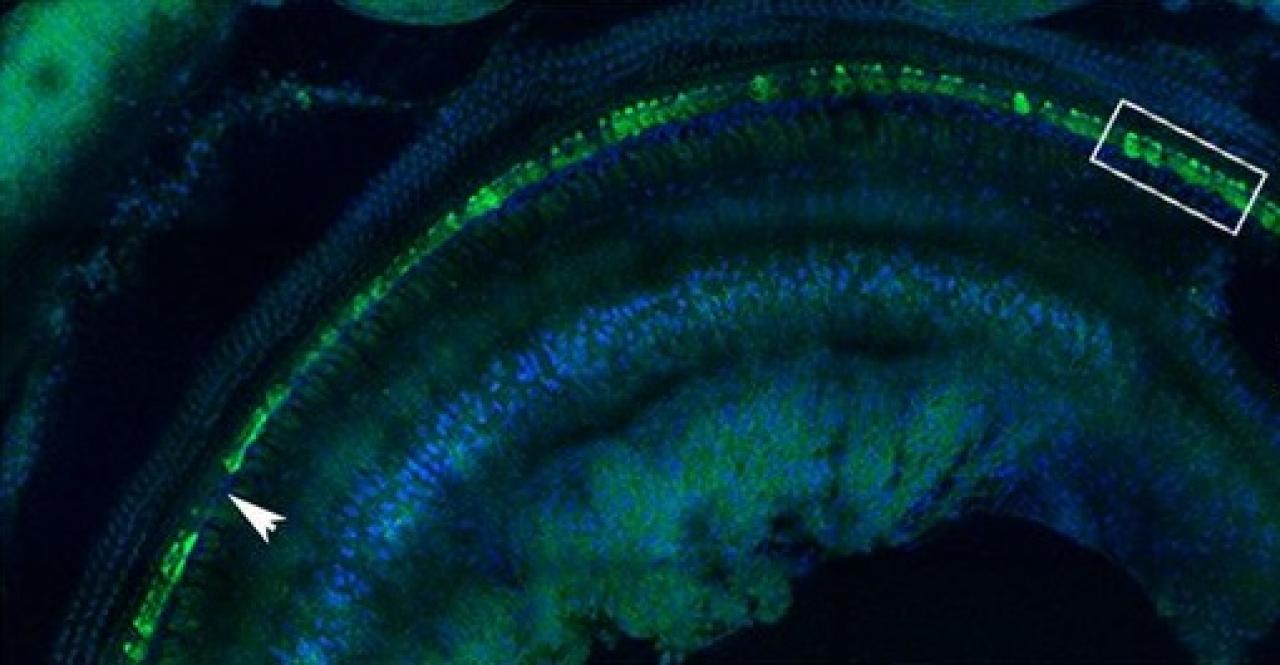
The hair cells of a mouse cochlea glowed bright green after a gene therapy developed several years ago in Lawrence Lustig's lab inserted a new otoferlin gene into the cells, correcting a genetic mutation that causes hearing loss. Image from Akil et al. 2019, doi: 10.1073/pnas.1817537116.
Lustig is quick to credit other groups who published similar results at the same time. "Clearly, lots of people were thinking about this," he says. "And we were only successful because of all the people who came before us, who developed mouse models and gene therapies for other conditions.""Everyone has their star performers, and one or two individuals who don't respond at all, but most people treated with these therapies have hearing deficits now in the mild-to-moderate range."
Biotech companies were also instrumental partners in moving the treatment into clinical trials. After his success with mice, Lustig began working with Decibel Therapeutics, later acquired by Regeneron.
The first child received the therapy about two and a half years ago in the UK. "This kid had an unbelievable result, with near normal hearing at this stage," Lustig says. Regeneron's otoferlin gene therapy, delivered to three children at Columbia University Irving Medical Center during the trial, was approved by the FDA in April 2026.
Four other groups around the world have developed gene therapy for otoferlin hearing loss, all based on the dual-vector approach. "Everyone's got slightly different techniques and viruses, but everyone's getting amazing results. Everyone has their star performers, and one or two individuals who don't respond at all, but most people treated with these therapies have hearing deficits now in the mild-to-moderate range," Lustig says.
Expanding the reach of gene therapy for hearing loss
The success with otoferlin has now sparked the development of gene therapy for other forms of deafness caused by genetic mutations."For me, after working for years on the idea in the lab, to see what's happening around the world is just unbelievably gratifying."
"This progress has put a lot of wind into everybody's sails, and several groups are moving forward with gene therapy for one of the most common forms of genetic deafness, caused by changes in a protein called connexin 26," Lustig says.
Though his lab no longer does bench work to create new gene therapies, Lustig has made Columbia a center for testing gene therapies in people with hearing loss and impairments.
"It's hard to do these clinical research studies. You need a large infrastructure, a lot of working parts," Lustig says. "We've shown that we can successfully do a gene therapy trial and that's because of what we built here.
"For me, after working for years on the idea in the lab, to see what's happening around the world is just unbelievably gratifying."


