
Story and mulitmedia by Joey Garcia, University Communications and Marketing
You've likely seen plastic pollution wash up on Tampa Bay shores. While it often takes the form of bottles, caps and containers, other plastics are nearly invisible, breaking down into particles smaller than a strand of human hair. Known as microplastics, these tiny pollutants can persist throughout the environment and move through the food chain, raising concerns about their impact on wildlife and potential risks to human health.
The scale of microplastic pollution in Tampa Bay is already well documented. Previous USF research estimates approximately 4 billion particles in the region's waters. As a USF graduate student in the Department of Integrative Biology, Kate McLendon is investigating how microplastics accumulate in red mangrove ecosystems across Tampa Bay.
If mangroves really are a sink for microplastics this could have major implications for the many organisms that depend on them and potentially provide a pathway for these contaminants to move through the food web. Ultimately, this research can help inform future efforts to better understand and address microplastic contamination in Tampa Bay and similar coastal ecosystems.
Kate McLendon
USF Graduate Student
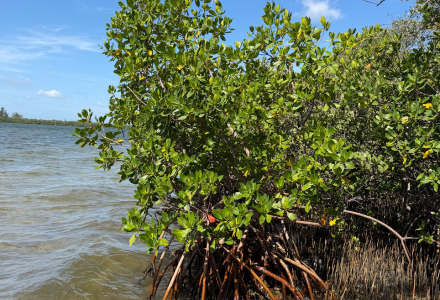
McLendon collected data accross four sites in Tampa Bay
McLendon focused her research on mangroves at Gandy Beach, the TECO Manatee Viewing Center in Apollo Beach, Fort De Soto and Upper Tampa Bay Park - well-known destinations where heavy visitor traffic can contribute to pollution reaching nearby mangroves.
"Unfortunately, microplastics have become a worldwide problem, and mangroves are especially known to trap a lot of trash and debris in their root systems as tides move in and out," McLendon said. "I'm studying their leaves to better understand what these particles can tell us about the pollution reaching habitats that support so many species."
STUDYING DAMAGED AND UNDAMAGED LEAVES
McLendon's study is unique because little research has examined how microplastics accumulate on plant surfaces compared with bodies of water and animals. She is comparing red mangrove leaves damaged by crabs with healthy leaves to determine whether leaf damage affects particle accumulation.
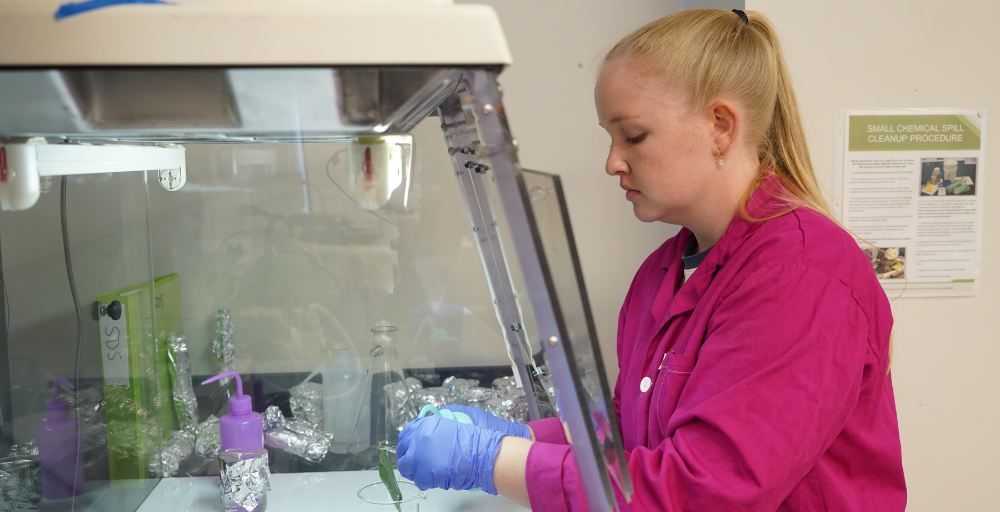
McLendon prepares damaged and undamaged red mangrove leaf samples for analysis
"To my knowledge, this is the first study looking at how microplastics accumulate on the surface of damaged versus undamaged leaves," McLendon said. "I wondered whether damaged leaves might trap more particles because crabs alter the texture of the leaf surface or if the smoothness of undamaged leaves allows particles to wash away more easily."
To test those possibilities, McLendon collected leaves from each of her four collection sites and then rinsed them with filtered deionized water. She then processed the samples through a vacuum filtration system designed to capture microscopic particles.
TRACKING SOURCES OF MICROPLASTICS
Once captured, McLendon analyzed the particles using a specialized microscope that identifies materials through infrared light. The technology allows researchers to detect and identify particles far too small to be seen with the naked eye.
"What amazes me is that we're finding hundreds of particles in an area the size of a pinhead," McLendon said.
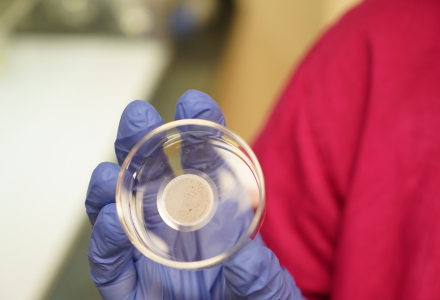
Microscopic particles collected from red mangrove leaf rinse samples are captured on a filter
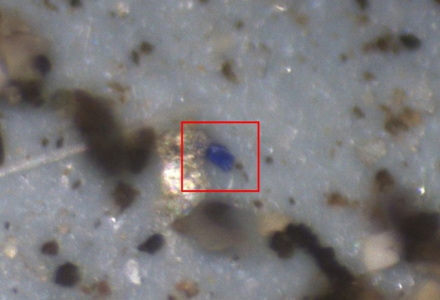
One particle identified during the study measured approximately 31 microns at its widest point, about half the width of an average human hair
Trial samples contained a diverse mix of materials ranging from rubber and common plastic polymers to plant fibers and fragments of animal exoskeletons. Leaves collected near Gandy Bridge contained particularly high amounts of rubber, which McLendon suspects may be connected to tire-wear particles from the nearby roadway. She also encountered larger plastic debris alongside the microscopic material, illustrating how visible litter can become a source of future microplastic pollution.
With sample collection and analysis ongoing, McLendon plans to publish her findings and present them next year.


