
A study developed by researchers in the UAB Department of Mathematics and the Centre for Mathematical Research (CRM) presents a model describing the behaviour of encapsulated bacteriophages within the gastrointestinal tract. Its objective is to better understand the advantages and limitations of encapsulation and to determine under what conditions this strategy can contribute to improving treatment efficacy.
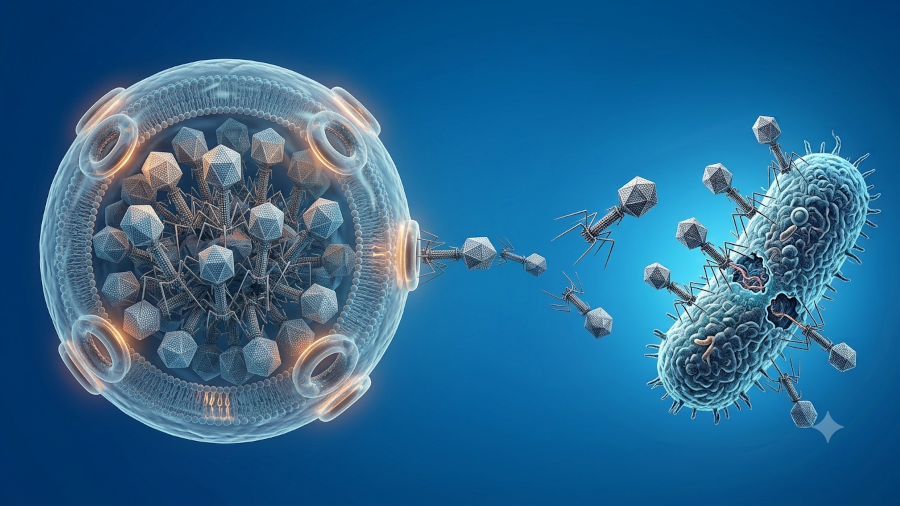
Bacteriophages, viruses capable of infecting and destroying bacteria, are considered one of the most promising alternatives to the growing problem of antibiotic resistance. In the face of rising antimicrobial resistance, these viruses have become one of the most promising therapeutic alternatives to conventional antibiotics. However, for these treatments to be effective, bacteriophages must overcome several obstacles before reaching the site of an infection. When administered orally, for example, they must pass through hostile environments such as the stomach, where a portion of the viruses can be degraded before reaching their destination.
To protect them during this journey, various research groups have developed encapsulation systems based on microcapsules. These structures protect the bacteriophages as they pass through the digestive system, but introduce a new challenge: while the viruses remain inside the capsule, they cannot infect bacteria. Understanding the balance between protection and release is key to optimising these types of therapies.
A study developed by Sílvia Cuadrado, lecturer in the Department of Mathematics at the UAB and affiliated researcher at the CRM, together with researchers from the Department of Mathematics at the UAB, Carles Barril and Xavier Bardina, presents a model that describes the behaviour of encapsulated bacteriophages within the gastrointestinal tract. Its aim is to better understand the advantages and limitations of encapsulation and to determine under what conditions this strategy can contribute to improving the effectiveness of treatments.
The proposed mathematical framework makes it possible to track the path of the bacteriophages from the moment of their administration until they reach the site of infection. This allows for the analysis of how they are progressively released from the capsules, how they move through the digestive system, and how they subsequently interact with the bacteria.
As researcher Silvia Cuadrado explains, "our model describes the dynamics of encapsulated bacteriophages in the gastrointestinal tract and addresses the central question of finding the balance between the protection and release of the bacteriophages to maximise therapeutic efficacy."
One of the study's key contributions is the explicit incorporation of the encapsulation process into a mathematical model of bacteriophage therapy—an aspect that had previously received little attention in scientific literature. Furthermore, the model distinguishes between the administered dose and the effective dose—that is, the actual quantity of bacteriophages that becomes available to combat the infection.
In this way, mathematics helps answer questions that are difficult to address experimentally: how many bacteriophages actually reach their destination? What characteristics should the microcapsules have? How frequently should they be administered to maximise therapeutic effectiveness?
Rather than providing a specific clinical prescription, the model developed by the researchers offers a tool to virtually explore different encapsulation and administration strategies before carrying out complex experimental trials. This approach could help in the future to design more effective phage therapies tailored to different types of infection.
However, the authors point out that the model's predictions will need to be validated experimentally. Future lines of research include the study of new bacteriophage release mechanisms, the incorporation of stochastic effects to more realistically describe small viral populations, and the extension of the model to systems composed of multiple biological compartments.
Overall, the work demonstrates how mathematics can contribute to the development of new therapeutic strategies, helping to optimise bacteriophage-based treatments prior to their experimental validation.
Original article:
C. Barril, X. Bardina, and S. Cuadrado, Dynamics of Encapsulated Bacteriophage in the Gastrointestinal Tract, Mathematical Methods in the Applied Sciences (2026): 4198–4213, https://doi.org/10.1002/mma.70342.


