
Energy systems that power whole cities, spacecraft that get explosively launched into a freezing vacuum, and jet engines that can fly 14 hours straight all rely on advanced materials that can withstand extreme forces and environments without failing. Scientists have developed incredible materials for these applications and beyond, but there is still room to innovate and push the boundaries.
A team led by Lawrence Berkeley National Laboratory (Berkeley Lab) is redefining the limits of metals by designing alloys that can take high heat and stay intact at sub-freezing temperatures. In their latest paper, now published in Nature, the researchers showed that two alloys with a type of atomic arrangement called body-centered cubic (BCC) show remarkable resistance to fracturing, even at a frigid 20 Kelvin (-423 degrees Fahrenheit).
Many metals, across the board, become brittle when they're cold, a phenomenon called the ductile-to-brittle transition. Both two alloys described in the current paper have BCC structure; one has a simple composition and the other is a medium-high-entropy alloy (MHEA) - a recently developed class of metals made with near-equal mixes of different elements. Most previous examples of body-centered cubic alloys are exceedingly prone to cracking, even at temperatures as high as 1,000 Celsius (1,832 F). But because they have remarkably high melting points, BCC alloys are a big focus for scientists designing materials for high-temperature applications like turbine blades or rocketry.
"High temperatures are always the holy grail. And people have been saying these are going to be the next generation of alloys for extreme environments, but we've found that they're so brittle, they're pretty hopeless," said lead author Robert Ritchie, a senior faculty scientist in Berkeley Lab's Materials Sciences Division and distinguished professor of Engineering at UC Berkeley. "We looked at ways to make ductile versions of these alloys, and the result is these two materials that show high toughness over a massive range of temperatures, all the way from liquid helium temperatures, 20 kelvins, all the way up to 1,300 degrees centigrade. For any alloy, that's interesting, and for an MHEA of this type, it's remarkable."
More research is needed before these metals can be adopted for real-world uses. For example, the scientists don't yet know how oxidation from use and exposure to the elements will affect performance. But the team's study clears a huge hurdle by proving that high-temperature BCCs can overcome the ductile-to-brittle transition that previously made them impractical, and in fact stay ductile at temperatures far below what their potential applications would require.
"If you look at the silicon we use in our computer chips, it has very high strength, but the toughness is about three MegaPascal root meters," said co-first author David Cook, who was a postdoctoral researcher in Ritchie's lab at the time of the research, and is now an assistant professor of Materials Engineering at the University of Cambridge. MegaPascal root meters (MPa√m) is a unit used to measure the toughness of materials. Strength is defined as a material's ability to keep its shape under force, whereas toughness is how much energy a material can absorb before it fractures or breaks. "When you look at the toughest of the existing body-centered cubic materials, such as steel, the toughness is only 10 to 20 MPa√m at liquid helium temperatures. Our alloys have a toughness of 100 MPa√m at 20K and above 250 MPa√m at room temperature."
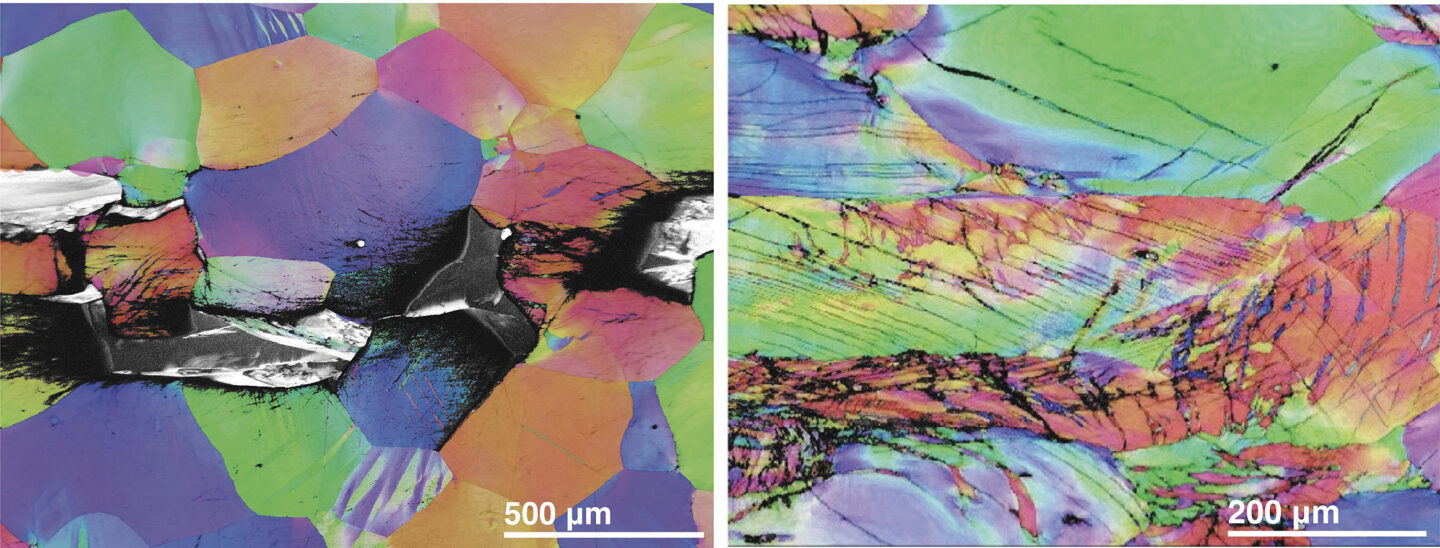
A close-up on crystals
Ritchie's lab creates and tests MHEAs with incredible properties, including one alloy that holds the current title for toughest material on Earth. That material, which has a different type of atomic structure, shows great promise for applications in extreme cold, but isn't suitable for high heat. In 2022, Cook began exploring atomic recipes for alloys with high melting points in the body-centered cubic class. Unlike traditional alloys which have one or two main elements with trace additives, the two evaluated in this paper combine similar proportions of metals, and each contain elements from chosen from two regions of the periodic table. The MHEA studied is Nb45Ta25Ti15Hf15, and the other has just two elements, Nb70Ti30, making it a "binary alloy."
After exploring tiny samples of the alloys made at Berkeley Lab's Molecular Foundry, the team needed big chunks to perform mechanical stress tests. These samples were cast and rolled by collaborators at UC Irvine and an Air Force materials lab. The tests at high heat and all the way down to liquid nitrogen temperatures (77 K or -321 F) were performed at Berkeley Lab. Testing at 20 K was done at the Engin-X instrument at the ISIS Neutron and Muon Source in the United Kingdom, with help from researchers at the University of Oxford.
After putting their samples through a gauntlet of tests to make them bend and snap, the team used microscopes at the Molecular Foundry's National Center for Electron Microscopy to zoom in on the materials and identify the mechanisms that allowed them to overcome the ductile-to-brittle transition across all measured temperatures.
Like the sparkly gems in our jewelry, metals have a crystalline structure, meaning they are composed of repeating "units" of atoms arranged in a certain way. Body-centered cubic is one type of atomic unit. When a crystal is stressed, the material will deform in various ways that depend on how the units slide, rotate, and shear away from each other. Generally, the more a material can deform, the more ductile it is, because these internal movements absorb the energy that is being applied. When it can't deform anymore, the energy applied causes it to break.
Cook and fellow co-first author Xiaoyu Chen, a Ph.D. student in Ritchie's lab, performed the microscopy to capture and analyze images and data of atomic-scale deformations of the samples. They theorize that both alloys experience a unique sequence of deformation under tension that has not been seen in other materials.
"It's a very unusual sequence, and it appears that the mechanisms are sort of competing with each other when you start deforming the material," said Ritchie. "There's a lot that's not yet understood, but these materials could help us get beyond the temperature limits of current nickel-based superalloys. Our MHEAs aren't the strongest in the world, but you don't need super strength for some applications, you just need to resist fracture and take the heat."
This research was funded by the Department of Energy (DOE). The Molecular Foundry is a DOE Office of Science user facility. The other researchers who contributed to this work are Xiaoyu Chen, Michael O'Leary, Satish Rao, Wenqing Wang, Calvin H. Belcher, Madelyn Payne, Pedro Borges, Tung Lik Lee, Arun Devaraj, Mark Asta, Enrique J. Lavernia, Diran Apelian, Andrew M. Minor, Dong Liu, and Punit Kumar.


