
Key Takeaways
- The new work presents an approach to find ice deposits hidden in the moon's subsurface.
- The team studied the physics underlying how moon rocks respond to seismic waves. Their experiments showed a difference in the seismic signatures of icy and dry rock.
- Rovers planned for future lunar exploration have drills that generate seismic waves; the models from this work could help interpret data from these rovers and build techniques for real-world ice discovery.
After a long absence from the moon's surface, NASA's Artemis program plans to get more boots (and rover wheels) on the ground. As the missions get longer and the research more complex, astronauts and their equipment will need more water than they can reasonably bring on the journey. Recent studies suggest that there are sizable water resources on the moon - in fact, much more than we believed during the Apollo era - but scientists still need to determine where the most concentrated frozen water is located within the moon's dusty and rocky subsurface.
This is where new technologies co-developed at Lawrence Berkeley National Laboratory (Berkeley Lab) will come in. Harrison Lisabeth, a research scientist in Berkeley Lab's Energy Geosciences Division, collaborated with researchers at the Universities of Maryland and Hawaii to build a computational model that predicts how the moon's subsurface responds to seismic waves depending on its composition. Their findings, now described in Science Advances, confirm that seismology could be a tool for searching for buried ice deposits, and the team's model could help future landing interpret data from real experiments.
"When NASA scientists want to perform geological surveys on the moon, they will need rock physics models to understand the fundamentals of how the subsurface behaves," said Lisabeth. "But we didn't have very good models until now because materials behave weirdly in the high vacuum and super cold environment of the moon."
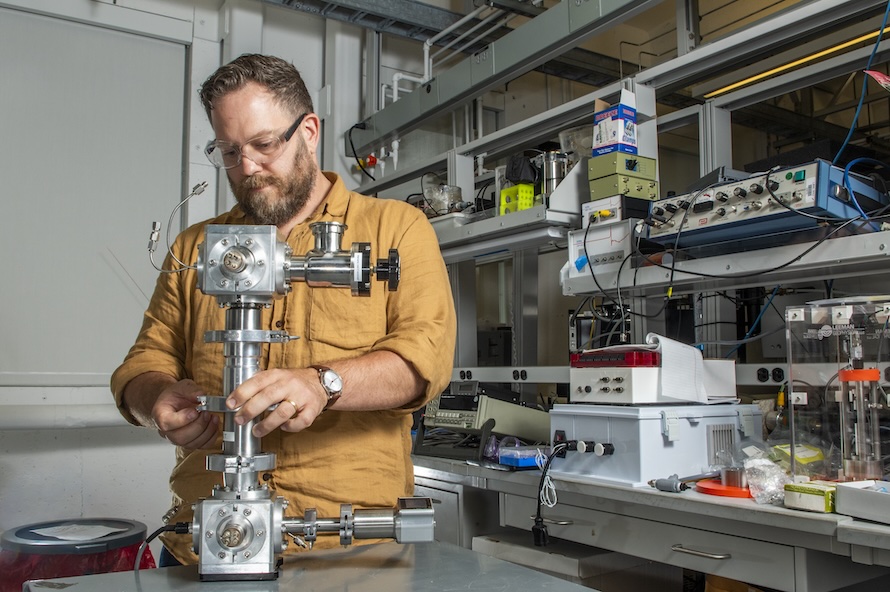
To equip Artemis scientists with what Lisabeth calls the "ground truth" of lunar subsurface physics, he worked with colleagues at the Advanced Light Source (ALS) to build a 15-inch cryogenic vacuum chamber, called the Frozen Regolith Observation and Sublimation Testbed (aptly abbreviated as FROST), which attaches to an ALS beamline for X-ray microtomography. The ALS is a DOE Office of Science user facility that generates beams of light at varying X-ray and infrared frequencies to study molecules and materials. FROST allows scientists to observe how physical and chemical forces cause microscopic changes to rock samples in the subzero vacuum conditions of the moon.
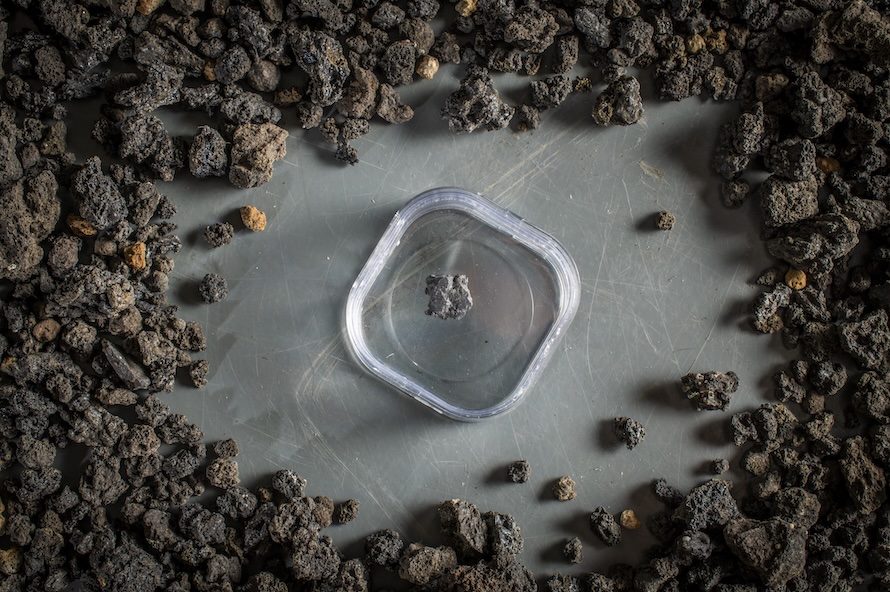
For this paper, which was the first use of FROST, Lisabeth and co-author Nicholas Schmerr studied how simulated regolith - aka, Earth rock altered by scientists at NASA's Johnson Space Center to be as close as possible to real moon rock - bends and deforms at the microscopic scale, and how these movements differ depending on how much ice is trapped inside.
The third co-author, Matthew Siegler, who is an expert on ice deposits on different bodies in the solar system, used data from satellite observations to model likely locations of large ice deposits on the moon and the mechanisms keeping it in place on geological time scales, given that ice will vaporize into space if it ever gets too hot.
The team used the molecular-scale rock physics revealed by the FROST experiments, Siegler's ice modeling, and a seismic simulation model built by Schmerr to develop a combined approach that can simulate the large-scale geophysics governing the moon subsurface. The models allow geophysicists to predict how ice would affect seismic waves and develop techniques that will allow them to seismically prospect for that ice. (As of now, their model describes movements down to about 800 meters below the surface.)
And although real field experiments will be needed to validate their findings, the simulations suggest that the different types of ice deposits that could form on the moon will each have distinctive seismic signatures.
"Our model provides testable hypotheses to design seismic experiments looking for water on the Moon," said Schmerr. "We plan to use it when the Volatiles Investigating Polar Exploration Rover, or VIPER, is delivered to the moon in the near future." Schmerr is a co-investigator on VIPER, which is using a suite of instruments, including its navigational accelerometers as seismic sensors, to probe for ice at the moon's south pole.
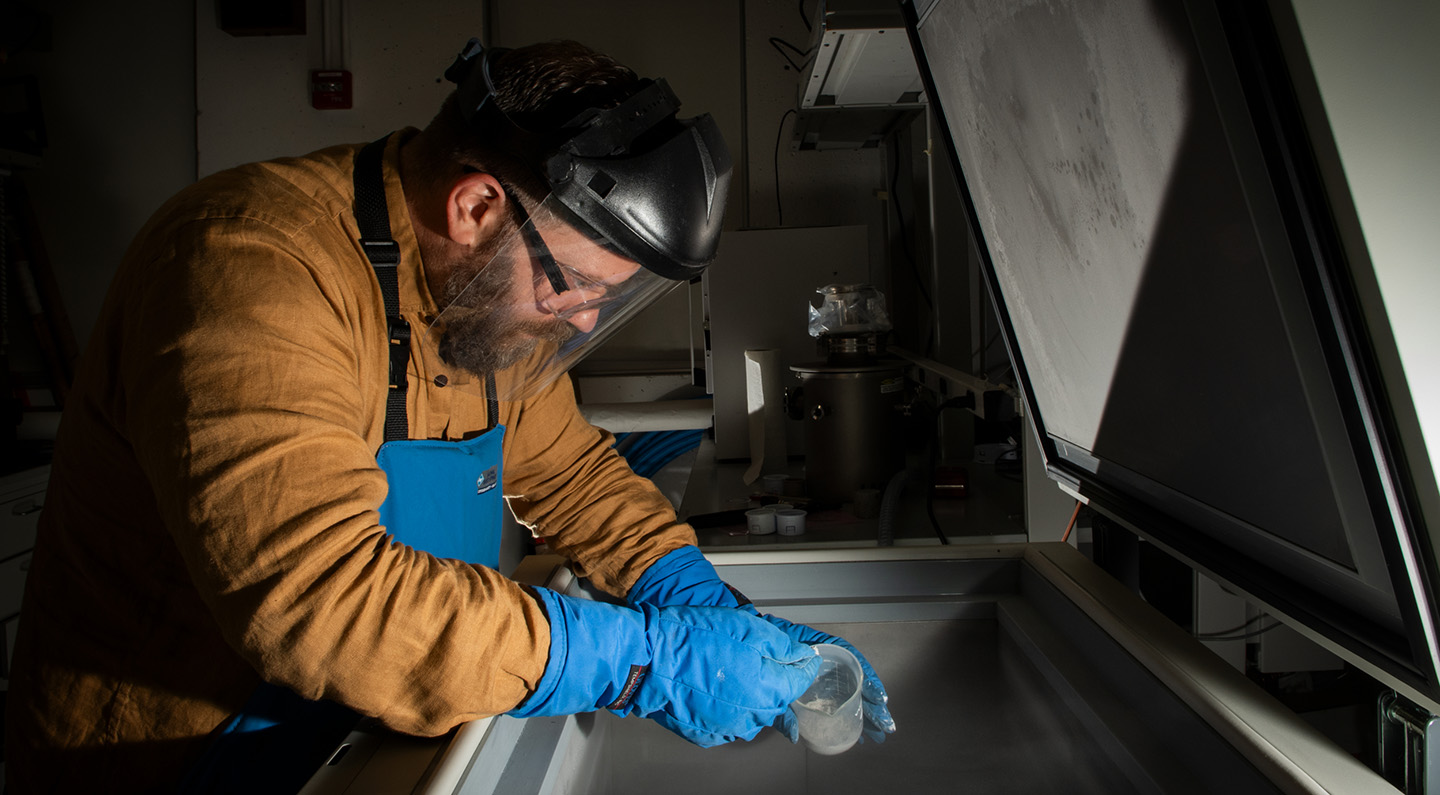
The three scientists are part of the larger Geophysical Exploration of the Dynamics and Evolution of the Solar System (GEODES) team, a NASA-funded project that uses geophysics methods to investigate the moon, near-Earth asteroids, and the moons of Mars to enable ground exploration. Schmerr is the GEODES principal investigator, Siegler is the ice deposits lead, and Lisabeth is an affiliate researcher focused on regolith. In his role at Berkeley Lab, Lisabeth often uses the ALS to characterize rocks and other materials under conditions mimicking the Earth's subsurface to gain insights that help inform development of geothermal energy and carbon storage systems.
When the Artemis program began, he saw the need for an experimental capability like FROST, as finding water will be one of the first priorities for a long-term presence on the moon. Lisabeth, with Dula Parkinson and Harold Barnard at the ALS, was awarded funding from Berkeley Lab's Laboratory Directed Research and Development (LDRD) program to design and construct FROST in 2023. Since then, the chamber has been used in several other studies on water transport and thermal properties of regolith and to investigate dynamics of glaciers on Earth.
"Our work is to make measurements and help learn the fundamental geophysics for the moon and other bodies, so we can make sure we have the best models," said Lisabeth. "Because when you're researching in the field, if you don't have ground truth, you're never going to understand what's happening a hundred meters down or three kilometers down."
"It is exciting that we may soon be able to test out models with not-too-distant future data coming from the instruments on VIPER," said Siegler. "This lander has a percussive drill that makes seismic waves as it digs samples, and onboard sensors to measure how short frequency waves propagate underneath it. VIPER's other tools can detect ice in the upper meter of the lunar soil, but these seismic waves might let us detect ice much deeper. These experiments will give us a first glimpse of near-surface properties on the moon."
This work was also supported by NASA and the DOE Office of Science.


