
Key Takeaways
- A $1.2 million Keck Foundation grant will help Ohio State scientists explore whether the spinal cord helps detect infection.
- Researchers will use imaging, genetics and AI to study spinal cord cells that may help guide the immune response.
- The discovery could lead to new ways to treat inflammatory diseases.
COLUMBUS, Ohio – The W.M. Keck Foundation has awarded $1.2 million to researchers at The Ohio State University Wexner Medical Center and College of Medicine to conduct novel spinal cord research.
This project, led by Phillip Popovich, PhD, professor and chair of neuroscience at Ohio State, explores whether the spinal cord helps detect infection and direct the body's immune response. The work challenges the long-held view that the brain is the nervous system's main controller of immunity.
"For more than a century, the story of how the brain and body talk to the immune system has centered on the brain. We think that story is missing a chapter," said Popovich, who holds the Ray W. Poppleton Research Designated Chair and serves as executive director of The Ohio State University Wexner Medical Center Belford Center for Spinal Cord Injury.
"Our research suggests the spinal cord isn't just a cable carrying messages up to the brain and back. It may have its own pathway for detecting infection and signaling the immune system without involving the brain. If we're right, it could change scientists' understanding of how the nervous and immune systems work together and create new opportunities to treat inflammatory diseases," he said.
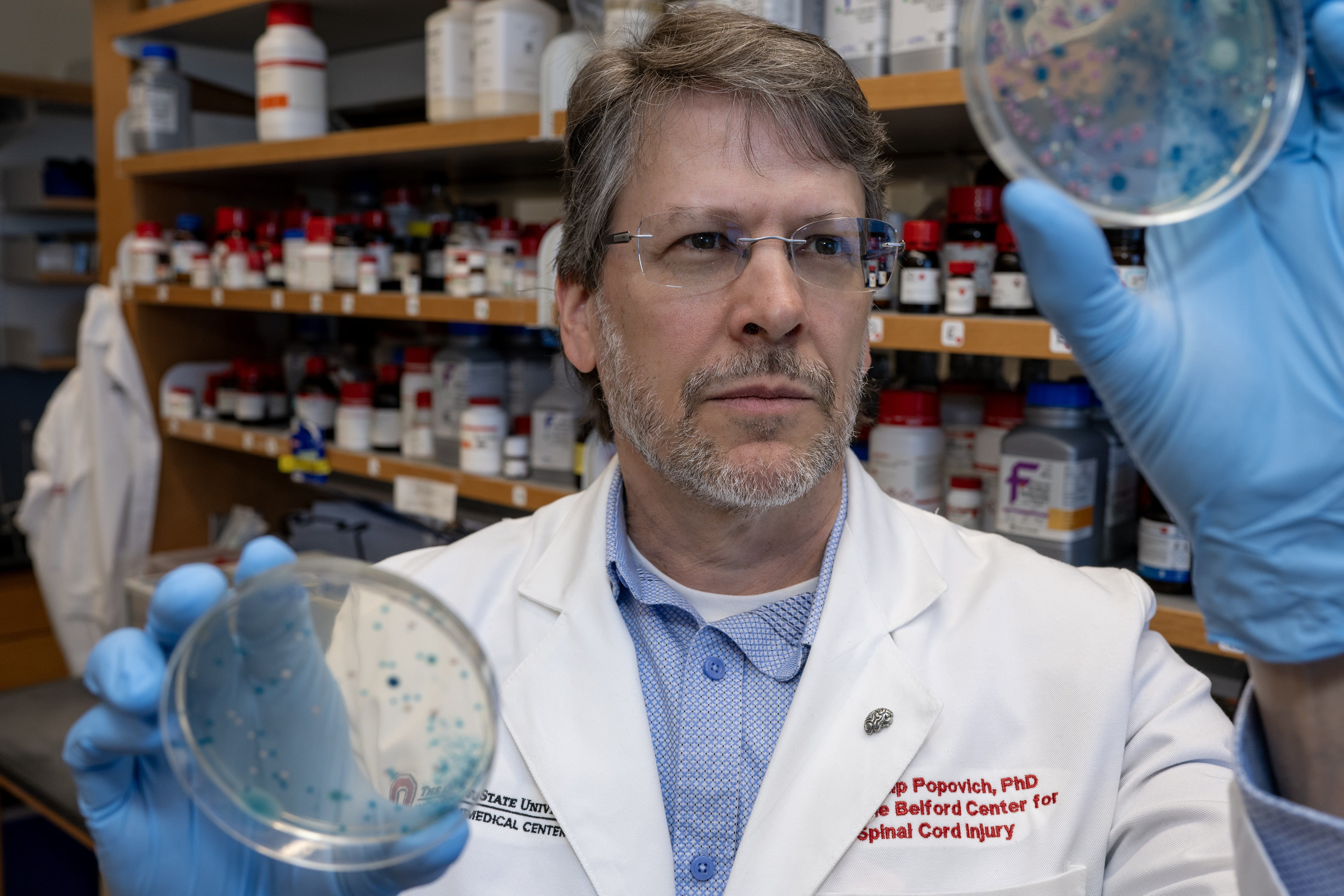 Popovich's team has identified a previously unknown group of spinal cord cells, called "immune synergy encoding" (ISE) neurons, which become active when inflammation occurs throughout the body. This finding suggests the spinal cord may have its own previously unknown connection to the immune system.
Using imaging technology and genetic methods, researchers will identify these nerve pathways in mice and study how they affect the body's immune response.
"We use genetically engineered mice that let us permanently tag neurons the moment they respond to an immune challenge, so we can go back later, and map exactly which cells lit up and where they connect," Popovich said.
The project has three stages:
- Create a detailed map showing which spinal cord nerve cells respond to infection or inflammation and where they send signals.
- Use that information in a computer model powered by artificial intelligence to predict which nerve cells play the biggest role.
- Activate or deactivate those nerve cells in mice to see whether they directly affect immune responses and behavior. This step will help researchers determine whether those nerve cells are actually causing the changes they observe.
Earlier research by his team found that a spinal cord injury permanently damages the immune system. Researchers call this condition spinal cord injury-induced immune deficiency syndrome, a weakening of the immune system that can occur after a spinal cord injury.
"That work established that the spinal cord is required for a healthy immune system. What it never answered is which neurons are doing that work and how. That circuitry has been a black box. This project is our attempt to finally open it, by studying the healthy spinal-immune connection instead of the injured one. We spent decades documenting what happens when this system is broken," Popovich said. "Now we're pivoting to map how it works when it's healthy, using the same spinal cord expertise but pointed at a completely new question."
Other Ohio State researchers involved in this study include:
- Qin Ma, PhD, professor and chief of the Division of Bioinformatics and Computational Biology at The Ohio State University and leader of the Immuno-Oncology Informatics group at The Ohio State University Comprehensive Cancer Center – Arthur G. James Cancer Hospital and Richard J. Solove Research Institute Pelotonia Institute for Immuno-Oncology (PIIO).
- Eugene Oltz, PhD, professor and chair of Microbial Infection and Immunity at the Ohio State College of Medicine and member of the Cancer Biology Research Program at Ohio State's Comprehensive Cancer Center – James Cancer Hospital and Solove Research Institute.
- Andrea Tedeschi, PhD, associate professor of Neuroscience at the Ohio State College of Medicine and faculty in the Ohio State University Chronic Brain Injury Program.
About the W. M. Keck Foundation
The W. M. Keck Foundation was established in 1954 in Los Angeles by William Myron Keck, founder of The Superior Oil Company. One of the nation's largest philanthropic organizations, the W. M. Keck Foundation supports outstanding science, engineering and medical research. The Foundation also supports undergraduate education and maintains a program within Southern California to support arts and culture, education, health and community service projects.


