
Connecticut's two most active research universities have synergized the acceleration of quantum innovation and education
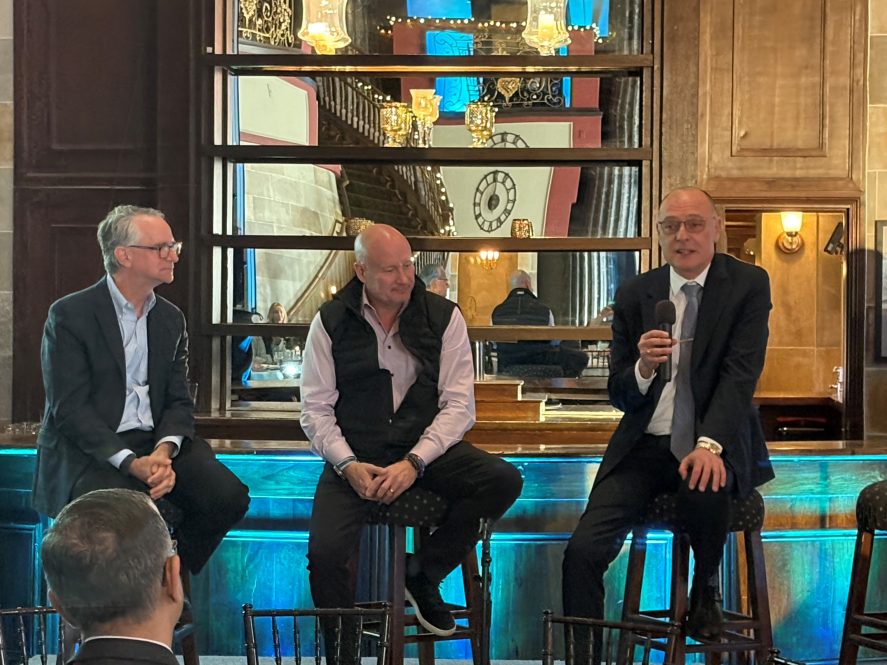
Yale Vice Provost for Research Michael Crair, state DECD Commissioner Daniel O'Keefe, and UConn interim Provost Pamir Alpay discuss Connecticut's quantum ecosystem during a conference on May 7. Photo by Matt Engelhardt
For more than 100 years, UConn and Yale have served as Connecticut's most prolific research universities. With quantum technology and innovation as a catalyst, the two institutions are enjoying unprecedented collaboration, to the benefit of the entire state.
On May 7, UConn's Technology Commercialization Services hosted the Connecticut Quantum Conference in Hartford. The event brought together academic, governmental, and business experts for panels on the impact of quantum computing and technology, as well as the implications for the state's economy.
"Today is about quantum and what quantum means for the future of our universities, state, and nation," said UConn President Radenka Maric, adding that Connecticut needs an ecosystem of scientists, investors, and resources to maximize potential. "The keyword is collaboration. Nobody can do it alone."
UConn and Yale have hardly been "doing it alone." In 2022, the National Science Foundation (NSF) announced its Regional Innovations Engine program, an initiative to invest billions of dollars into research that catalyzes innovation ecosystems throughout the country. The announcement sparked mutual interest among UConn interim Provost Pamir Alpay and Yale vice provost for research Michael Crair.
With UConn's expertise in areas like advanced materials and sensors and Yale's strength in biosciences, Alpay and Crair saw a partnership to advance the state through quantum computing and technology. The result was QuantumCT, a proposal that has united not only the state's research institutions, but also government, industry, and other state colleges and universities.
"It was an easy decision to collaborate on quantum, because of the strengths of the universities and the ability to collaborate on the greater good for society," Crair said at the convention.
Three years after NSF Engines was launched, Connecticut's proposal is a finalist for an NSF grant for as much as $160 million over 10 years, earmarked to advance the region as the nation's quantum accelerator. A planning grant helped establish QuantumCT as a nonprofit facilitator, and with $61 million invested by the state, quantum projects have proliferated across the state. If the NSF proposal is successful, the state has pledged another $60 million to grow infrastructure and expand the workforce.
Education is a major component as the state prepares the workforce to implement quantum skills into different economic sectors. To do that, Maric and Crair both made clear at the conference the importance of making quantum understandable in "plain English" and demystify the science involved.
Also during the conference, Alpay, Crair, and state commissioner of the Department Economic Development and chief innovation officer Daniel O'Keefe gave a panel on Connecticut's quantum ecosystem. They detailed the progress that has already occurred and celebrated unprecedented collaboration, with UConn and Yale as the lead partners.
O'Keefe praised the two R1 research universities for their partnership and the potential their respective areas have for advancing quantum in Connecticut's key industries. These include national security, finance, and high-tech manufacturing, aerospace, pharmaceutical sciences, and other areas that historically have driven the state's economy.
"That's where we win: when we take a foundation of innovation and research and apply it in our core industries," O'Keefe said.
O'Keefe added that from the state's perspective, quantum represented opportunities and advantages that Connecticut can thrive and defend. In making the investment, he said that he viewed what other states like Illinois and Colorado were committing and encouraged the governor to double those figures.
"We are not messing around here," O'Keefe said.
Alpay agreed, saying that the research strengths of UConn and Yale are complementary and can push advancement in many areas of need. He singled out cyber security as an area where quantum can improve, as well as other areas where Connecticut traditionally thrives.
"There's so much that is happening here in the state that could benefit from that kind of acceleration," Alpay said.
Crair said there were four areas where QuantumCT is investing financial and intellectual capital: research collaboration, nurturing startup companies and venture opportunities, workforce development, and community engagement. The conference represented all those areas, with partners agreeing that the proposal has bred success even as news of the grant continues to loom.
"I give the NSF great credit for what we are doing and what we hope to achieve with QuantumCT," Crair said.


