Mayo Clinic researchers have created a detailed map of the pulvinar, a deep brain region that could help doctors more precisely target brain stimulation therapies for people with drug-resistant epilepsy.
The findings, published in the Journal of Neuroscience, reveal that brain regions separated by only a few millimeters connect to entirely different brain networks. The discovery provides a blueprint for placing electrodes more precisely during deep brain stimulation, an emerging treatment for epilepsy.
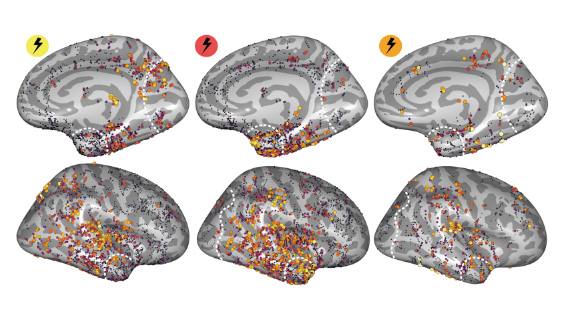
The researchers studied people with drug-resistant epilepsy who already had temporary electrodes implanted as part of their clinical care. By delivering small electrical pulses to different parts of the pulvinar and measuring the brain's responses, the team created a map showing how this largely unexplored region communicates with the rest of the brain.
The pulvinar is part of the thalamus, a deep brain structure that relays and coordinates information from sight, sound, touch and other senses. Because it lies deep within the brain, scientists have had limited opportunities to study how its different regions connect to other brain networks.
"We were surprised by how large, detailed and complex this deep brain structure is, and by its potential role in guiding epilepsy treatments," says Dora Hermes Miller, Ph.D., a biomedical engineer at Mayo Clinic and senior author of the study.
The findings have immediate relevance for clinical care and build upon ongoing research to develop personalized treatment for people with drug-resistant epilepsy. "We are already using the pulvinar maps to help individualize pulvinar deep brain stimulation targeting in patients with drug-resistant epilepsy, while continuing to study how these maps relate to long-term outcomes," says co-author Nick Gregg, M.D., a neurologist at Mayo Clinic.
Why researchers studied the pulvinar
Researchers recognized the pulvinar's therapeutic potential when they were caring for patients with drug-resistant epilepsy. As part of their clinical care, patients had electrodes placed in several brain regions, including the pulvinar, to evaluate whether stimulation could reduce seizures.
"When we stimulated the pulvinar, we expected to see the same brain networks respond each time," Dr. Hermes says. "Instead, some patients showed activation of visual brain areas while others didn't. That unexpected finding led us to ask why."
By studying 30 patients, the researchers discovered that the pulvinar is not a single, uniform structure. Instead, it contains specialized regions connected to different brain networks involved in vision, memory, language and attention.
The distances between these pulvinar subregions were remarkably small. Brain regions separated by as little as 3 millimeters connected to completely different brain networks.
"That level of detail means that if neurologists want to suppress the seizures coming from those areas, they have to place electrodes in the precise right spot. And these findings provide a guide towards that spot," Dr. Hermes says.
What the study means for personalized epilepsy treatments
Epilepsy affects more than 50 million people worldwide. About one-third continue to have seizures despite medication. For many of these patients, neuromodulation - a treatment that uses electrical stimulation to regulate brain activity - can help reduce seizures.
"These findings provide data that enables exploration of tailoring neuromodulation therapies in a more personalized way, targeting each patient's specific epilepsy networks," says Gregory Worrell, M.D., Ph.D., a study co-author and neurologist at Mayo Clinic.
Researchers are now investigating which parts of the pulvinar should be stimulated - and at what frequencies - to better control seizures while minimizing side effects.
"Our aim is to make therapy more precise, more consistent and ultimately more effective," Dr. Gregg says.
The study highlights the collaborative mission of Mayo Clinic's Bioelectronic Neuromodulation Innovation to Cure (BIONIC) initiative, which unites clinicians, scientists and engineers to translate advances in brain science into personalized neuromodulation therapies.
For a complete list of authors, disclosures and funding, review the study.