
About 25 million people in the U.S. - roughly eight out of 100 - are diagnosed with asthma. Allergens, air pollution, extreme weather conditions, or other irritants can cause chronic lung inflammation, leading to coughing, wheezing, or shortness of breath.
One lesser-studied side effect: Asthma attacks induce mechanical forces that permanently alter airway tissue - damage that occurs independently of inflammation alone. New research led by Binghamton University used leading-edge lung-on-a-chip technology to show that the repeated mechanical stress from asthma attacks causes overproduction of proteins for the extracellular matrix that joins cells together. It also leads to the overgrowth of blood vessels, a condition known as angiogenesis.
Over time, both factors cause thickened airway tissue that constricts breathing.
For a paper published in Nature Biomedical Engineering, Assistant Professor Jungwook "Jay" Paek - a faculty member at the Thomas J. Watson College of Engineering and Applied Science's Department of Electrical and Computer Engineering - collaborated with colleagues at Binghamton as well as the University of Pennsylvania, the University of Toledo, and the Pacific Northwest National Laboratory.
The new paper continues postdoctoral research that Paek did at Penn with his advisor, Professor Dan Huh, before coming to Binghamton in 2023.
"This is the first time that anyone has demonstrated the effect of a mechanical process on tissue remodeling - including both fibrosis and angiogenesis - in asthma patients," he said. "It's groundbreaking, and that's why a prestigious journal like Nature BME is publishing it."
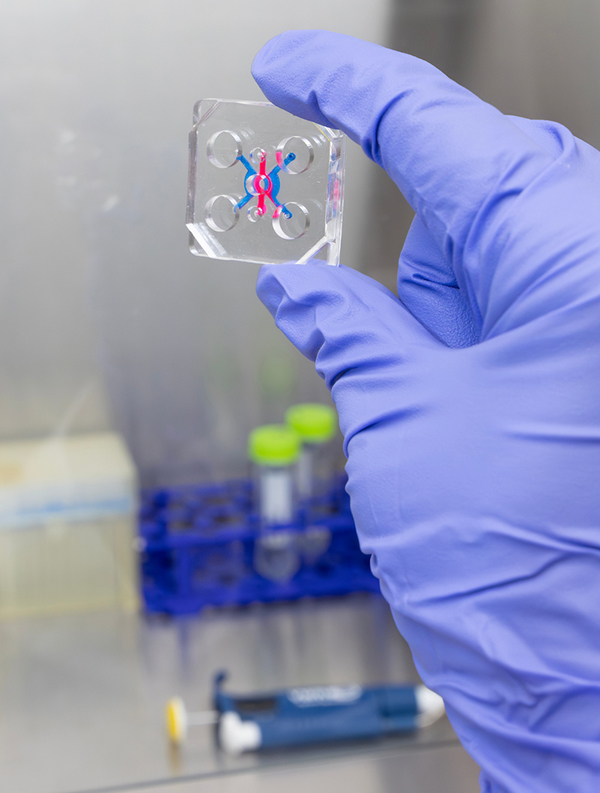
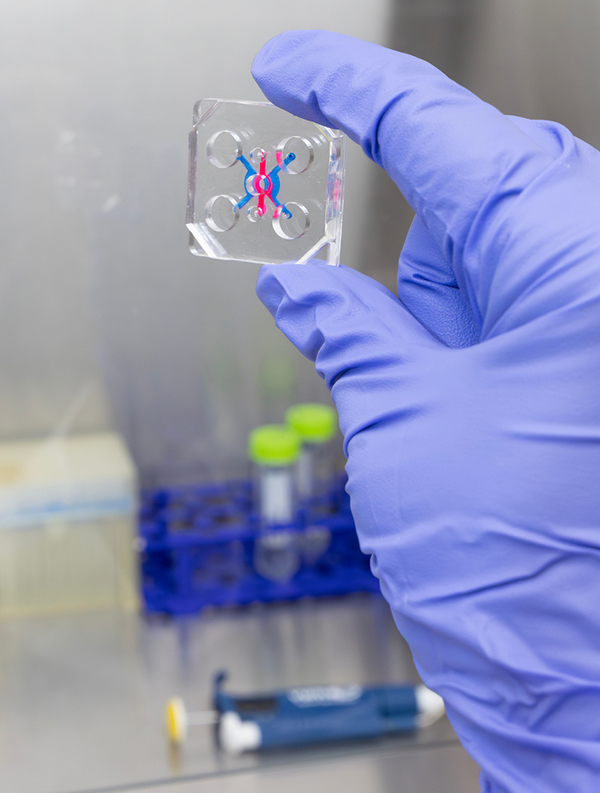
Organ-on-a-chip uses microfabrication techniques borrowed from the semiconductor industry to reproduce conditions in the human body with just a small culture of cells.
For this study, the researchers built the microfluidic device so that the tissue could undergo structural deformation by pressurizing or evacuating a connecting chamber. As part of their observations, they tested the potential for medication delivery to modulate the cells' activity, laying the foundation for possible future asthma treatments.
"This technology is at the intersection of biological science, biomedical engineering, electrical engineering, and mechanical engineering," Paek said.
Binghamton doctoral student Anika Alim contributed to the research as part of Paek's project team. As an electrical engineering student, she had little experience with bioengineering principles or lab work, but she got up to speed quickly.
"I started to learn about organ-on-a-chip on the very basic level," she said. "Then I did a dive deep into how it can replicate human physiology. With this technology, we can see how our human body actually functions when asthma attacks happen."
She appreciates how the research expands her base of knowledge and experience, as well as Paek's mentorship through the research: "When I first started, he showed me everything himself - it was a very collaborative experience. I had no idea how to work with cells, but he was there at every step. I'm very grateful."
Paek's current research at Binghamton centers on Parkinson's and other neurodegenerative diseases, including a study published earlier this year about how those conditions affect blood circulation and a National Institutes of Health grant to investigate how protein aggregates called Lewy bodies contribute to neurological breakdown.
"Focusing on how neurons are electrically active within the human body leans more toward electrical engineering principles based in biological science," he said.


