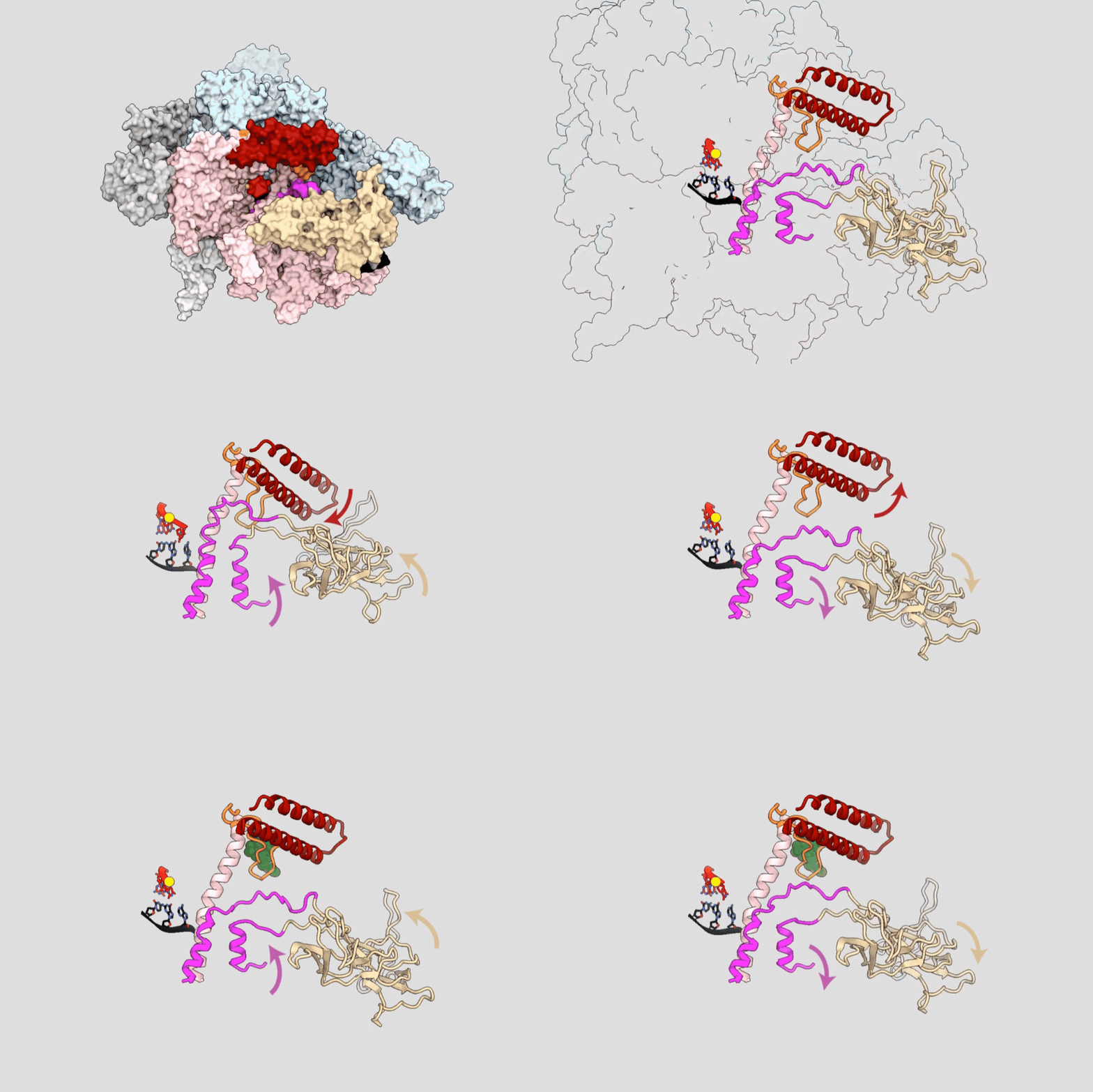
The Darst lab has shown how two classes of antibiotics (pictured in green) jam the enzyme responsible for the transcription of DNA to RNA. They do this by locking a key structural component in place. (courtesy of Darst lab)
Scientists have long been fascinated by two promising classes of antibiotics that disable RNA polymerase (RNAP). They knew that these drugs could grind gene expression to a halt in several pathogens, including the bacterium behind tuberculosis, by binding to specific locations in the RNAP. But despite decades of study, a key question remained: what process are the drugs actually targeting?
Now, a new paper in PNAS solves that mystery and simultaneously uncovers a new element of basic biology. Using these antibiotics as tools to clarify the finer points of RNAP function, the researchers discovered that the enzyme works only if a certain moving part briefly swings into place to stabilize RNA synthesis-and that these drugs disable the enzyme by preventing that motion. The findings reveal a previously unknown mechanism of RNA synthesis shared across diverse forms of life and lay the groundwork for developing next-generation antibiotics.
"It's sort of a two-for-one," says Seth A. Darst, head of the Laboratory of Molecular Biophysics at Rockefeller. "We now know how these inhibitors work, and the inhibitors also revealed a conformational change in the active site that we didn't know was important."
RNAP in motion
Two experimental classes of antibiotics-CBR9379, which targets E. coli RNAP, and AAP-SO2, which targets Mycobacterium tuberculosis RNAP-have puzzled scientists for decades. Researchers knew that these antibiotics were RNAP inhibitors, which disable the enzyme responsible for transcribing DNA into RNA, a process that underlies gene expression in every living cell. But traditional X-ray crystallography, an ideal method for capturing static snapshots of proteins, could not explain how the antibiotics were interfering with RNAP's function.
Part of the problem was that RNAP works by cycling through a series of choreographed changes in shape as it builds RNA. Some of these movements are essential: one moving part, called the trigger loop, must repeatedly close and reopen to add each new RNA building block. Others, such as the neighboring rim helices/F-loop-which sits suspiciously close to the antibiotics' binding site-are more enigmatic. Researchers did not know whether it moved during RNA synthesis or, if it did, what role those movements played in RNAP function.
To figure out how these antibiotics were doing their jobs, the team realized that they would need a tool capable of capturing RNAP in action. "X-ray crystallography had shown us where these antibiotics bound RNAP, but their mechanism of action was unclear," says Yukti Dhingra, a postdoctoral associate in the Darst lab. "With cryo-electron microscopy, we hoped to see the movement of RNAP and determine if these drugs were inhibiting a specific movement."
An unexpected discovery
With cryo-EM, the team captured thousands of images of the enzyme in both E. coli and Mycobacterium tuberculosis. They then sorted these images into distinct structural states, reconstructing the range of shapes that RNAP naturally adopts as it builds RNA.
As expected, the trigger loop alternated between open and closed states. But the researchers discovered that the rim helices/F-loop moved as well. As the trigger loop closed, the rim helices/F-loop swung into place and briefly made contact with it, stabilizing the enzyme as it added each new RNA building block. Under normal conditions, the team found that the enzyme population split between open and closed conformations, reflecting RNAP's constantly shifting shape as it built RNA. When the antibiotics were added to the sample, however, they locked the rim helices/F-loop in its open position, preventing it from interacting with the trigger loop.
"Without the inhibitor, the enzymes were in two prominent states, closed and open," Dhingra says. "But when we added the inhibitor, the closed state disappeared entirely. We were looking at an ensemble of different conformations and, with the addition of the antibiotic, we could see the ensemble shift."
These antibiotics were working the same way. Both drugs were preventing the rim helices/F-loop from stabilizing the trigger loop which, in turn, was preventing the trigger loop from driving RNA synthesis-halting RNAP and taking their respective pathogens offline.
While solving the mystery of these antibiotics, the team also revealed a previously unrecognized movement central to the function of one of biology's most important enzymes. Because they observed the same rim helices/F-loop mechanism in E. coli and Mycobacterium tuberculosis, their work suggests that this newly recognized movement may be a fundamental feature of RNAP across other domains of life. "Seeing this movement in organisms that are evolutionarily apart shows us that it is a fundamental requirement for the enzyme to function," Dhingra says.
Beyond basic biology, the findings also provide a high-resolution structural blueprint for antibiotic development. Because these compounds target a vulnerability unique to the bacterial version of RNA polymerase, it is an attractive target for future therapies. That could prove especially valuable for combating tuberculosis, where resistance to existing treatments continues to rise. Unlike rifampicin, the cornerstone of current TB treatment, these compounds disable RNA polymerase through a different mechanism, and recent studies from Elizabeth Campbell's Laboratory of Molecular Pathogenesis suggest that these compounds can work alongside rifampicin to make a more effective cocktail for treating tuberculosis.
"We used chemically unrelated inhibitors for both E. coli and M. tuberculosis RNAP to reveal a universal, previously unrecognized conformational change required for efficient catalysis," says Campbell. "This motion likely applies to all cellular RNA polymerases."