What the research is about
When we think of gold, we often picture the shiny yellow metal used in jewelry. But when gold is made into particles on the nanometer scale, it begins to behave differently. Depending on their size and shape, these tiny particles absorb light in different ways and can even appear red or blue.
These extremely small particles are called gold nanoparticles. Researchers are exploring their use in areas ranging from sensing and catalysis to medicine. To bring out the properties needed for each application, however, scientists need ways to precisely control the size and shape of the nanoparticles.
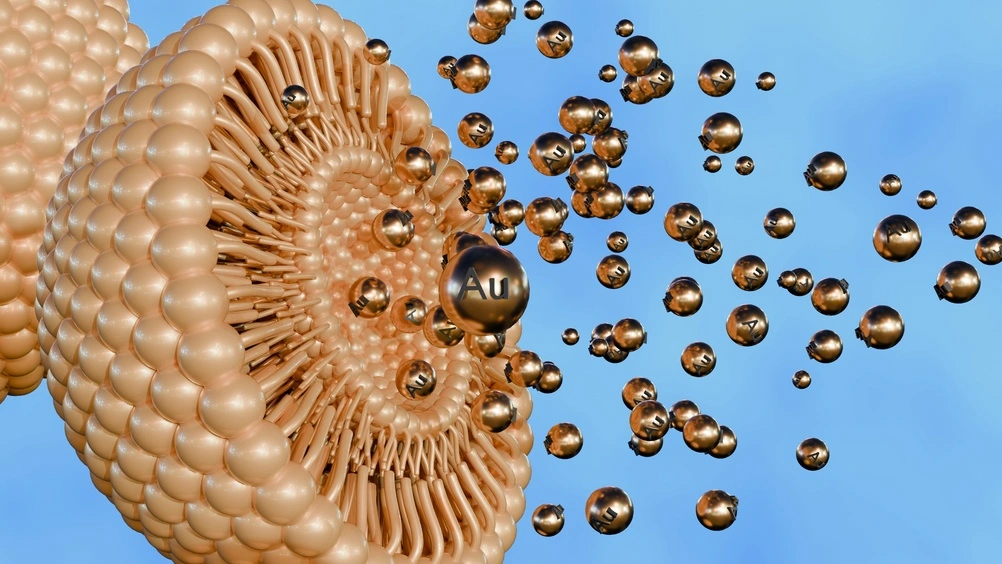
One approach is to use peptides. Peptides are short chains of amino acids, the same building blocks that make up proteins. Different peptides can help produce gold nanoparticles with different shapes, including spheres and triangles. In an ordinary solution, however, gold nanoparticles can begin forming at many different locations, making it difficult to give each particle the same environment in which to grow.
A research team led by Associate Professor Masayoshi Tanaka at Institute of Science Tokyo (Science Tokyo) therefore explored a different approach: confining the reaction within a very small space. The researchers wondered whether creating a more uniform environment for particle growth could lead to more uniform gold nanoparticles.
To do this, they used liposomes, tiny capsules surrounded by a double layer of lipids similar to a cell membrane. The team examined how gold nanoparticles formed and grew in these liposome-based reaction environment. As the experiments progressed, an unexpected pattern began to emerge.
Why this matters
The researchers used a peptide called B3, which helps drive the formation of gold nanoparticles and also influences their shape. In a conventional solution, B3 is known to produce both spherical particles and thin, triangular gold structures.
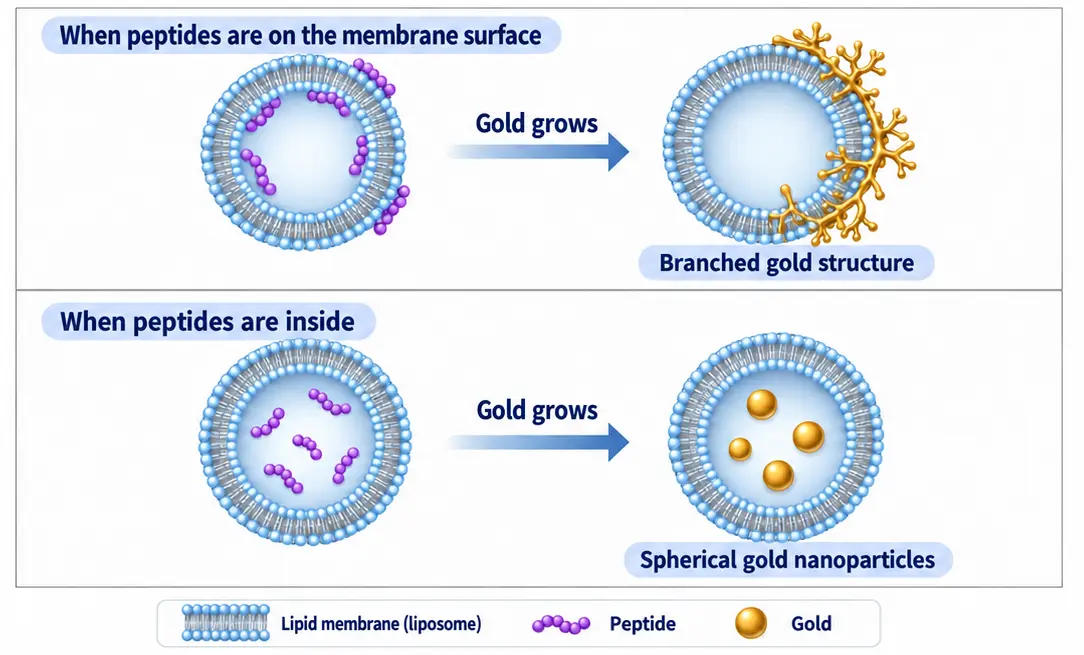
Inside liposomes, however, the outcome changed dramatically depending on where B3 was located. When B3 was positioned near the lipid membrane, gold grew into highly branched structures (Fig. 1, top). When the researchers changed the lipid composition so that B3 remained inside the liposome, spherical gold nanoparticles formed instead (Fig. 1, bottom).
In other words, the shape of the gold nanoparticles depended strongly on where the peptide was located inside the liposome.
Until now, the type of peptide used has been considered an important factor in determining nanoparticle shape. This study shows that location matters as well: even the same peptide can guide gold along a different growth pathway depending on where it is positioned.
The finding suggests a broader principle for nanoscale materials design. It may not be enough to decide what molecules to use; researchers may also be able to control material growth by designing where reactions take place.
What's next
The branched gold structures produced in this study are expected to have a large surface area, making them promising for applications such as catalysis and highly sensitive sensors that detect trace amounts of substances.
The spherical gold nanoparticles formed inside the liposomes, meanwhile, remain enclosed by a lipid membrane. This could make them useful for biomedical applications such as bioimaging, which allows researchers to visualize processes inside the body, and photothermal cancer therapy, in which light is converted into heat to damage cancer cells.
By refining the combination of peptides and lipid membranes and controlling where reactions occur, the researchers hope to develop new ways to design nanomaterials with shapes and functions tailored to specific applications.
Comment from the researcher
This study began with a simple idea: could we use the tiny space inside a liposome to produce more uniform gold nanoparticles? As the experiments progressed, however, we discovered something we had not expected-the location of the peptide itself had a major effect on the shape of the gold.
Research does not always lead to the result we first imagine. Sometimes, unexpected observations give rise to entirely new ways of thinking. We hope to build on the idea of controlling "where" reactions occur and apply it to the design of new materials.
(Masayoshi Tanaka, Associate Professor, School of Materials and Chemical Technology, Institute of Science Tokyo)

Dive deeper
Related research by Associate Professor Masayoshi Tanaka
Explore more research in Science for All
Science for All showcases cutting-edge research at Science Tokyo and highlights the ideas, people, and possibilities shaping the future.

Follow Science Tokyo research on X
Our Research Frontiers account features selected stories from Science for All and regularly shares research from across Science Tokyo.