
"Algaecide-Releasing Buoys for Sustained Harmful Algal Bloom Control" ACS ES&T Water
Algae blooms make a pond's surface shine in mesmerizing green hues. But if the microorganisms responsible are cyanobacteria, they can also release toxins that harm humans and wildlife alike. So, a team reporting in ACS ES&T Water has designed a "set it and forget it" system for distributing algaecide using specialized buoys tethered at the site of a bloom. In tests, the buoys removed nearly all cyanobacteria without the need for frequent reapplication.
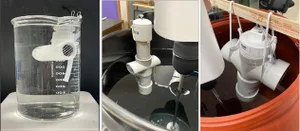
Adapted from ACS ES&T Water 2026, DOI: 10.1021/acsestwater.5c01257
Algae blooms occur when extra nutrients in the water - likely from fertilizer runoff - cause tiny microorganisms like algae and cyanobacteria to proliferate. In 2014, one such algae bloom in Lake Erie near Toledo, Ohio, rendered drinking water unsafe for hundreds of thousands of residents. And now, a team of researchers from the University of Toledo are looking to create an algaecide treatment system that puts a stop to a bloom before it has even started. The team, including Umberto Kober, Hanieh Barikbin, Youngwoo Seo, Yakov Lapitsky and colleagues, designed a system that releases algaecide steadily over a period of weeks or months, making it less expensive and more efficient than existing options that require frequent reapplication.
The team constructed small, medium, and large-sized buoys out of PVC pipes, forming either a "T" or cross shape. Hydrogel disks were inserted into the pipe openings to control the diffusion of the liquid algaecide into the surrounding water. The buoys were then filled with a commercial hydrogen peroxide-based algaecide, which, upon immersion, slowly diffused through the hydrogel disks. The buoys were also engineered so that once the algaecide was gone, the buoy fell to its side, visually indicating that a refill was needed.
To test their performance, the small, algaecide-loaded buoys were put in a beaker with 1 liter of cyanobacteria-containing water collected from Lake Erie and monitored for two weeks. Every day a small portion of water was replaced with new lake water to ensure the buoys were continually exposed to fresh cyanobacteria. This way, the team could evaluate whether the buoys provided sustained algicidal activity rather than killing the cyanobacteria early in the process. Researchers found that the cyanobacteria were almost entirely eliminated within a week, and other microbes remained largely unscathed. Researchers estimate that their buoys could reliably release algaecide for at least four consecutive release cycles, each lasting 35 days.
Though further research is needed, including enhancements to prevent microbe growth on the buoy's surface, the researchers say that this work overcomes challenges in sustained and targeted algaecide treatment.
"If successfully scaled up, this concept could enable early mitigation of harmful algal blooms without the need for labor-intensive repeated algaecide applications," says Lapitsky.
The authors acknowledge funding from the U.S. Army Corps of Engineers. The algaecide used in these experiments was provided by the SePRO Corporation, an algaecide manufacturer.
Authors Yakov Lapitsky, Umberto Kober and Youngwoo Seo have filed a patent application on this research.


