
Most biologists who study pathogenic microbes have focused on strains such as Escherichia coli or Staphylococcus aureus, which are not only important for human health, but also relatively easy to grow in the lab.
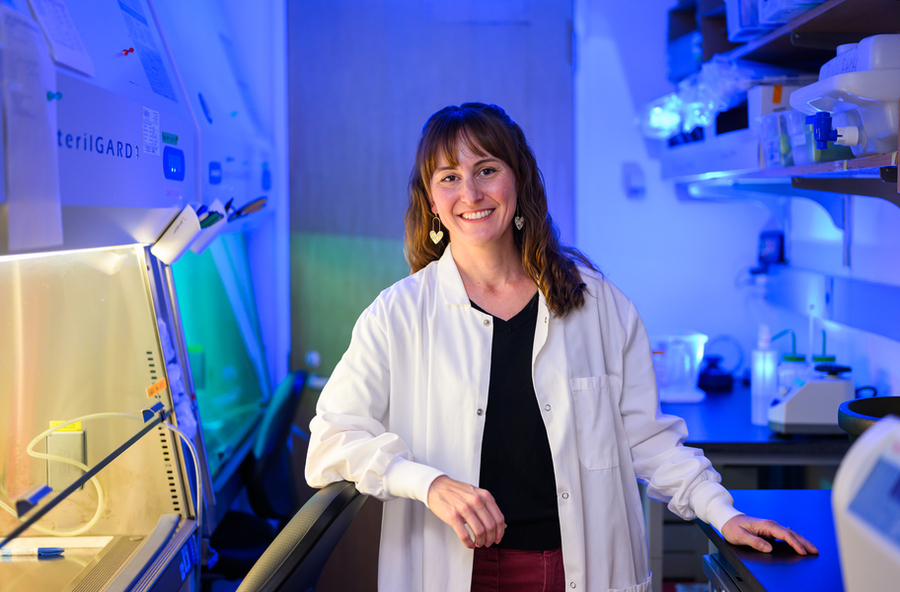
Rebecca Lamason, an MIT associate professor of biology, wants to take a more expansive approach that includes bacteria that are more challenging to study. Tackling those microbes, she says, can help scientists learn more about the huge diversity of strategies that pathogens have evolved to interact with their hosts.
In her lab, she has devised new tools for analyzing pathogens such as Rickettsia parkeri, a tickborne bacterium that causes a mild form of spotted fever. She also studies Listeria monocytogenes, a microbe commonly linked to foodborne illnesses.
From studying these microbes, she hopes to learn more about the many strategies that pathogens have devised to take over host cell machinery, which also offers insight into the fundamental functions performed by those host cells.
"We cannot learn everything from a single type of bacterium or a single type of cell," Lamason says. "There's a rich diversity of biological mechanisms that are out there, and I think we have just barely scratched the surface on that."
In just one recent example, her lab found that R. parkeri can form very tight connections with a cell structure called the endoplasmic reticulum (ER), which mimics some of the interactions that the host cell's own organelles have with the ER. They're still puzzling out the reason for this interaction, which hasn't been seen with other microbes.
"It's one of those things too where we had gone into the microscope room to look at something else to ask a different question, and we discovered this other unexpected interaction," Lamason says. "This has been a really fun experience, and it's also very common when you're doing cell biology experiments: you see some phenomenon that you didn't expect."
How systems interact
As a high school student, Lamason was drawn to cell biology and physiology, and she decided she wanted to pursue a PhD even before she knew exactly what that career path would look like.
"I didn't have anybody in my family that had a PhD or worked in science, and so I didn't really know what it took or what it was to get a PhD, but for some reason I wanted to do it," she says.
Her father was in the military, so her family moved quite a bit, mainly between Florida, California, and Virginia, before settling in Pennsylvania. After graduating from high school, where she was the editor-in-chief of the school newspaper, Lamason spent two years at a local community college before transferring to Millersville University to finish her bachelor's degree.
At Millersville, she majored in molecular biology and biotechnology and worked in a lab studying chlorella viruses, which infect algae.
"We were characterizing different variants that we could isolate from a pond that was next to the building, so we were looking at very simple questions, but that experience allowed me to see what it was like to ask questions, what it was like to work regularly in a lab," she recalls.
Previous item Next item
To gain more experience before applying to graduate school, she worked as a research technician at Hershey Medical Center for a couple of years, in a lab studying zebrafish as a model to understand the genetics of cancer.
As a PhD student at Johns Hopkins School of Medicine, where she studied immunology, Lamason realized that what she liked most about biology was studying how different biological systems interact with each together.
"The immune system was an interesting way to get that, because there were all these moving parts, all these cells that had to talk to each other to mount an effective immune response," she says. "Studying immunology helped me realize what I liked more and more was cell biology. How does the cell, a really complex environment, respond to these external signals and commit to a program or a response that then supports some kind of function?"
For her postdoc, she chose a lab where she could look at those questions through the lens of host-pathogen relationships, at the University of California at Berkeley.
"What really excited me about pathogens is that they are these wonderful little cell biologists, who often have to navigate the complex environment of the host cell and have evolved unexpected ways to solve problems," she says. "If they have to get through a barrier, or they have to tell the cell not to die or they have to turn off a response, they have evolved distinct ways to do this."
Working with Matthew Welch, a cell biologist at Berkeley, she began studying the two organisms that are now the focus of her current research: R. parkeri and L. monocytogenes.
R. parkeri, similar to viruses, cannot survive outside of a host cell and is fully dependent on the host cell machinery to replicate itself. L. monocytogenes, on the other hand, can survive and replicate on its own.
"These constraints shape the biology and the types of interactions that these organisms can use to cause infection," Lamason says. "That's what really got me interested in these two very different bacteria and in studying the different cellular and bacterial factors that drive a specific outcome."
Solving technical challenges
In her lab at MIT, which she started in 2017, Lamason has identified many of the host proteins and other factors that help those two species of bacteria perform functions such as moving between infected cells, which they each do in different ways. In order to do much of this work, Lamason and her students, postdocs, and technicians have had to develop new techniques for studying these microbes.
Until recently, there was no way to target specific genes in R. parkeri cells, but using CRISPR, Lamason's lab developed the first technique for doing so, in 2024. That has made it easier for them to delve into the roles of specific genes of interest. They also developed ways to label bacterial proteins that are secreted into the host cell, making it much easier to pick them out from the cells' own proteins.
"My lab recognizes the technical challenges that face our field, and so sometimes we're building things to solve problems and sometimes we're just chasing down really interesting observations and trying to understand how it works," Lamason says.
Previous item Next item
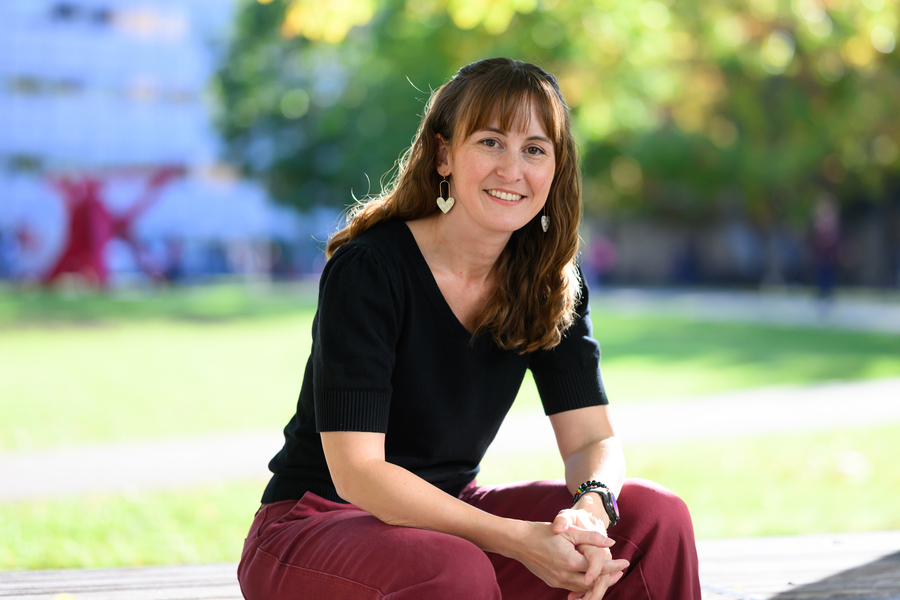
When looking for faculty jobs, Lamason was drawn to MIT by the sense of collaboration she found. When members of her lab need to learn a new technique, or explore the workings of a cell organelle the lab hasn't studied before, they can find help from one of the many other MIT labs that have expertise in different aspects of biology.
"That's been the key to our success - not only attempting and having these riskier ideas, but having the support of the community to help us think about how do we execute on those," she says. "There's this wonderful community of scientists to help you think through and complete the kind of work that you want to do and also to push you to think bigger about how to approach a problem."
When she's not puzzling out biology problems, Lamason likes to take to the ice as part of a women's hockey league in Boston. She took up the sport as a beginner a few years ago, in part as a way to take her mind off the everyday stresses of academia.
"It's a good challenge, and a good way to get out of the lab and the office and give you something else to think about. If my grant got rejected, if I was having a bad day at work, it was a good way to shut my brain off for a little bit and focus on staying upright," she says.


