Key takeaways
- According to the latest research from the Center for Scholars & Storytellers at UCLA, franchises receiving "above-average" ratings from adolescents on on-screen representations of people of color, women, or LGBTQ+ individuals made $175.5 million dollars more than franchises with representations rated only "average" in authenticity.
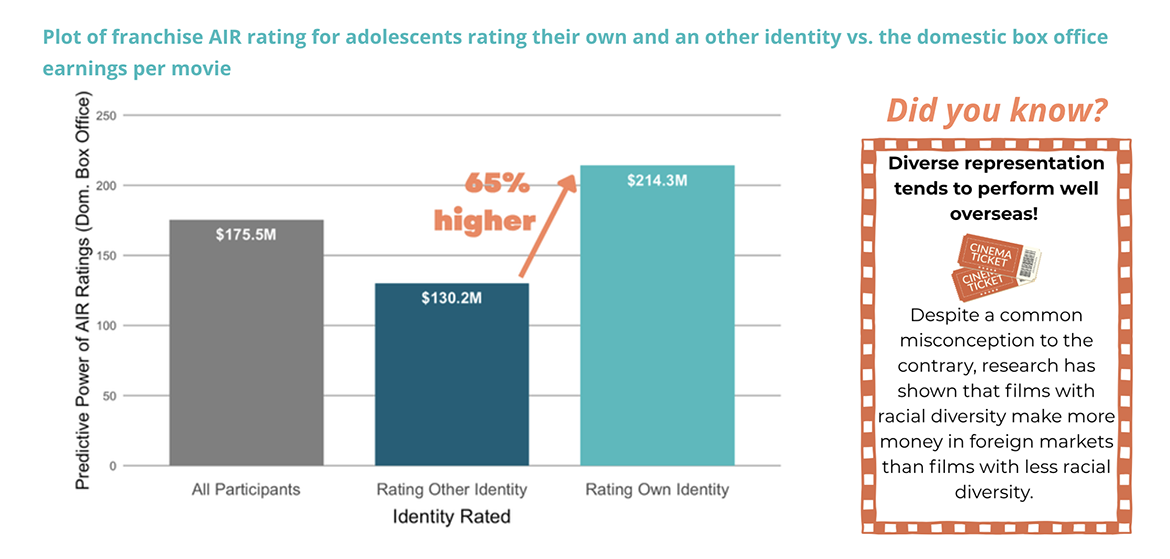
- Adolescents, defined in this study as aged 13-24, rating the quality of representation of their own identity predicted box office success 65% better than adolescents rating identities not their own.
- Diving deeper into what adolescents look for in representation, film franchises that lacked cultural representation or included minimal or unrelatable roles for diverse characters led to poorer performance at the box office.
When a movie franchise features inclusive representation that adolescents see as authentic, the film does better at the box office, according to a new report from the Center for Scholars & Storytellers (CSS) at UCLA.
The new report, "Real Recognizes Real: Adolescents on Authentic Inclusive Representation in Franchises," shows that young audiences want to see authentic representation on the big screen and are sophisticated judges of it. Their evaluations predicted franchise success, suggesting that studios looking to reduce risk and better connect with audiences should not only consult experts but also look directly to adolescents' views.
For the study, CSS partnered with global insights and strategy firm NRG (National Research Group) to survey 23,284 young people, aged 13 to 24, defined in this report as "adolescents," about 29 popular film franchises, including "Avatar" and the "Spider-verse." CSS also engaged two adolescent researchers in the study's execution and report authorship to ensure that adolescent perspectives were also included in our interpretation of survey data
CSS researchers also found that the more positively adolescents rated the representation of people of color, women, or LGBTQ+ individuals, the greater the franchise's box-office success. The difference in average box office earnings per movie between a franchise that adolescents said represented a diverse identity in an "average" way (3 out of 5) and one that represented it "somewhat well" (4 out of 5) was $175.5 million.
"Young people know when representation feels real, and they respond to it," said Yalda T. Uhls, adjunct professor of psychology at UCLA and founder and CEO of CSS. "They are looking for characters who feel culturally grounded, emotionally real and are meaningfully woven into the story."
Franchises remain the financial engine of the film industry, and young audiences are central to their success. At a time when studios are looking for ways to reduce risk and create stories that resonate across audiences, the takeaway is clear. "When the industry listens to adolescents, everyone benefits," says Uhls.
The findings revealed another instructive insight: Ratings from adolescents who shared the identity they were rating predicted box office success 65% better than adolescents rating identities they did not share. The difference in average box office earnings per movie between a franchise that adolescents with lived experience said represented their own identity in an "average" way (3 out of 5) and one that represented it "somewhat well" (4 out of 5) was stark, with the latter earning $214.3 million more.
"Young people, even young teens, are genuinely experts in authentic representation of their own identities through their lived experience. They know what 'real' looks like and they flag inauthenticity intuitively," said Matt Puretz, a senior researcher at CSS and lead author of the study. "Their perspectives offer insights that even expert consultants or adults with lived experience can't replicate, and as the numbers show, studios should pay attention."
Young people associate key characteristics with authentic representation
To better understand what drives adolescents' ratings, CSS examined flaws that young people most associated with poor representation. Three issues consistently stood out: a lack of cultural grounding, minimal roles for diverse characters and characters who didn't feel relatable.
The takeaways, according to the researchers, are for movies to center real, culturally-embedded relationships. When diverse characters have meaningful bonds with one another that bring out their identities, it lays the groundwork for representation that adolescents consider authentic. Authentic representation drives stronger connections to the franchise, and that connection drives success.
"Many adults underestimate how clearly young people see and evaluate the world around them, including the media they consume," said Alisha Hines, vice president of research and programs at CSS. "Our findings continue to make clear that adolescents have real expertise, and that our own biases can keep us from listening to the insight and wisdom they have to offer."
Among the report's key recommendations for studios and creators:
- Consult young people during production and screen testing, especially youth with lived experience of the diverse identities portrayed in the film.
- Be wary of the three fatal flaws. During writing and production, ask whether the representation in your film includes genuine cultural grounding, whether diverse characters have meaningful roles and whether audiences have the chance to relate to the specificity of those characters.
- Don't be afraid to make relationships the center of the story; they can add dimension and relatability to diverse representation.
The report — the latest in a series on Authentically Inclusive Representation (AIR) — was supported by the Funders for Adolescent Science Translation (FAST).