
Professor Tim Vlandas , Professor of Comparative Political Economy and Social Policy in the Department of Social Policy and Intervention, argues that the government's overhaul of the triple lock misses the bigger problem: by still protecting pensioners when growth stalls, it leaves governments with little electoral reason to pursue growth.


On 29 September the Prime Minister announced one of the biggest changes to the state pension since the triple lock was introduced in 2011. From April 2030 the pension will still rise each year by inflation or 2.5 per cent, whichever is higher, but it will no longer ratchet permanently ahead of average earnings .
The government expects to save £15 billion a year by the late 2030s and £50 billion by 2050. This money is earmarked for a National Care Service. With a Budget due on 28 October , and the second Pensions Commission reporting in full next spring, the argument is far from over.
The existing triple lock stays in place until April 2030. The full flat-rate pension is forecast to rise by £488 next April to just over £13,000 a year , taking it above the income tax personal allowance, though the government has promised to exempt those with no other income. With over 13 million people now drawing it, the state pension costs £154 billion a year, of which £131 billion goes on the triple-locked parts.
So far the debate has been almost entirely about cost. But it gets two things wrong on cost, and it misses a third issue that matters more than cost. First, the British state pension is not generous by comparative standards. Second, its rising cost is not only driven by the triple lock, although it has certainly increased pension generosity over time. Third, the reform risks making the political problem with the triple lock even worse.
Britain's state pension is less generous than most of Europe's
On the first point, the comparative evidence is clear. Even when counting workplace pensions, the OECD calculates that an average earner retiring here can expect a net replacement rate of 54 per cent of previous earnings from mandatory provision, against an OECD average of 63. Of eighteen western European countries, only Ireland, Switzerland, Germany and Iceland do worse; France reaches 70 per cent, Italy 79, Spain 86. Excluding the workplace pension, the state pension alone replaces 22 per cent of an average earner's income, against an OECD average of 43 per cent for public schemes.
On public pensions, we also spend less than many OECD countries, at 7.1 per cent of GDP against an OECD average of 8.1. Instead, Britain relies on private saving, which it subsidises through the tax system (Panel A of Figure 1). Once private pensions in payment are included, total benefit spending reaches 10 per cent of GDP, a little above the OECD average of 9.4. Panel B of Figure 1 shows that Britain is below the middle on both tax and pension spending in western Europe.
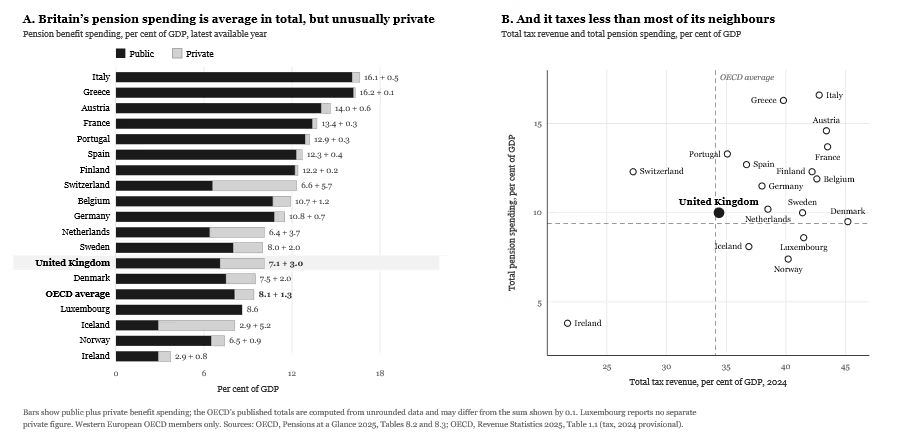
Figure 1. Pension spending and tax revenue in western Europe, per cent of GDP. Sources and notes are shown in the figure.
"So far the debate has been almost entirely about cost. But it gets two things wrong on cost, and it misses a third issue that matters more than cost. First, the British state pension is not generous by comparative standards. Second, its rising cost is not only driven by the triple lock, although it has certainly increased pension generosity over time. Third, the reform risks making the political problem with the triple lock even worse."
The triple lock explains only part of the rising cost
On the second point, the cost is indeed rising, and the triple lock contributes to it. State pension spending is £154 billion this year, £47 billion higher in real terms than in 2010, and that is despite a sharply rising pension age over the same period. Out of that total increase, the Institute for Fiscal Studies attributes £16 billion to the triple lock.
Had the new formula applied since 2011, the IFS calculates that spending this year would be £9 billion lower, which more than halves the cost of the old triple lock. Even then, the same analysis notes, the pension would still have risen 6 per cent in real terms since 2010.
Moreover, the pattern is not peculiar to Britain. Between 2000 and the early 2020s, public pension spending across the OECD rose from 6.7 to 8.1 per cent of GDP. The OECD estimates that demographic change alone would have pushed it up by 2.5 points, and that higher employment pulled it back down by 1.1. Demography therefore accounts for a lot of the increase in spending on pensions.
Next, what the reform will save is as uncertain as what the old lock would have cost. The IFS put the bill for keeping it to 2050 at around £20 billion a year , while stating that the true figure "could reasonably be anywhere between £5 billion and £40 billion per year", depending on how volatile inflation and earnings turn out to be. On the savings, they are equally cautious: "it is hard to know how much this reform will save the Exchequer; savings are likely to be relatively small in the first few years, but rise substantially over time."
The IFS is also pessimistic about whether the savings will suffice to fund social care: "We should not expect this reform to save enough that it could fund universal social care in the next parliament." Funding social care will likely require further savings or more taxes.
In 2024, UK tax revenue was 34.4 per cent of GDP, against an OECD average of 34.1, which ranks Britain 22nd of the 38 OECD countries. Fifteen of the seventeen western European members tax more , several of them far more: Denmark 45.2 per cent, France 43.5, Italy 42.8, Belgium 42.6. Only Switzerland and Ireland tax less.
The reform keeps pensioners insulated from economic stagnation
This brings me to my third point, which has been largely missing from this debate: the main issue with the triple lock is how it insulates a large and growing group of voters from the negative effects of economic stagnation. As I argue in a recent article on the electoral politics of economic stagnation, governments need growth to cope with the consequences of ageing. But older voters, who increasingly decide elections, are insulated from economic stagnation, so governments have less electoral incentive to pursue growth.
Because the state pension is indexed to the highest of prices, earnings or 2.5 per cent, it has kept rising through nearly two decades of weak growth. Real wages barely grew between 2008 and 2024, but pensions continued to rise. This, I argue, is why successive governments could neglect economic growth.
The proposed reform makes this political problem worse. Today, when earnings grow faster than prices and faster than 2.5 per cent, pensioners receive the earnings rate. From 2030, pensioners will still be protected when growth stalls, but will no longer receive the full earnings rate when it recovers.
"Governments need growth to cope with the consequences of ageing. But older voters, who increasingly decide elections, are insulated from economic stagnation, so governments have less incentive to pursue growth."
The new formula keeps the automatic increases that cause the political problem. Pensions should instead rise with earnings alone, with no guaranteed increase for inflation and no 2.5 per cent minimum. Older voters would then have a direct stake in economic growth, and would share in it when it came. This would give governments a stronger electoral incentive to raise output.


