
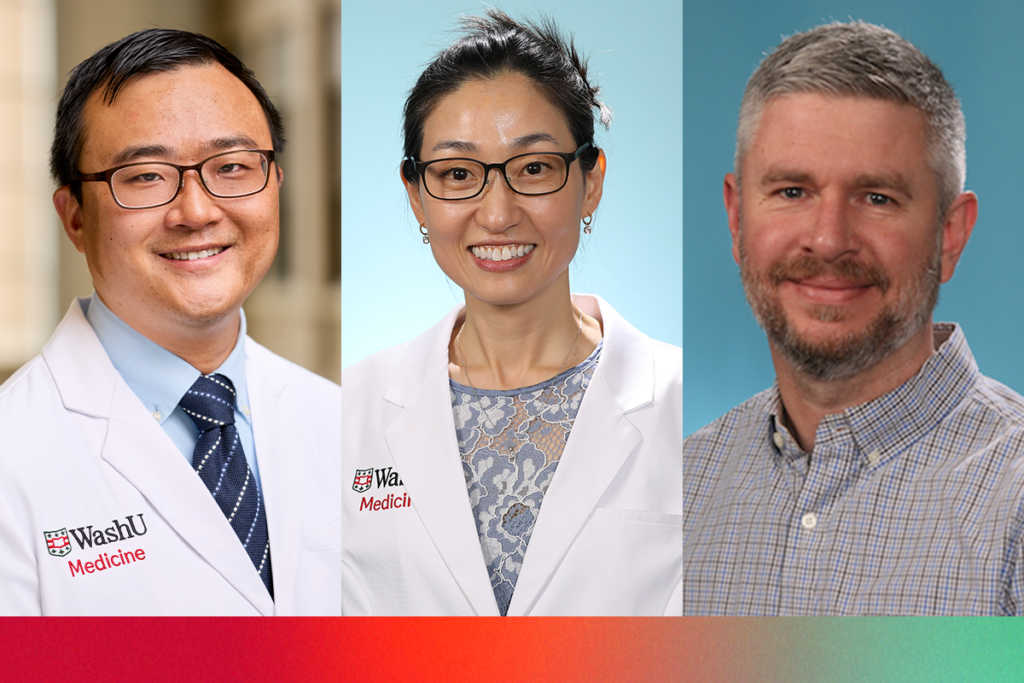
Three researchers at WashU Medicine have been honored with a National Institutes of Health (NIH) Replication Prize, an award that recognizes and rewards progress in making biomedical research more transparent, reliable and reproducible.
Aaron Y. Lee, MD, the Arthur W. Stickle Distinguished Professor and head of the John F. Hardesty, MD Department of Ophthalmology & Visual Sciences at WashU Medicine, and Cecilia S. Lee, MD, the Jane Hardesty Poole Distinguished Professor of ophthalmology and visual sciences at WashU Medicine - along with their collaborators Nayoon Gim, an MD/PhD student at the University of Washington, and In Gim, a computer science PhD student at Yale University - received a Track 2 (Replication Exemplar) $50,000 prize for developing a framework to improve the speed and reproducibility of electronic health record (EHR)-based research, a form of clinical research that looks for patterns in patients' electronic medical records to better understand diseases, treatments and health outcomes.
The team developed LATCH (Large Language Model-Assisted Testing of Clinical Hypotheses), a system that uses clinical questions written in plain language to generate fully auditable analyses using electronic health record data, such as diagnoses, medications and lab results. By using artificial intelligence to organize hypotheses and built-in workflows that can be independently verified, LATCH provides a scalable model for strengthening consistency and reproducibility in real-world data research. Using diabetes as a test case, the researchers replicated findings from 20 published studies in three to 15 minutes per study. They conducted more than 100 tests to reproduce findings from past studies and identify potential new patterns in the data.
A Track 1 (Replication Ideas) $5,000 prize went to WashU Medicine researcher Scott A. Handley, PhD, a professor of pathology and immunology, for identifying a high-impact area of research that is in critical need of replication studies. Handley identified that a landmark 1,800-citation pediatric Crohn's disease microbiome study documented five types of treatments administered including antibiotics, biologics, steroids, immunosuppressants and mesalamine without testing their effects, representing a critical gap in understanding how therapies reshape the gut microbiome.


