
A study in PLOS Biology of 133 species of flies, mosquitoes and their relatives show that most species fly in surprisingly similar ways. Physical and aerodynamic laws shape the evolution of their flight behaviour more strongly than previously thought. Mosquitoes prove to be a striking exception.
Flies, mosquitoes and their relatives belong to one of the most evolutionarily successful groups of animals on Earth. This group, known as the Diptera, comprises around 15% of all described animal species. Scientists suspect that many more species remain undiscovered. This extraordinary success is largely due to their ability to fly, powered by one of the most demanding motor systems in nature.
Searching for patterns in insect flight
To better understand how dipterans fly, the researchers carried out the first large-scale comparative analysis of flight behaviour across this group. Body and wing characteristics were mapped for 133 species. In addition, detailed flight measurements and aerodynamic analyses were conducted for 46 species.
"Much research on insect flight focuses on a single species at a time," says Florian Muijres, Professor of Experimental Zoology at Wageningen University. "It is like shining a torch into a dark room: you only see a small part of the whole picture. By comparing dozens of species, we were able to turn on the light and for the first time see the full picture, thereby identifying patterns that apply across the entire group."
The comparison revealed a striking result: in most dipterans, wing movements and flight aerodynamics are surprisingly similar. The physical constraints of flapping flight force evolution into a narrow range of optimal solutions. Despite the enormous diversity in ecology and body form, most dipterans share the same aerodynamic blueprint.
Carlos Faulquier
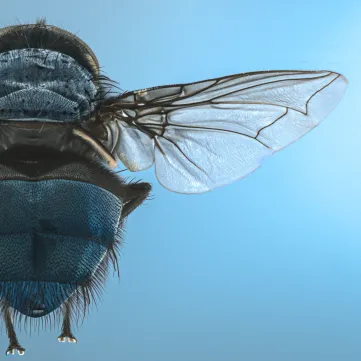
High-resolution stacked image of the blowfly wing and thorax. The translucent wing attaches via an intricate hinge system to the muscular thorax that powers rapid wingbeats.
Mosquitoes are the exception
One important exception breaks this rule: mosquitoes. These insects beat their wings at extremely high frequencies - up to 1,000 times per second - resulting in highly inefficient flight: around three times less efficient than that of fruit flies of comparable size.
"Many mosquitoes mate in dense swarms in the air, where their characteristic buzzing sound plays an important role," says researcher Ilam Bharathi. "Our results indicate that their wingbeats are adapted not only for aerodynamic performance, but also for acoustic communication. In that sense, a mosquito's flight resembles an insect version of a peacock's tail: energetically costly, but important for finding a mate."
Carlos Faulquier
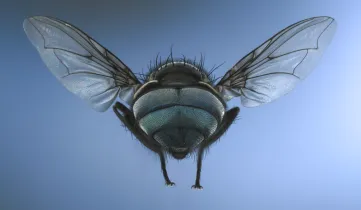
Posterior view of a blowfly captured with high-resolution stacked imaging. The paired wings extend from the large thorax that houses the flight motor powering rapid wingbeats.
The physics behind evolution
These findings help explain how physical constraints and evolutionary pressures shape animal flight. In addition, the efficient flight strategies observed in many flies may inspire future drones. A better understanding of the acoustic biology of
mosquitoes may also provide new leads for research into the control of disease-transmitting species. Sound plays an important role in finding a mate, meaning that disrupting these signals could offer new ways of disrupting their reproduction.
Read the full publication: Dipteran flight diversity is shaped by aerodynamic constraints, scaling, and evolutionary trade-offs


