
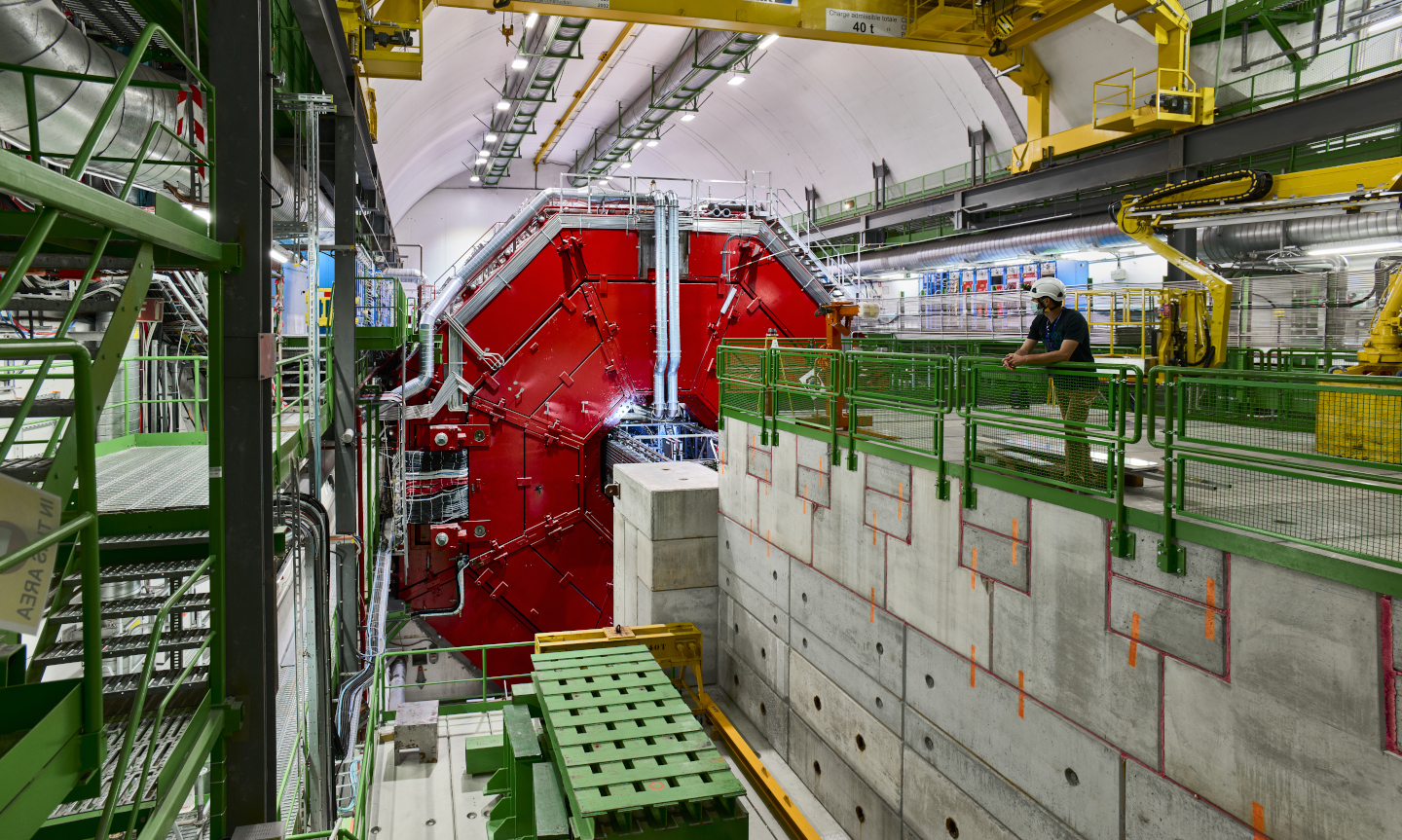
View of the detector in the ALICE cavern with its large magnet doors closed. (Image: CERN)
In the first few microseconds after the Big Bang, the Universe was in an extremely hot and dense state of matter known as quark-gluon plasma (QGP), which can be reproduced with high-energy collisions between heavy ions such as lead nuclei. In a paper published today in Nature Communications, the ALICE Collaboration reports observing a remarkable common pattern in proton-proton, proton-lead and lead-lead collisions at the Large Hadron Collider (LHC), shedding new light on possible QGP formation and evolution in small collision systems.
Physicists initially believed that colliding small systems, such as protons, could not generate the extreme temperatures and pressures needed to form QGP. But in recent years, signatures of QGP have been observed in proton-proton and proton-lead collisions at the LHC, indicating that the size of the collision system may not be a limiting factor in QGP creation.
A key signature of QGP formation is anisotropic flow, where the particles produced in a collision are not emitted evenly but in preferred directions. For particles moving at intermediate speeds (or momenta), this anisotropic flow depends on the number of quarks they contain: particles that are made up of three quarks (baryons) exhibit stronger flow than those that are composed of two quarks (mesons). The leading explanation for this difference is something called quark coalescence - the process through which the quarks in the QGP combine into larger particles. And as baryons contain one more quark than mesons, they inherit more flow.
In its new study, the ALICE Collaboration measured the anisotropic flow of multiple meson and baryon species produced in proton-proton and proton-lead collisions, by carefully isolating the particles that were genuinely flowing together. The analysis showed that, like in heavy-ion collisions, the anisotropic flow was much stronger for baryons than for mesons at intermediate momenta.
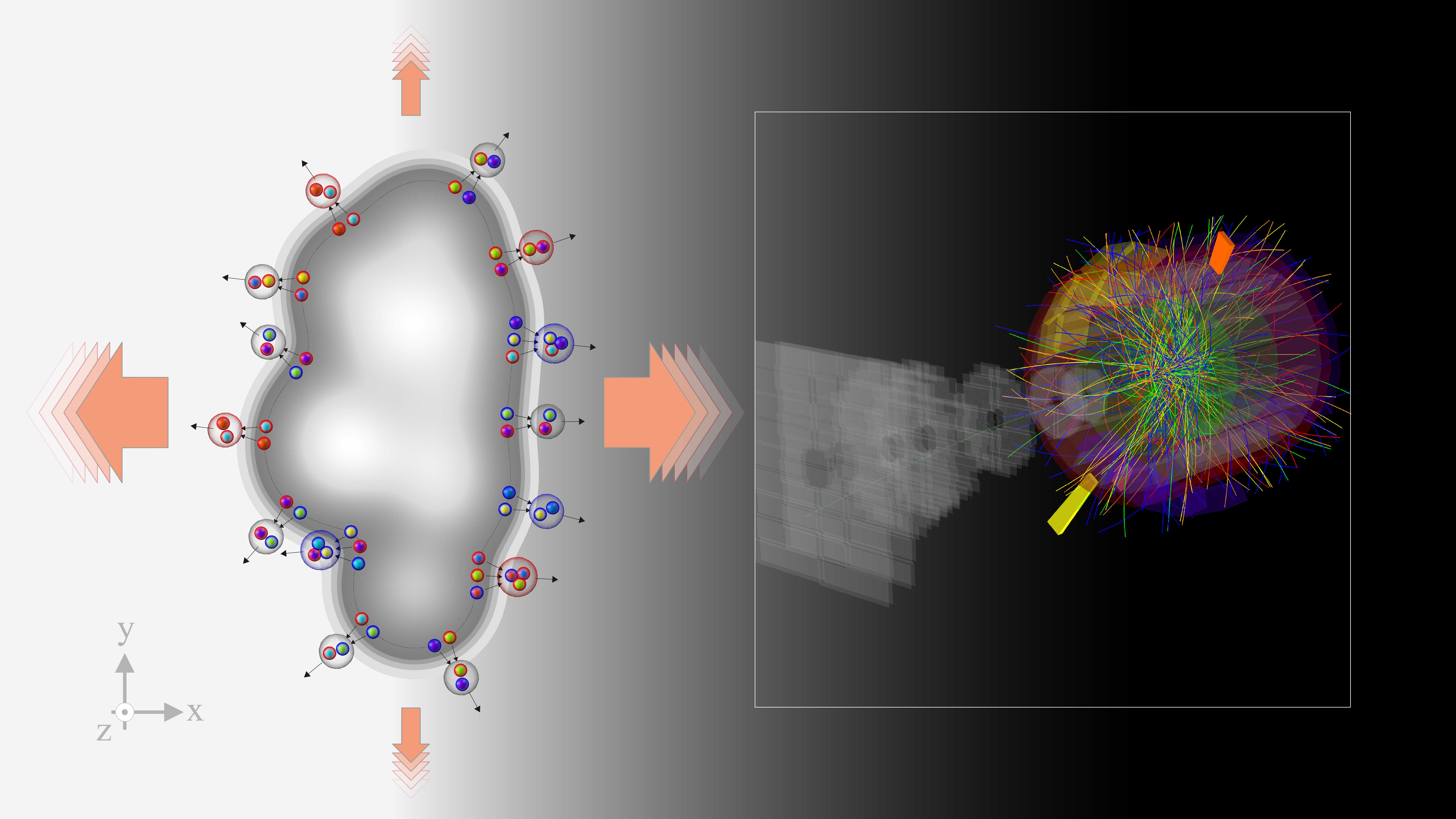
"This is the first time we have observed, for a large interval in momentum and for multiple species, this flow pattern in a subset of proton collisions in which an unusually large number of particles are produced," says David Dobrigkeit Chinellato, Physics Coordinator of the ALICE experiment. "Our results support the hypothesis that an expanding system of quarks is present even when the size of the collision system is small."
The ALICE researchers went on to compare the new flow measurements to predictions from simulations that assume QGP formation and its evolution. They found that models that incorporate the anisotropic flow of quarks and their subsequent coalescence into mesons and baryons successfully explain the observed flow pattern, whereas models that exclude either process fail to capture it. However, even the successful models are not exactly right. There are still discrepancies between the models and data that are largely linked to uncertainties in the modelling of the proton's substructure and the initial geometry of the collisions.
"We expect that, with the oxygen collisions that were recorded in 2025, which bridge the gap between proton collisions and lead collisions, we will gain new insights into the nature and evolution of the QGP across different collision systems," said Kai Schweda, ALICE Spokesperson.


