
A multidisciplinary study has uncovered a critical component in the formation of biofilms, the complex structures used by bacteria to colonise surfaces. The research may have implications for future infection treatments including for people with cystic fibrosis.
Researchers in the group of Professor Jacob Malone at the John Innes Centre investigated the opportunistic human pathogen Pseudomonas aeruginosa using molecular and biochemical techniques alongside microscopy and proteomics.
Biofilms produced by this bacterium are associated with chronic infections, including lung infections in cystic fibrosis patients. They are also a key factor in increased antibiotic resistance and bacterial infection persistence.
Despite the major health challenges associated with biofilms, many proteins that are differentially expressed under biofilm conditions remain uncharacterised leaving substantial gaps in our understanding of this complex bacterial lifestyle.
This study, in collaboration with the University of Warwick, used infected pig lung tissues in an experimental model that mimics cystic fibrosis infections, alongside a synthetic chronic wound model.
Through these innovative approaches, the team identified a novel biofilm regulatory protein called Biofilm Architecture Regulator (BatR) and showed how it interacts with the stress response enzyme SrkA as part of a molecular signalling network.
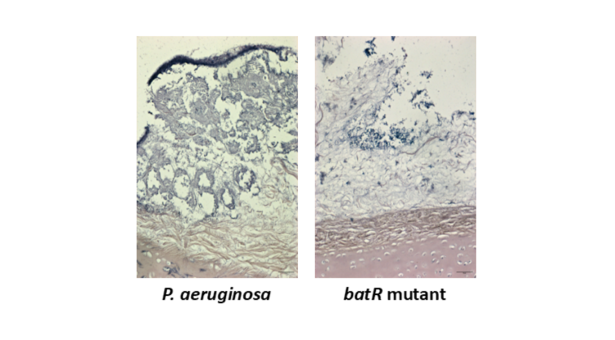
Experiments, comparing standard P. aeruginosa populations with mutants in which the network was disrupted, showed that BatR markedly enhanced biofilm viability when exposed to low dose-concentrations of antibiotics.
Taken together, the study showed that the previously unknown BatR/SrkA network plays a significant role in biofilm architecture and the response of Pseudomonas aeruginosa infection to challenge by antibiotics.
The team will now focus on identifying further elements of the BatR/SrkA pathway as a step towards clinical trials.
Corresponding author of the study Professor Jacob Malone, a group leader at the John Innes Centre, said: "Our study has implications for our understanding of biofilm architecture, maintenance and stability, presenting potential new targets for anti-infective treatments of the future.
"The surprising element of this research is that BatR is a small protein that doesn't resemble anything obvious. Nonetheless, disrupting it has severe effects on biofilm stability and robustness."
Experimental work and data analysis for this study was led by first, and co-corresponding author Dr Ainelen Piazza at the John Innes Centre, while Dr Freya Harrison (Warwick University) led on clinical modelling.
The John Innes Centre proteomics platform supported the work with quantitative proteomics and co-immunoprecipitation analysis.
A Novel Stress Response Pathway Mediates Biofilm Architecture in Pseudomonas aeruginosa appears in PLOS Pathogens.
Caption main images – BatR contributes to biofilm architecture (purple) on pig lung tissue (pink). Images are shown here for stained tissues treated with Ciprofloxacin. Pseudomonas aeruginosa biofilm forms a sponge-like structure covered by a thick layer of matrix. Both structures are disrupted in the batR mutant biofilm.
Images produced by Dr Ainelen Piazza


