
(SACRAMENTO)
A new study demonstrates that a person with severe paralysis caused by amyotrophic lateral sclerosis (ALS) can use a brain-computer interface (BCI) at home to communicate, work and interact with the digital world — without the need for researcher support. Published today in Nature Medicine, its results mark a significant step toward delivering practical, assistive technology for people with severe speech and motor impairments.
The BCI system was developed at UC Davis, in collaboration with colleagues at Brown University and Mass General Brigham Neuroscience Institute. It is equipped with advanced decoding algorithms that translate neural signals into text (speech BCI) and enable cursor control (movement BCI). It allows for full interaction with a personal computer.

The brain-computer interface is designed to restore communication and computer control by decoding neural activity linked to attempted speech and movement. Although recent advances have achieved high accuracy in research settings, real-world adoption has been limited by two key challenges: independent at-home use and reliable long-term performance.
The new BCI system overcomes both barriers. The study shows that it can now support rich, independent digital and in-person communication in real-world settings.
"For years, BCIs have been proof-of-concept devices that lived in highly controlled research labs. This work shows that we may have crossed a threshold, by empowering a person with paralysis to speak on his own terms," said UC Davis neurosurgeon David Brandman. Brandman is the co-principal investigator and co-senior author of this study. He is an associate professor in the UC Davis Department of Neurological Surgery and co-director of the UC Davis Neuroprosthetics Lab.
Casey can use the system to communicate his own thoughts, not only while we're there in a controlled environment, but whenever he wants. Sometimes, he would do that over 12 straight hours."-Nicholas Card, postdoctoral scholar, UC Davis Neuroprosthetics Lab

The BCI system allowing independent and accurate communication
Casey Harrell, a 47-year-old man with ALS, is a participant in the BrainGate2 clinical trial. He has weakness in his arms and legs (tetraparesis), and his speech is very hard to understand (dysarthria).
In 2023, Brandman implanted the investigational BCI device into Harell's left precentral gyrus, a brain region responsible for coordinating speech. He placed four microelectrode arrays that are designed to record brain activity from 256 cortical electrodes.
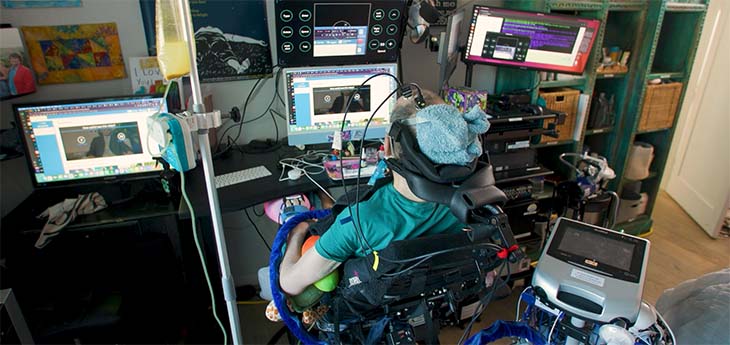
Over nearly two years, Harrell used the BCI system in his home for more than 3,800 hours. He operated it independently on a near-daily basis. During that time, Harrell communicated more than 183,000 sentences and close to 2 million words. His average communication speed was 56 words per minute, a remarkable increase over time since he started using the system.
"It is a life that is more full of dynamic action and with friends and family, with colleagues, and it is something that allows me to communicate more in my natural way of communicating than any other technology that I have experienced," Harrell shared through the BCI system.
The study also showed that Harrell rated 92% of the sentences as accurate or mostly correct. The system scored over 99% word accuracy in controlled testing with a 125,000-word vocabulary.
"In our previous study, we showed 97% accurate word decoding. But Harrell could only use the neuroprosthesis when someone from our research team was there to set it up. Now we've made improvements that bring this medical technology closer to clinical usefulness: He can use it at home without researcher support. It's even more accurate (99%), keeping up as he attempts to speak faster, and has been working very well for almost two years," explained the study's co-senior author, neuroscientist Sergey Stavisky. Stavisky is an assistant professor in the Department of Neurological Surgery. He is the co-director of the UC Davis Neuroprosthetics Lab and co-principal investigator of the study.
Using the BCI, Harrell is able to send emails and messages, browse the internet and maintain ongoing communication with family and friends. By combining speech decoding for text input and cursor control for navigation, he independently operates his computer — supporting employment despite paralysis.
"Casey can use the system to communicate his own thoughts, not only while we're there in a controlled environment, but whenever he wants. Sometimes, he would do that over 12 straight hours," said the study's lead author, Nicholas Card. Card is a postdoctoral scholar in the UC Davis Department of Neurological Surgery. "The system worked well, was reliable and stable, and delivered consistent results. This is one of the strongest demonstrations that BCIs can be practical and useful."
For years, BCIs have been proof-of-concept devices that lived in highly controlled research labs. This work shows that we may have crossed a threshold, by empowering a person with paralysis to speak on his own terms."-David Brandman, neurosurgeon and co-director of the UC Davis Neuroprosthetics Lab

Transformative BCI technologies
The findings highlight the potential of intracortical BCIs as transformative assistive tools for individuals with severe motor impairments, including ALS. By enabling naturalistic communication and full digital access, such systems may significantly improve independence and quality of life.
"It is very sweet to have the ability to look at my wife's eyes when she hears my voice and conjures up a sweet memory and to explain to my daughter who does not really remember anything about when I was still talking to them and remind them of what I used to sound like," Harrell shared.
Harrell's experience will also benefit future users of the system.
"In addition to testing a way to restore communication, this clinical trial is producing a wealth of unique data that we're studying to better understand how the human brain produces speech," Stavisky said. "As far as we know, these 3800 hours of brain recording as Casey used the system is by far the largest individual brain recording dataset with single neuron resolution. This will help us develop even better therapies."
In addition to testing a way to restore communication, this clinical trial is producing a wealth of unique data that we're studying to better understand how the human brain produces speech."-Sergey Stavisky, neuroscientist and co-director of the UC Davis Neuroprostehetics Lab

Clinical trials advancing BCI science
Brandman is the site-responsible principal investigator of the BrainGate2 clinical trial. The trial is still enrolling participants.
"This fundamental advance in BCI technology could not have been possible without the tireless dedication of participants in clinical trials. It is by working together with them that we have achieved so much. Thanks to them, the future will be brighter for people living with ALS, spinal cord injuries and other neurological conditions," Brandman said.


