
Results from an early-stage clinical trial, published in Nature Communications, found encouraging outcomes among patients with newly diagnosed cancer whose tumor had spread to distant organs. Most strikingly, one patient experienced a pathologic complete response-meaning no viable cancer cells could be found-and remains cancer-free for more than two years without any further treatment. These findings offer an important signal that a new approach may be able to overcome one of the disease's greatest challenges: its resistance to immunotherapy.
"We desperately need new tools in our arsenal," says Gulam Manji, MD, PhD, a medical oncologist specializing in pancreatic cancer and lead investigator of the trial. "Immunotherapy has transformed treatment for many other cancers, but so far, we haven't seen that same success in pancreatic cancer."
Breaking through pancreatic cancer's defenses
The 'tumor microenvironment' - the complex ecosystem of immune cells, connective tissue, blood vessels and other components surrounding a tumor - is likely to blame. In pancreatic cancer, that environment is particularly immunosuppressive, shielding the tumor from immune attack and making it one of the biggest barriers to effective immunotherapy.
More than a decade ago as a fellow in the laboratory of Kenneth Olive, PhD, Manji began studying how those defenses could be dismantled.
One target was CXCR4, a receptor involved in directing immune-cell movement. Signaling through the CXCR4/CXCL12 pathway helps create the immunosuppressive environment around pancreatic tumors. But previous clinical trials combining CXCR4 inhibition with immunotherapy alone had not produced meaningful clinical benefits.
The Columbia team also identified another important mechanism of immune suppression in pancreatic cancer involving regulatory T cells, or Tregs. This finding helped guide the design of the combination therapy, including the selection of gemcitabine, a chemotherapy agent known to reduce or selectively target Treg populations and potentially lessen this form of immune suppression.
The researchers began testing combinations and treatment sequences in mouse models. Eventually, they identified a regimen that could attack the tumor's defenses from several directions: motixafortide, which blocks CXCR4; cemiplimab, an immune checkpoint inhibitor; and two chemotherapy drugs, gemcitabine and nab-paclitaxel.
Importantly, the order of treatment mattered. Blocking CXCR4 first helped reshape the tumor environment, creating an opening for the therapies that followed.
Translating discovery into therapy
Based on those findings, Manji and colleagues launched a clinical trial at Columbia and Brown University. The trial required sampling of tumor tissue both before and during treatment to better understand changes elicited within the Tumor microenvironment by the combination treatment. Studies on the obtained tumor samples were funded by the HICCC's Velocity pilot grant, providing critical seed support.
The newly published results report on the initial phase 2 trial of the four-drug combination in 11 patients with metastatic pancreatic cancer whose who were treatment naive.
Patients had a median progression-free survival of 9.7 months and median overall survival of 10.1 months. By comparison, patients receiving first-line gemcitabine and nab-paclitaxel typically have a median progression-free survival of approximately three to four months and median overall survival of approximately six months.
"The goal is to turn an exceptional response into something we see much more often."
One patient, had an even more remarkable response. He responded so well to treatment that he was ultimately able to undergo surgery. When pathologists examined the removed tissue, they found no viable cancer cells-a pathologic complete response. He has now remained cancer-free for more than three years after beginning therapy and more than two years after surgery without any treatment.
"This type of response is incredibly rare in metastatic pancreatic cancer," says Manji. "To see it, along with the outcomes across the study, gives us reason to believe we may be tapping into something important."
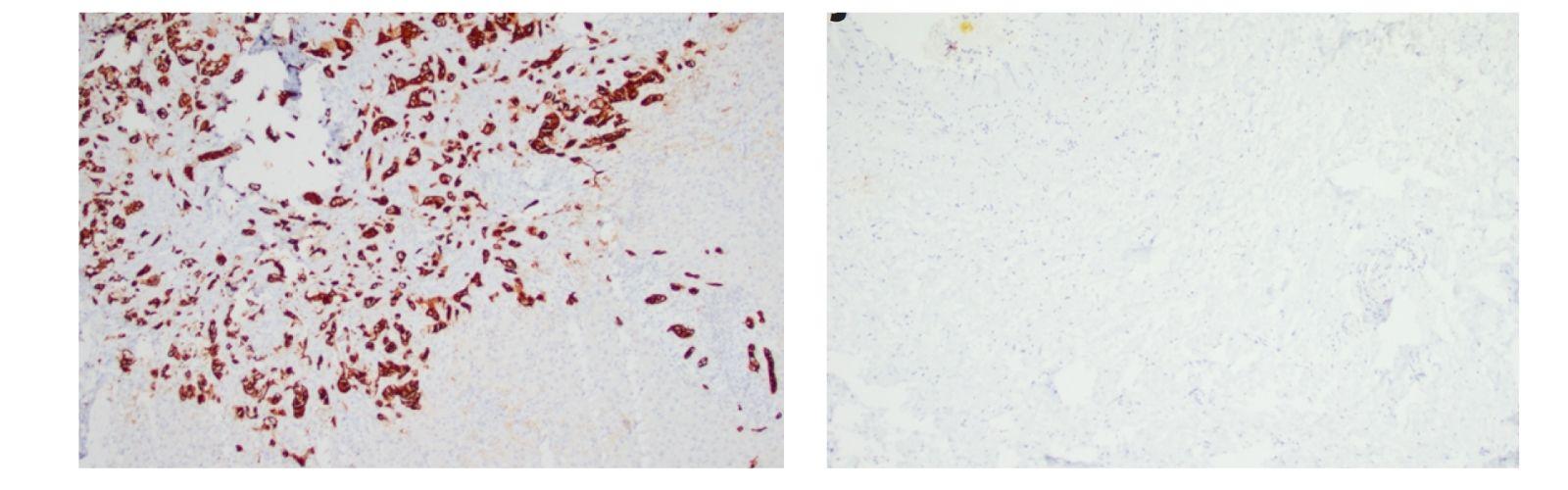
An exceptional responder to the clinical trial with metastatic pancreatic adenocarcinoma at diagnosis (left) had such a positive response to the combination therapy shrinking his tumor that he was able to undergo surgery to remove any remaining cancer cells (right). He remains cancer-free for more than three years.
Understanding how the therapy works - and stops working
The trial wasn't designed simply to test whether the treatment worked. It also gave researchers a rare opportunity to understand why it works-and what happens inside the tumor when it eventually stops working.
"By bringing patient tumor samples back into the lab, we can watch the tumor and immune system respond to one another in remarkable detail."
Researchers used advanced single-cell and computational technologies on blood and tumor samples collected throughout the study to map how individual cancer and immune cells changed in response to treatment.
Those analyses showed that the combination therapy was doing what the team had hoped: reshaping the immune environment around the tumor and changing how immune cells functioned.
But they also revealed how pancreatic cancer eventually fights back. Over time, the T cells responsible for attacking the cancer became dysfunctional, or "exhausted," losing their ability to sustain an effective immune response.
In other words, the therapy can break through some of pancreatic cancer's defenses-but the cancer may eventually build new ones.
"By bringing patient tumor samples back into the lab, we can watch the tumor and immune system respond to one another in remarkable detail," says Benjamin Izar, MD, PhD, co-senior author on the paper whose laboratory specializes in advanced single-cell and computational approaches to understanding how tumors evolve. "If we can identify the cellular changes that precede resistance, we can begin designing therapies that intervene earlier, before the cancer has a chance to adapt."
That finding is now helping shape the next phase of the research.
Back to the lab - and the next generation of therapy
The team has recently launched a large multicenter clinical trial evaluating the therapy while continuing laboratory studies to understand why some patients respond better than others.
Researchers will continue analyzing patient samples collected throughout treatment to identify biomarkers that predict who is most likely to benefit, as well as to understand how tumors evolve as they become resistant.
One area of focus is a subset of cancer-associated fibroblasts that produce CXCL12, the molecule that binds CXCR4 and contributes to the exclusion of cancer-fighting immune cells from the tumor microenvironment. Researchers will investigate whether the abundance of these CXCL12-producing fibroblasts can serve as a biomarker to predict treatment response. They will also examine whether tumors activate additional immune checkpoints as they evolve under treatment, potentially identifying new therapeutic targets that could be incorporated into future combination strategies.
"Every patient on this trial is teaching us something," says Manji. "We took what we learned in the lab and brought it to patients, and now we're taking what we're learning from those patients back into the lab to discover next generation treatments. Ultimately, the goal is to turn an exceptional response into something we see much more often."


