What the research is about
In 1915, Albert Einstein and Wander Johannes de Haas discovered a remarkable phenomenon: when the magnetic property of atoms known as spin is changed, the object itself begins to rotate. This is called the Einstein-de Haas effect.
At first glance, this may seem very strange. Normally, an object at rest only starts rotating when an external force is applied. However, in this case, rotation can occur without any external push. When the direction of spin-an intrinsic property of atoms-is changed, the entire object begins to rotate. This happens because of the law of conservation of angular momentum, which states that the total amount of rotation in a system remains constant.
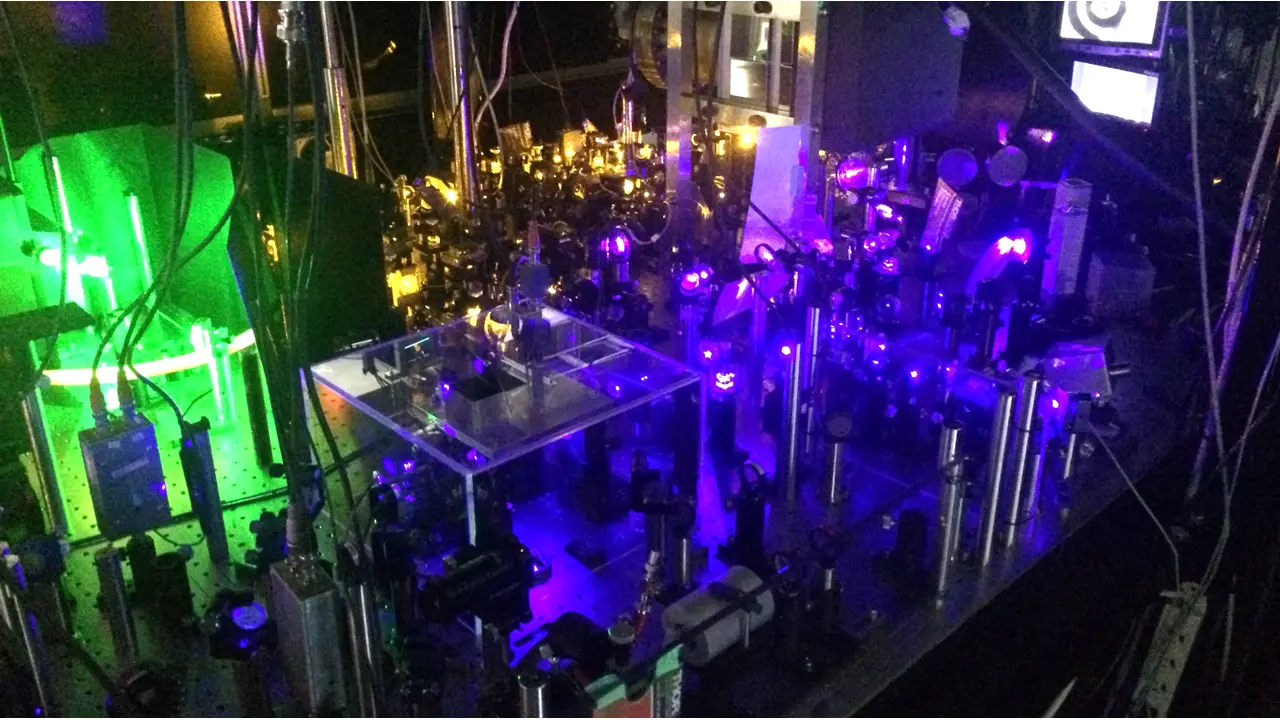
To understand how this phenomenon occurs, researchers have traditionally used solid materials such as iron. However, inside solids, atoms vibrate and impurities are present, creating various kinds of disturbances (or "noise"). Because of this, it has been very difficult to observe the detailed process by which changes in spin lead to forces and eventually to rotation. In addition, a spin behaves like a tiny magnet, making it highly sensitive to external magnetic fields such as Earth's magnetic field.
To overcome these challenges, a research team led by Professor Mikio Kozuma at Institute of Science Tokyo (Science Tokyo), along with Specially Appointed Assistant Professors Hiroki Matsui and Yuki Miyazawa, developed a new approach. They combined two key strategies: creating an ideal state of matter at the atomic level and eliminating external noise as much as possible.
This "ideal state" is known as a Bose-Einstein condensate (BEC), a phenomenon predicted by Einstein based on ideas from Indian physicist Satyendra Nath Bose. In other words, the team used one of Einstein's predicted phenomena to explore another phenomenon he helped discover.
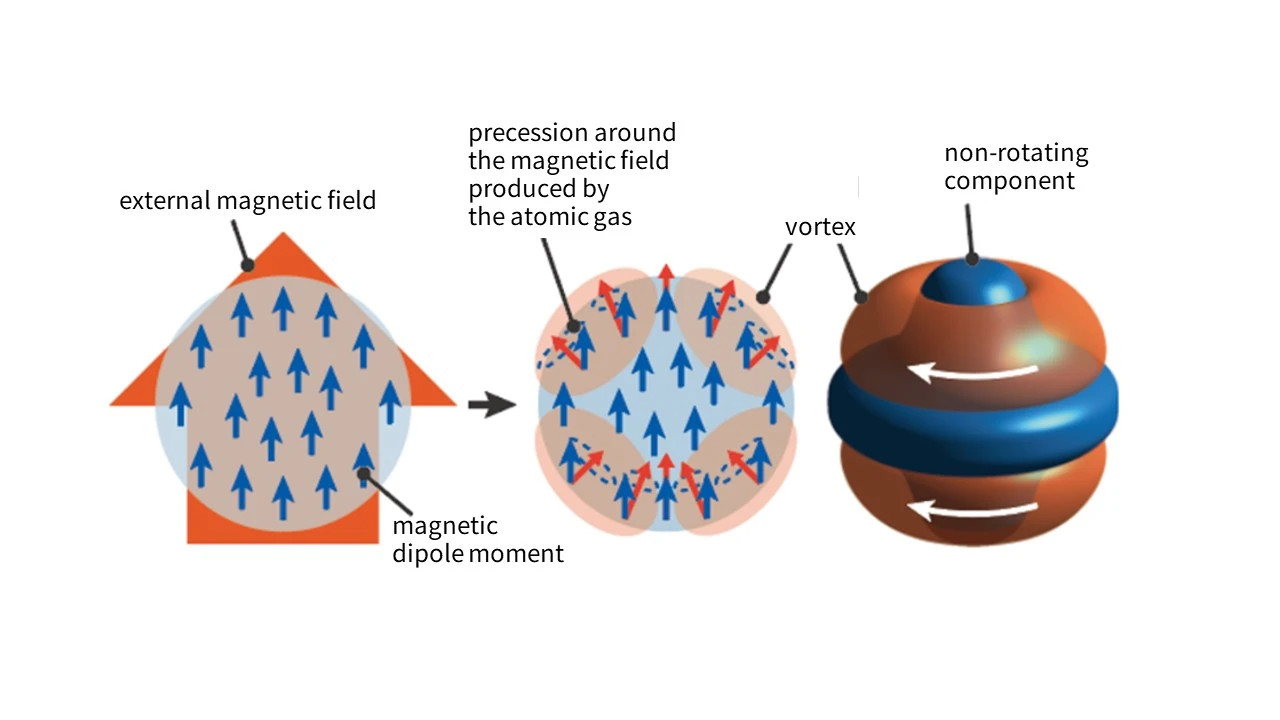
On the left, an external magnetic field aligns the spins, the tiny magnetic moments carried by the atoms. In the center, when the magnetic field is reduced, the spin directions change, and interactions between the atoms' magnetic moments generate rotational motion. On the right, this results in a vortex in the Bose-Einstein condensate-a collective rotation of the atoms-shown schematically.
Why this matters
The researchers first cooled the material to extremely low temperatures, reducing random thermal motion and eliminating noise. In everyday materials like air or water, atoms and molecules move randomly. But when cooled close to absolute zero, atoms enter the same quantum state and behave collectively like a single large wave. This is what we call a Bose-Einstein condensate.
In this state, the motion of atoms can be directly observed as wave-like behavior. This makes it possible to clearly see how spin is converted into rotation. The team chose europium (Eu) atoms because they have strong spin-spin interactions-meaning their tiny magnetic properties strongly influence one another-making the effect easier to observe. As of March 2026, this team is the only group in the world capable of creating a Bose-Einstein condensate of europium, which is a major achievement.
They also created an extremely quiet experimental environment by reducing external magnetic fields to nearly zero. This was a major technical challenge, as Earth's magnetic field is far stronger than the conditions required for the experiment. Using advanced magnetic field control techniques, the team succeeded in creating an ultra-low-noise environment.
Under these conditions, they observed the europium Bose-Einstein condensate. As a whole, the atoms formed a round shape reflecting the shape of their container, but when focusing on atoms whose spins had changed, they found that these atoms formed a ring-shaped distribution. However, a ring shape alone does not prove rotation. To confirm this, they used an interferometer, a device that visualizes the wave nature of atoms as patterns. By analyzing shifts in the phase (the timing of the waves), they confirmed that the system was indeed rotating. This showed clearly that changes in atomic spin were converted into the rotation of the entire fluid. In this way, a phenomenon that had previously only been understood indirectly was captured directly in a visible form.
What's next
In this study, the researchers started with all spins aligned and then reduced the magnetic field to near zero, observing the onset of rotation in the condensate.
This leads to an even more intriguing possibility. If atoms are cooled into a Bose-Einstein condensate under conditions where the magnetic field is already nearly zero, the system may begin rotating on its own, without any external manipulation.
Normally, the lowest-energy state of a system is expected to be completely at rest. However, in this case, it is predicted that a rotating state itself could be the most stable-a counterintuitive and fascinating possibility.
Such a phenomenon has never been observed before. However, with the experimental platform developed by Professor Kozuma's team, it may become observable in the near future.
Comment from the researcher
Our research is based on two distinct pillars: curiosity-driven research, motivated purely by intellectual interest, and needs-driven research, aimed at solving practical problems. We keep the two clearly distinct rather than mixing them.
This work is an example of curiosity-driven research. By setting aside the question, "What is this useful for?" and instead pursuing pure curiosity, we can look at experimental results with an open and unbiased mind.
I am very pleased that our work has produced a result connected to Einstein's name in two different ways.
(Mikio Kozuma, Professor, Institute of Integrated Research, Institute of Science Tokyo)

Dive deeper
Explore more research in Science for All
Science for All showcases cutting-edge research at Science Tokyo and highlights the ideas, people, and possibilities shaping the future.