
Cornell researchers have developed a new type of computing device that stores information electrically but reads it through tiny mechanical motion, an unusual approach that could open a path toward more energy-efficient hardware for artificial intelligence and scientific computing.
The device, described in the journal Nano Letters in April, combines ferroelectric materials with a microscopic vibrating beam, allowing stored analog information to be accessed without relying on conventional electrical readout. It is designed for neuromorphic computing, a brain-inspired approach to information processing, as well as broader analog in-memory computing, where memory and computation are closely integrated.
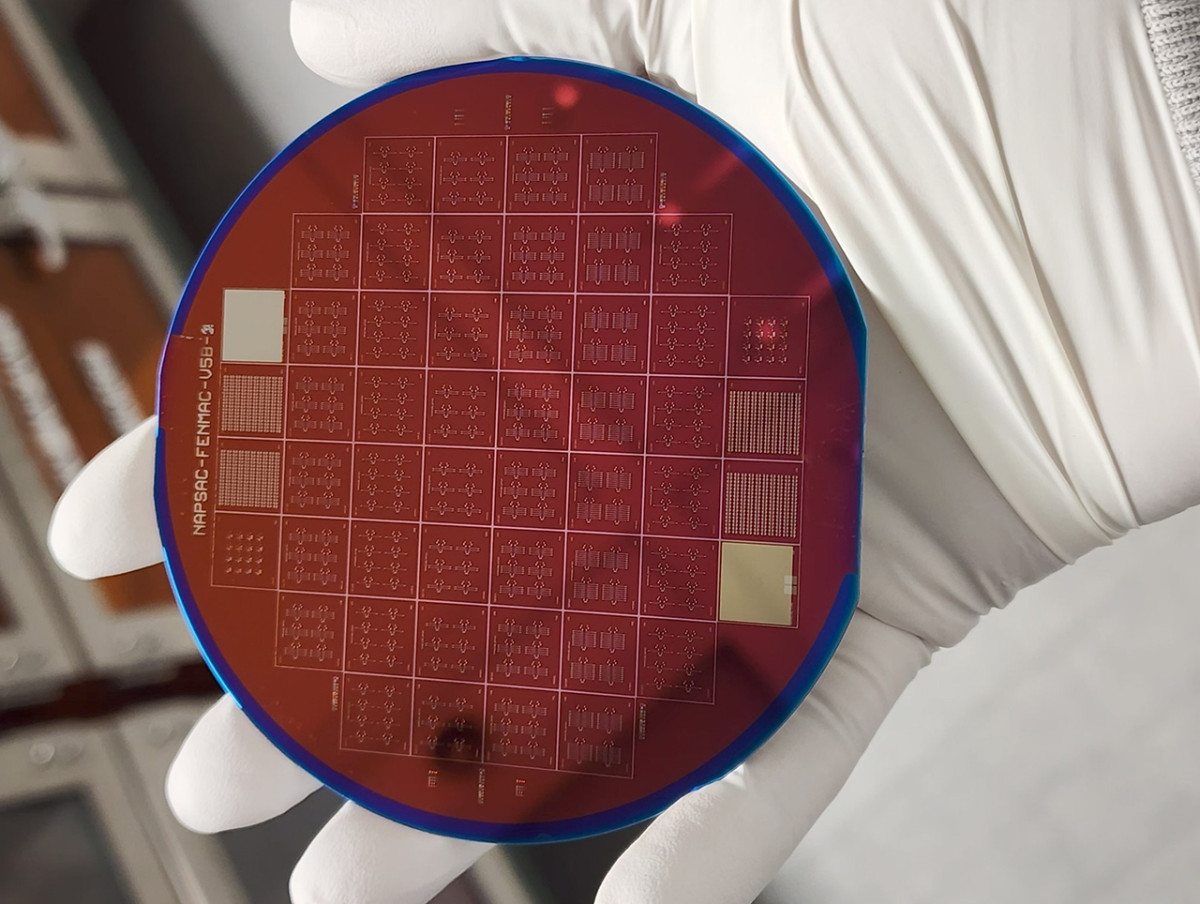
A prototype ferroelectric nanoelectromechanical multiply and accumulate computer array chip fabricated at Cornell contains multiple FeMEMS devices arranged to work together with the eventual goal of performing energy-efficient AI computations.
"Today's computers are extremely powerful, but they usually separate memory from computation," said doctoral student Shubham Jadhav, who led the research along with Amit Lal, the Robert M. Scharf 1977 Professor in the School of Electrical and Computer Engineering at the Cornell Duffield College of Engineering. "For AI and scientific computing, that means the system spends a lot of time and energy simply moving numbers around. We are asking whether the material itself can store a value and help compute with it at the same time."
In many ferroelectric devices, the same electrical pathway is used to write, store and read information, but that can introduce unwanted current paths and readout-related disturbances. The researchers wanted to keep the electrical write function, but move the readout into a mechanical channel so the stored state could be accessed with reduced electrical disturbance and very low idle power at the device level.
To achieve that, the team built a ferroelectric microelectromechanical system, or FeMEMS, using a 20-nanometer layer of hafnium zirconium oxide integrated into a suspended beam. Electrical pulses program the material by changing the orientation of microscopic ferroelectric domains inside the beam. A small read signal then makes the beam vibrate, and the resulting motion reveals the stored value.
Rather than simple binary ones and zeros, the researchers demonstrated roughly 200 distinguishable electromechanical states, giving them fine control over analog values. That precision matters because analog computing errors can accumulate when many operations are performed together.
"If each stored value is only approximate, those small errors can build up across many calculations," Jadhav said. "By creating many distinguishable states, we can represent analog weights more precisely."
Because the incoming signal and the stored state interact directly inside the device, the beam's motion provides a physical analog of multiplication - one of the most common operations in AI systems. In a simplified analogy, if the programmed beam state represented the number 6 and the incoming signal represented 8, the beam's motion would correspond to their product, 48. In real AI hardware, this kind of multiplication is repeated many times to process information.
While the work is motivated by neuromorphic computing, Jadhav said the approach could also extend beyond AI hardware. Electrically programmable beam motion could help researchers study emerging ferroelectric materials and develop adaptive microsystems that combine ferroelectricity with capacitive, optical or mechanical sensing.
The next step is to develop larger arrays of the device that could perform more complex matrix operations while integrating control circuitry and capacitive sensing systems.
"Before CMOS became the dominant technology, computing was a much more open playground," Jadhav said. "Researchers explored many different physical ways to store and process information. CMOS eventually became so powerful and scalable that many of those ideas faded into the background. Now, as conventional scaling becomes more difficult, we can revisit some of those concepts using modern materials, micro- and nanoscale fabrication, and multiphysics design. That is what makes this platform exciting."
The work was supported by the Defense Advanced Research Projects Agency's NanoWatt Platforms for Sensing, Analysis, and Computation program. The devices were fabricated at the Cornell NanoScale Facility, supported by the National Science Foundation. Electron microscopy was performed at Cornell's Platform for the Accelerated Realization, Analysis, and Discovery of Interface Materials and the Cornell Center for Materials Research.
Syl Kacapyr is associate director of marketing and communications for Duffield Engineering.


