
Two projects led by the University of Exeter have been awarded grants by the Engineering and Physical Sciences Research Council (EPSRC).
EPSRC has funded 15 projects in total under a scheme called: "Unlocking the full potential of nature-based engineering opportunity."
The Exeter-led projects are:
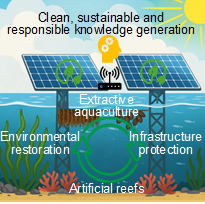
- SeaHIVE (Sea Ecovoltaic Arrays for Habitat Integration, Vitality and Energy), which will develop prototype "reef-inspired" solar arrays mounted on the seabed, combining energy generation with aquaculture (fish farming) and monitoring.
- FROND (Flow & Runoff Observations for Nature Inspired Drainage), which aims to provide a data-driven understanding of local- and catchment-level impacts of nature-inspired drainage solutions.
Dr Zheng Jun Chew, who leads SeaHIVE, said: "We are truly excited to receive this funding, which will help us explore an inspiring new wave of multifunctional marine infrastructure.
"Through SeaHIVE, we aim to go beyond traditional single-purpose offshore systems by developing reef-inspired solar structures that support biodiversity, enhance water quality and feature smart, self-powered sensing for improved marine and aquaculture management.
"This project is particularly meaningful because it brings together expertise from engineering, including solar energy (Dr Aritra Ghosh), machine learning (Dr Zhou Zhou), and marine ecology (Dr Robert Ellis).
"We hope to contribute to a more resilient, regenerative and low-carbon blue economy, making a positive impact on our ocean's future."
Partners in the two-year project are: Zenco Bioenergy (UK) Ltd, Seaweed Generation Ltd, Universiti Malaysia Perlis (UniMAP) and Universiti Sains Malaysia (USM).
Stormwater challenges
The FROND project will focus specifically on sustainable drainage systems (SuDS) and nature-based solutions (NBS), which are increasingly being employed to address stormwater management challenges.
Professor Peter Melville-Shreeve, who leads the project, said: "Despite extensive model-based research and asset-scale trials, there is currently limited empirical evidence on how such systems perform in the long term and, critically, how multiple assets interact at a catchment scale."
Dr Chris Sweetapple, Research Fellow delivering the project, said: "We hope that the project outputs will influence future SuDS and NBS design practices, and ultimately contribute to how nature-based solutions are used in the future to address challenges such as flood resilience and pollution management in the face of climate change, enhancing the transition to more resilient and sustainable water management solutions and reducing reliance on carbon-intensive grey infrastructure.
"Learnings will have global relevance and implications, given the growing global trend for inclusion of green infrastructure in climate adaptation measures.
"Our partnership with Central Bedfordshire Council (including access to their telemetry data and demonstrator catchment) will provide a direct pathway to UK impact and allow us to build on their DEFRA funded Flood and Coastal Innovation Project, ResilienTogether."


