
The challenge
Salt, sugar and saturated fat
Around 80 per cent of our daily diet is foods that are processed to some degree. Eating too many foods that are high in salt, sugar and saturated fat is leading to a rise in diet-related diseases in many countries, including Australia. 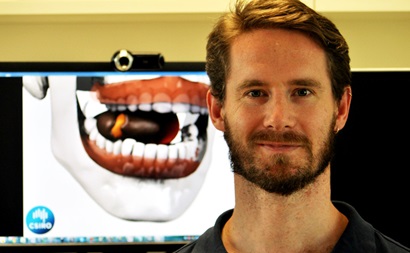
CSIRO biomechanical engineer and computer modeller, Dr Simon Harrison, said the world's first 3D dynamic virtual mouth can provide detailed insight for developing healthier foods that are lower in salt, sugar and saturated fat but with the same or similar taste.
"In polite company, we can't see inside someone's mouth while they're eating and, until now, it has not been possible to view how the chewing process alters food," Dr Harrison said.
Our response
The science of chewing
Using a cutting-edge technique called smooth particle hydrodynamics, we've developed a virtual mouth built on real data about the physics of chewing. It predicts how a particular food breaks down and how flavour is released in the mouth. It also shows the distribution and interaction of components such as salt, sugar and fat.
Through this technology, we can view and analyse how food at the microscopic level works in the mouth, and how it influences our taste perception.
[Image shows a rotating skeleton jaw, teeth and lips.]
[Image changes to show a caramel-filled chocolate egg between the teeth.]
[Image changes to show the jaw closing, the teeth chewing on the chocolate egg and the chocolate egg breaking up.]
[Image changes to show a square caramel-filled chocolate being chewed by the teeth.]
[Image changes to show a soft lolly being chewed by the teeth.]
[Image changes to show side-by-side close ups of the teeth chewing on a jelly bean.]
[Image changes to show side-by-side close ups of the teeth chewing on a jelly baby.]
[Image changes to show side-by-side close ups of the teeth chewing on a life saver.]
- View transcript
- Copy embed code


