
For the last five years, the Dark Energy Spectroscopic Instrument (DESI) has been systematically scanning the night sky. Today marks the completion of its first map, which is the largest high-resolution 3D map of the universe ever made.
Included in the map are more than 47 million galaxies and quasars - bright galaxy cores that surround active supermassive black holes - as well as 20 million nearby stars within the Milky Way. It's an astounding accomplishment, and the instrument has outperformed even the best expectations of the scientists leading the endeavour.
"The first five years of DESI operations have already produced transformative scientific results," says Dr. Will Percival, a professor at the University of Waterloo and Perimeter Institute, and co-spokesperson for the experiment. "DESI is 20 times better than any previous facility at mapping the universe in 3D and has produced the incredible map shown in the images below. The positions of the galaxies shown encode many physical processes at work in the universe, allowing us to understand it in a myriad of new ways."
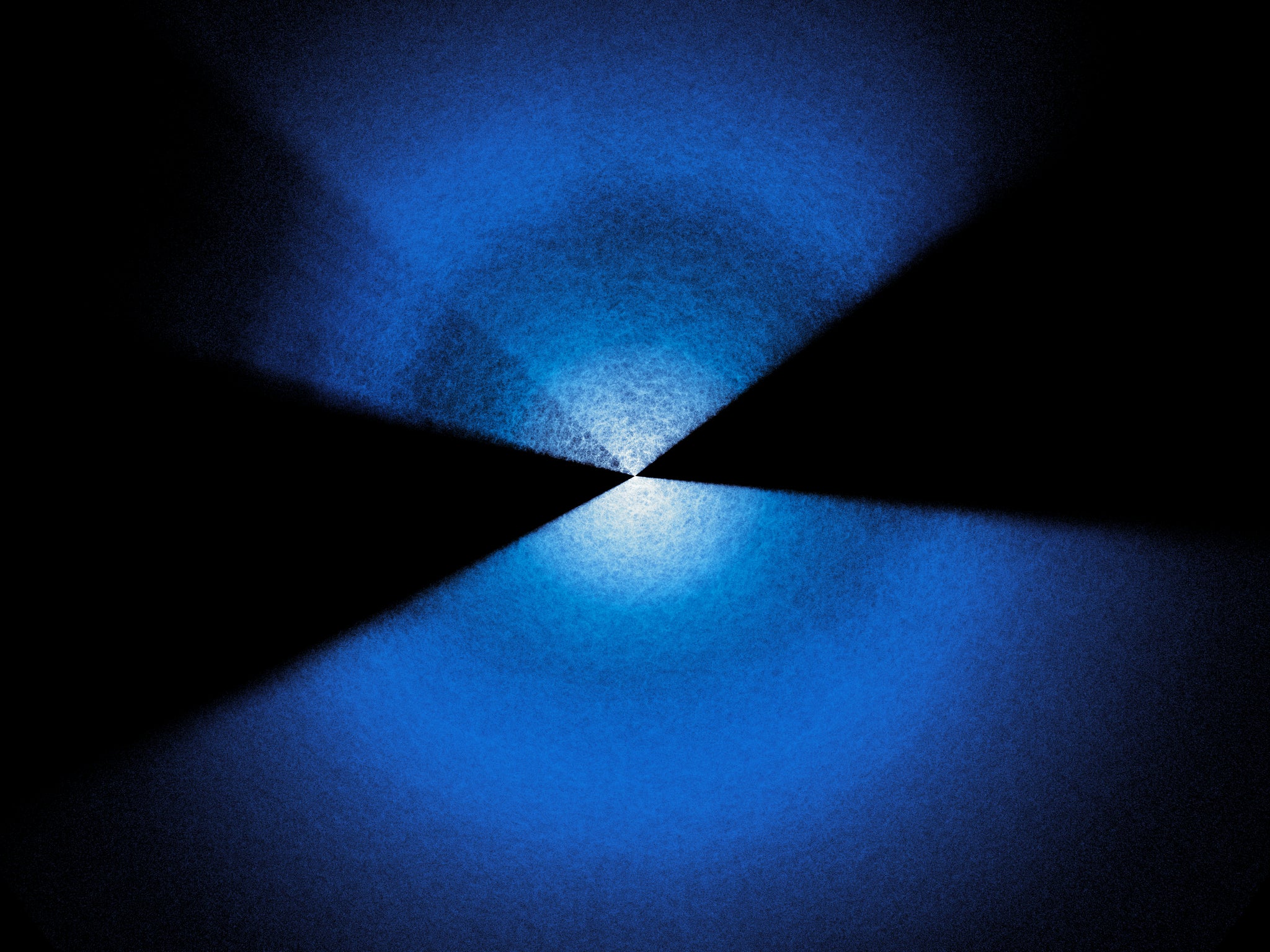
Researchers use DESI's huge 3D map to study dark energy. Earth is at the center of this map, and every point is a galaxy.
One of DESI's main science goals is to better understand dark energy and its influence on the universe's evolution. Dark energy makes up about 70 per cent of the energy density of the universe, and acts as a force that drives the accelerated expansion of the universe. For decades, the best evidence indicated dark energy was an unchanging cosmological constant, but results from DESI's first three years suggested that dark energy itself is evolving.
Now that the full five-year set of data has been collected, those initial results can be tested, and the implications for how experts understand the ultimate fate of the universe are significant. It takes time to analyze the map, so the scientific results from the five-year map are not expected until 2027, while further refinement of the three-year data is likely to come later this year.
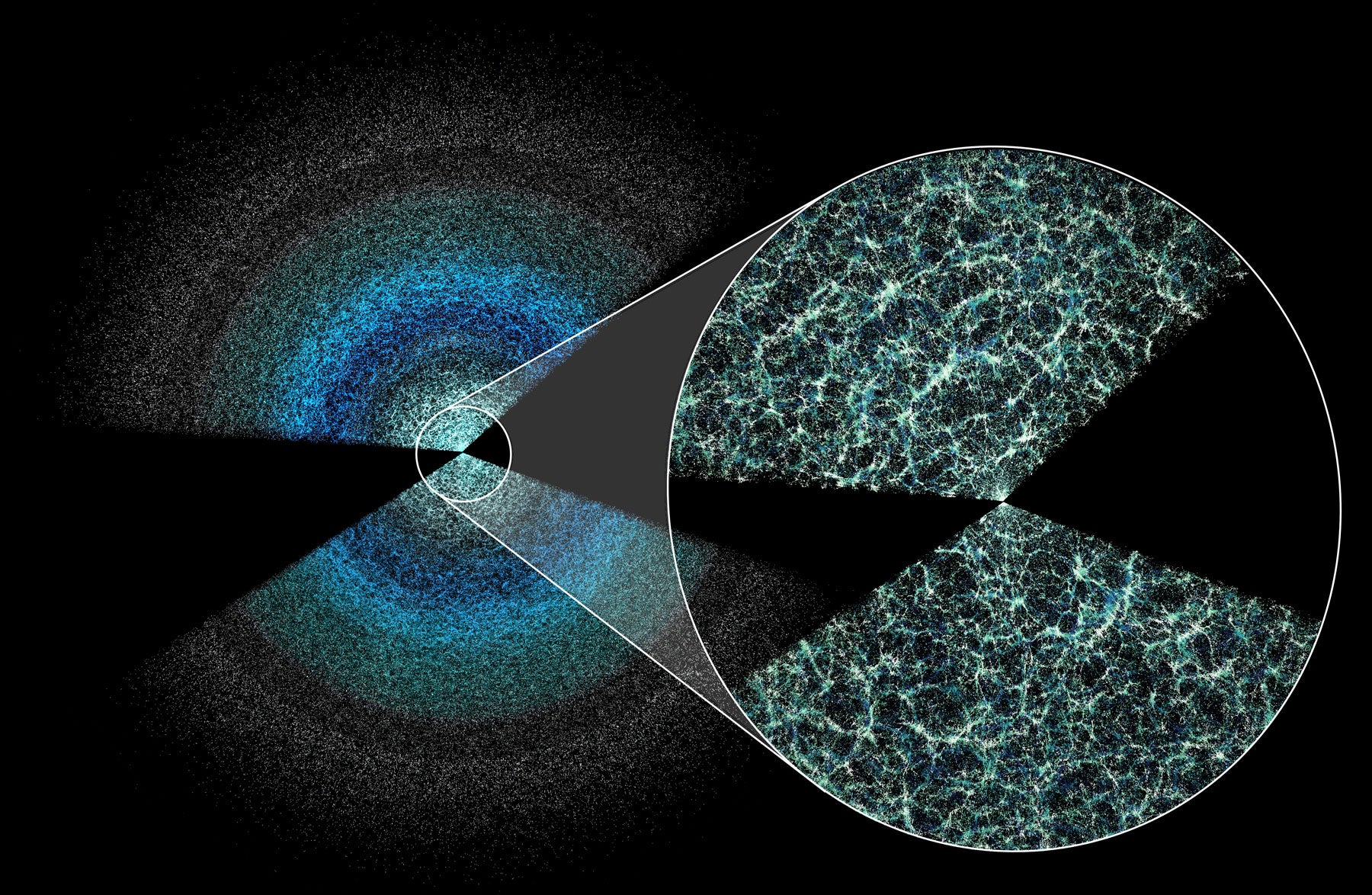
A thin slice of the map produced by the DESI five-year survey shows galaxies and quasars above and below the plane of the Milky Way. The universe's large-scale structure is visible in the magnified inset. Earth lies at the center of the wedges, and the black gap marks where our own galaxy obscures distant objects. Light from the furthest galaxies shown is 11 billion years old by the time it reaches Earth.
DESI is a global collaboration, with more than 900 researchers and 70 institutions contributing their expertise to the project, and is managed by the U.S. Department of Energy's Lawrence Berkeley National Laboratory.
"A project of the size and scope of DESI requires hundreds of people working together, all contributing their unique expertise and care and attention," says Dr. Dustin Lang, computational scientist at Perimeter Institute. "It is incredibly gratifying to see all of that work - long nights in telescope control rooms, long days writing computer code, maintaining the instrument, planning out the survey night by night - finally come to fruition. When I started working on DESI in 2014, I could only dream of the achievements the DESI team has made."
The instrument is a remarkable machine. The secret to its success comes from 5000 tiny robots, each carrying a fibre-optic cable connected to a precision sensor. Their movements are accurate to less than the width of a human hair, allowing them to point directly at pre-determined areas of the night sky. The project has become so efficient that it has been able to revisit certain areas of the sky featuring particularly faint objects to resolve them more clearly. On clear nights from its Arizona mountaintop perch, DESI can map more than 100,000 stars and galaxies, a feat that would have taken weeks or months with previous instruments.
At the University of Waterloo and Perimeter Institute, researchers, including many undergraduate and graduate students, have contributed to creating the map and preparing to analyze it. Current work includes studying regions in the universe containing few galaxies known as voids, finding out how galaxies form and evolve, studying the clustering of galaxies to understand the very early universe when the seeds that grow to form galaxies were created, measuring the Hubble constant that quantifies the current expansion rate, and measuring dark energy through the baryon acoustic oscillation technique.
Piece by piece, DESI has carefully mapped more than a third of the whole sky. And that won't be the end.
The plan is to continue operations through 2028, which will expand the map by about 20 per cent, and cover parts of the sky that are considered more difficult to observe, such as areas where the glow from the galactic arms of the Milky Way obscure observations. DESI will also be able to peer deeper into existing areas of the map to study faint luminous red galaxies.
"We've built a remarkable piece of equipment that met all our expectations and then some," says DESI director Dr. Michael Levi of Lawrence Berkeley National Laboratory. "Now we're pushing beyond our original plan. We don't know what we'll find, but we think it'll be pretty exciting."


