
Alex Knapp, an electrical engineering undergraduate student at the University of Cincinnati, is using artificial intelligence and machine learning to improve health outcomes and medical discovery in diagnostic imaging.
The Goldwater Foundation recognized Knapp and his research by naming him a 2026 recipient of the prestigious Goldwater Scholarship.
The Goldwater Scholarship and Excellence in Education Foundation, established by Congress 40 years ago, honors the legacy of U.S. Senator Barry Goldwater by supporting undergraduates who show exceptional promise in science, engineering or mathematics.
To gain more experience in the area of machine learning, Knapp began working at Cincinnati Children's Artificial Intelligence Imaging Research Center - a co-op job he landed by cold-emailing the associate director of the center and making a successful case as to why they should add him to the team.
Working with the support and mentorship of Elanchezhian Somasundaram, PhD, and Jonathan Dillman, MD, Knapp was able to complete his remaining co-ops at the center, and has continued to work there part-time during his semesters in the classroom.
For one project, Knapp helped develop a method to test and improve a medical imaging AI system's ability to identify unusual or complex patient cases - such as diseases or other unique pathologies - where the machine learning system is more likely to make mistakes. By focusing on these challenging examples, the approach makes it easier to test and strengthen the accuracy of machine learning models without relying as heavily on costly expert physician data.
In another ongoing project, Knapp is contributing to the development of a method to detect liver cancer in children in MRI scans by creating realistic, computer-generated tumors to train AI systems. By adding thousands of these synthetic lesions to healthy scans, this strategy overcomes the scarcity of real patient data for a rare cancer and allows the model to learn from a much larger set of examples, improving its ability to accurately spot cancer in imaging.

Alex Knapp has worked with Cincinnati Children's Artificial Intelligence Imaging Research Center on a project training AI to detect liver cancer in MRI scans, as shown in the image above. Photo/Provided
Knapp is passionate about encouraging other students to pursue an interest in machine learning. He chose the field because of its broad scope that isn't tied to any one industry, giving him diverse career opportunities.
"Machine learning can be applied to any field. Right now, I'm working in medical imaging, which is great, but since machine learning is a generalized technology that can be applied to information, you can work in any sector," Knapp said. "It could be biology, medical imaging, material design, chip manufacturing - there are so many possibilities."
Knapp acknowledges that there are negative aspects to the rise of AI and machine learning capabilities, particularly when used by bad actors, but he also sees firsthand the immense benefits of these technologies to advance science and improve our health.
"There was a group awarded the Nobel Prize last year for amazing work in protein folding. It's being used for drug discovery and for medical imaging diagnosis," Knapp said. "There is a positive impact that technology like machine learning can have if used the right way. There is a lot of good that can come."
Outside of his academic and research work, Knapp has been active in a variety of intramural sports throughout his time at UC.
"I think it's critical for people to have some activity that gets them completely away from whatever they're doing, whether it's school or work," Knapp said. "Keeping active is important to keep your mind ready for everything else that you do. And I've certainly met a lot of new people on my sports teams that are great friends now."
Knapp will graduate in 2027 with a degree in electrical engineering and a minor in computer science. He plans to pursue a PhD to continue his research in AI and machine learning for medical imaging.
Featured image at top: Baldwin Hall on UC's Uptown campus. Photo/Corrie Mayer/CEAS Marketing
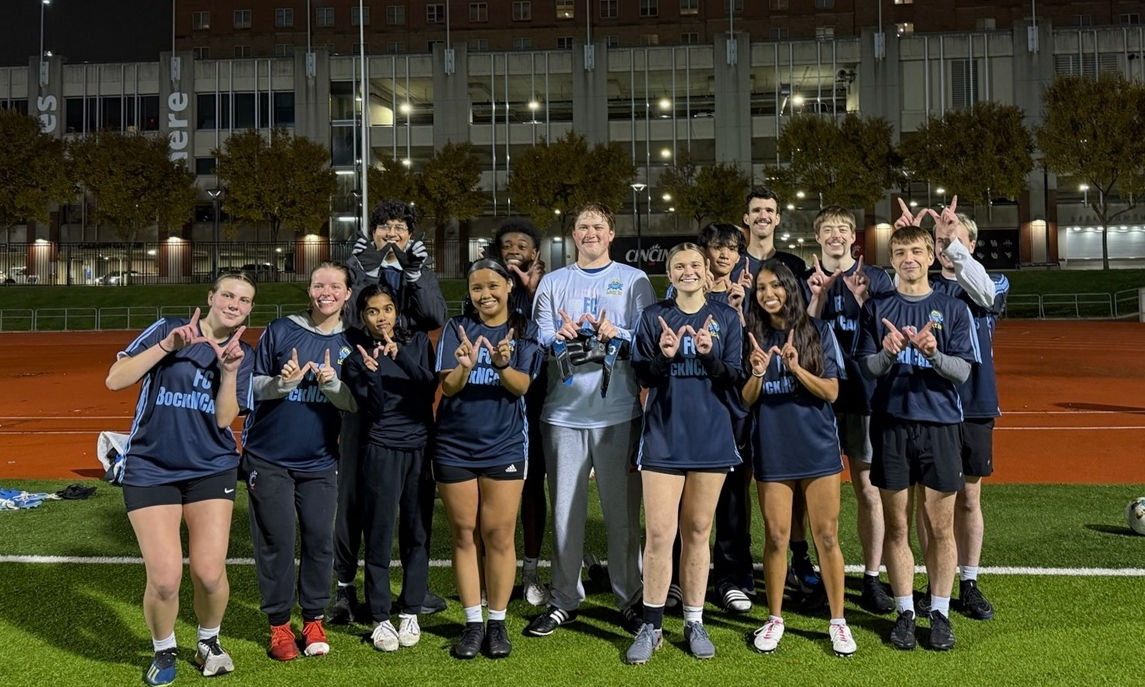
Alex Knapp participated in nearly every intramural sport at UC as a way to keep active and have fun with friends. Photo/Provided


