Adam Stieg/UCLA
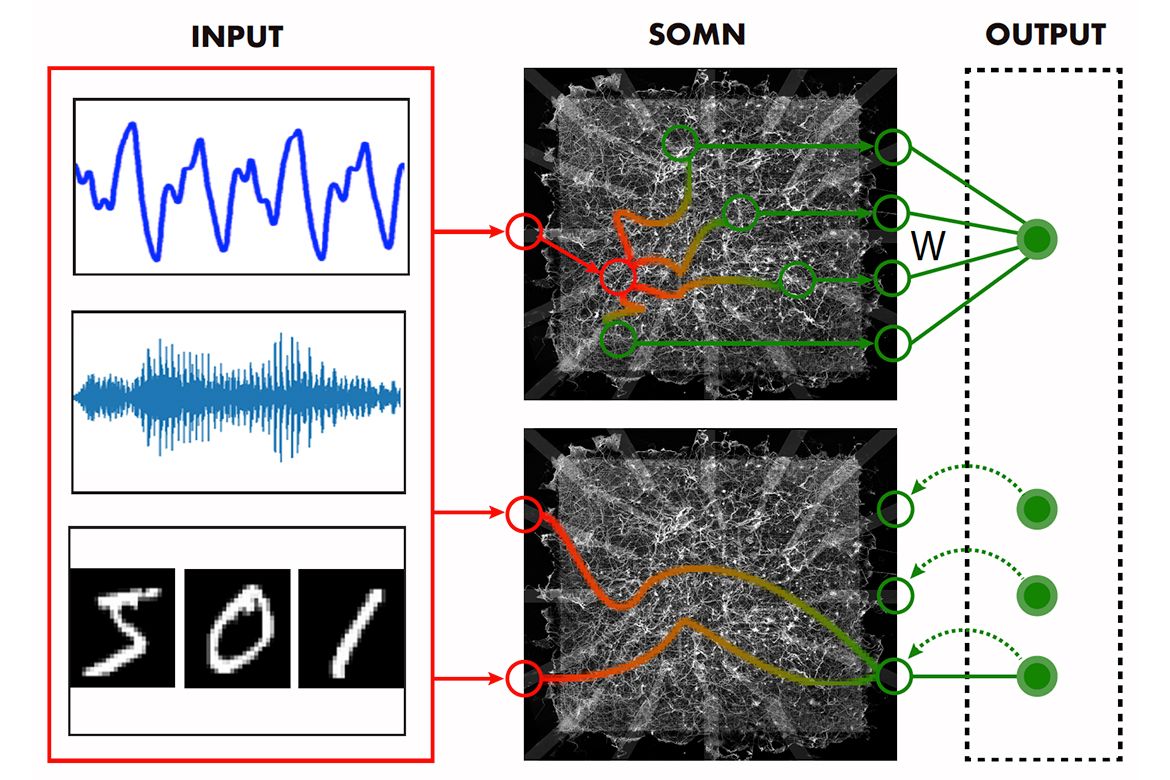
This schematic shows two ways to process data with an emerging computing platform - nanowire networks that physically adapt based on input (displayed as microscopic images in the middle column).
Key takeaways
- UCLA helped launch a complementary approach to computing in which richly connected, self-organized networks of nanowires or nanoparticles act as hardware-based neural networks.
- Inspired by the brain, this approach is well-suited for processing complex data quickly and energy-efficiently.
- A forward-looking article in Nature Reviews Physics explores these self-organized networks and their potential to complement cloud computing by handling sensor data locally in applications such as smart devices, autonomous vehicles, industrial robots and satellites.
Digital computing using silicon chips has transformed nearly every aspect of modern life and enabled the remarkable growth of artificial intelligence. But as AI models scale up, that growth comes with increasing demands for energy, water and computing infrastructure.
At the same time, many emerging applications — from satellites and robots to distributed sensors — need to process information where it is generated, often with limited power and connectivity.
UCLA helped blaze the trail for a complementary computing approach that could one day work alongside silicon-based digital computers to mitigate these challenges. In this conception, software and hardware are no longer separate. There is no neural network software executed on the hardware. Rather, the hardware itself is the neural network, where computation occurs directly within the structure of a self-organizing material that's allowed to establish physical connections measured on the scale of billionths of a meter.
Over the last 15 years, researchers have uncovered rich collective behavior in these systems that can be harnessed to process complex information in real time with low power demands. The advantages could help advance physical AI — systems in which computation and learning are embedded directly into the physical hardware that senses and interacts with the world.
Now, the journal Nature Reviews Physics has published a forward-looking review article by an international team of scientists who have developed and advanced this emerging computing platform.
Co-author Adam Stieg, a UCLA research scientist and associate director of the California NanoSystems Institute at UCLA, and CNSI member James Gimzewski, a distinguished professor of chemistry at the UCLA College, were lead investigators behind one of the first studies to introduce this approach. In recent years, Stieg has collaborated closely on further developing the technology with review co-author Zdenka Kuncic, a physicist at the University of Sydney in Australia.
"Silicon-based electronics have shaped how we think about computing, but they're not the only way to do it," Stieg said. "In our systems, the model evolves in the physical network itself. It adapts and changes."
Possibilities for physical AI by computing at the edge
The self-organizing networks are inspired by certain aspects of the human brain's cortex — the seat of perception, cognition and reasoning.
Like the brain, the systems process complex data without using much power. The review paper notes that self-organizing networks have performed various benchmarks for machine learning, such as speech and image recognition, in real time by exploiting the physical behavior of the network rather than running a conventional neural network model in software.
The technology holds potential to realize physical AI when applied in edge computing — processing that happens at all the spots where sensors gather data from the real world.
Today's sensors can generate enormous amounts of data, but often only a small fraction is ultimately useful. Conventional systems typically digitize those data and then rely on algorithms to recognize patterns, identify important features and extract the information needed for AI to make sense of it.
That approach can be especially costly at the edge, where energy, computing power and communications bandwidth are limited. Satellites, for example, may collect far more data than they can efficiently transmit to Earth, requiring information to be compressed, filtered or reduced before transmission.
The review authors envision a future in which self-organizing physical networks become part of the computing process itself. Rather than simply serving as hardware on which software runs, these networks can adapt their structure in response to incoming signals, learning and computing physically. Such systems could ultimately enable AI to operate continuously and locally in resource-constrained environments.
"Most AI treats the hardware as a passive platform for running software," Stieg said. "We're asking what becomes possible when the hardware itself is adaptive — when the material reorganizes in response to information and becomes part of the learning process. That points toward a very different kind of AI: one that is physical, energy-efficient and able to operate and adapt locally."
Learning from the brain, literally
Computing inspired by the brain goes back to the 1980s, and continues in today's neural network software. However, the self-organized networks physically embody that metaphor.
There are two distinct ways of designing these systems: UCLA-developed nanowire networks first introduced in 2011, and nanoparticle networks originally unveiled in 2013 by a team including review co-author Simon Brown, a physicist at the University of Canterbury in New Zealand.
"I'm less interested in what the system is made of than what it can do," Stieg said. "Can it respond, adapt and process information in some of the ways biological systems do? If so, there may be many different materials that can get us there."
The researchers aspire to produce technology with brain-like capabilities to process changing streams of information efficiently while operating with far lower power demands than conventional AI hardware.
At a simplified level, the nanowires or nanoparticles can be compared to neurons, while the changing electrical connections among them resemble synapses. As in the brain, these systems process information in the form of electrical signals. And, as in the brain, the signals lead to new connections forming. Frequent stimulation establishes persistent connections — analogous to memory — and lack of stimulation degrades connections — analogous to forgetting.
The researchers emphasize that the brain metaphor has its limits.
"The original inspiration was the brain, but we were never trying to build one," Stieg said. "I don't think of the brain as a computer, and I don't think we can reproduce the full richness of a biological system. The goal is to understand which properties make biological systems so effective and see whether we can build those into engineered systems."
The review article notes that the computing platform could be the subject of study for physicists, material scientists, chemists, neuroscientists and computer scientists.
"To really take advantage of this approach will require synergy across multiple disciplines," Stieg said. "You can see that in the wide-ranging expertise of my collaborators and co-authors, each of whom brings unique domain expertise to the table."
Review authors and funding
Theoretical physicist Francesco Caravelli of the University of Pisa in Italy is the first and corresponding author of the review. Other co-authors are experimental physicist Gianluca Milano of Italy's National Institute of Metrological Research and physicist Carlo Ricciardi of the Polytechnic University of Turin in Italy.
The authors acknowledge support from the U.S. Department of Energy, New Zealand's MacDiarmid Institute for Advanced Materials and Nanotechnology, New Zealand's Marsden Fund, the European Union's Next Generation EU program and the European Research Council.