
The placenta is essential for a healthy pregnancy, but the earliest steps of its formation have been hidden from scientific view.
Now Columbia researchers led by Mijo Simunovic have created lab-grown organoids that reconstruct the earliest steps in human placenta formation, offering a powerful new tool for studying how pregnancy begins and why it often fails. The development of the 3D models is described in the current issue of Nature Cell Biology.
"Being able to watch a human placenta form in the lab should be a boon to both basic embryology and clinical research," says Simunovic, an assistant professor in the Department of Chemical Engineering (School of Engineering) and Department of Genetics and Development (Vagelos College of Physicians and Surgeons) and member of the Columbia Stem Cell Initiative.
"We hope it will be useful in studying how the placenta forms and how its formation can go awry, which is one of the leading causes of early pregnancy failure."
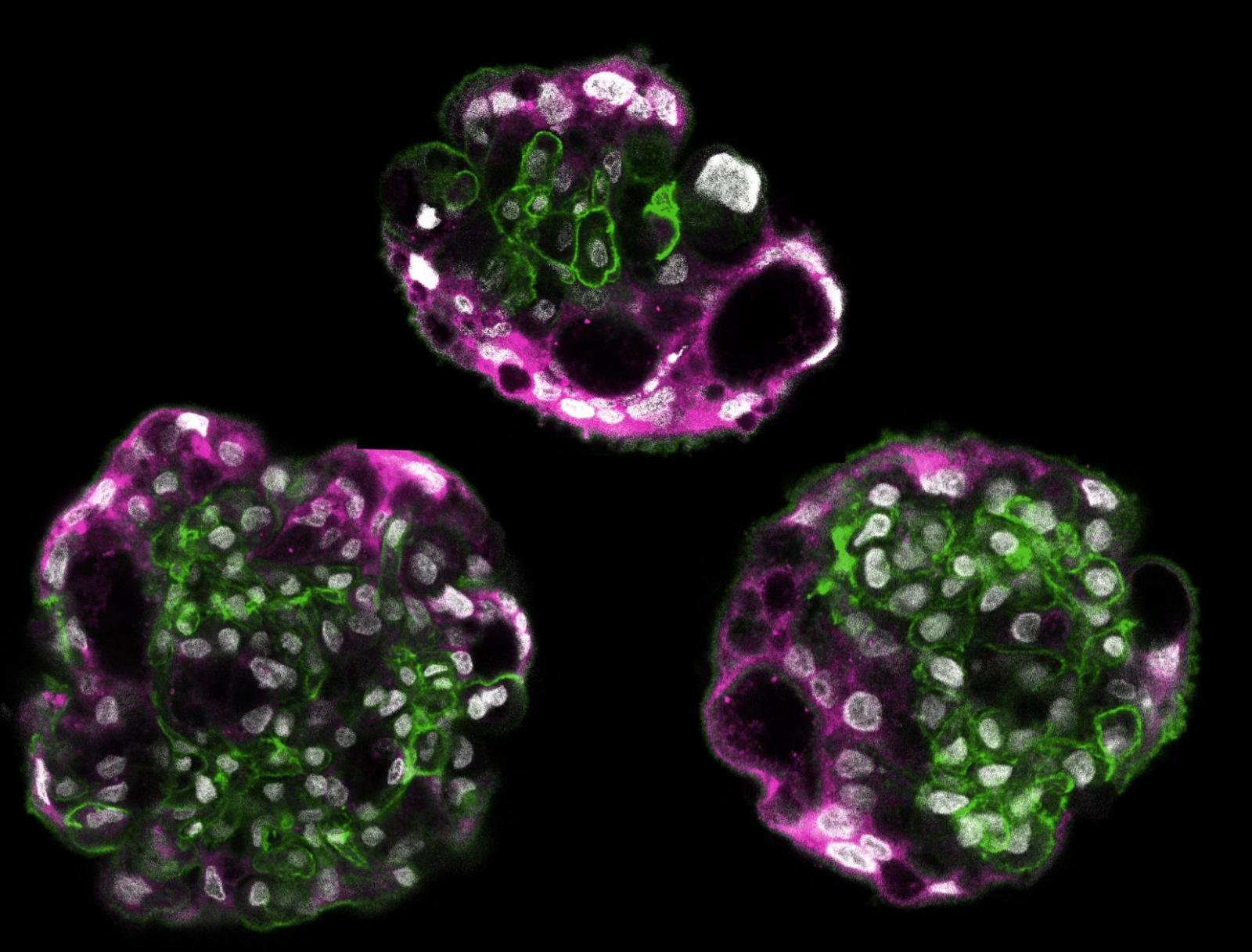
3D Placenta Stem-Cell Models. Lab-grown stem-cell models that reconstruct the earliest steps in human placenta formation offer a powerful new tool for studying how pregnancy begins and why it often fails. Images provided by Mijo Simunovic.
The placenta is the critical organ that establishes pregnancy, but the development of the human placenta has been a hard phenomenon to study. Besides happening inside the uterus, where it's impossible to watch, placenta formation varies across species. "The implantation of human embryos is vastly different from the mouse, for instance, so if you want to understand human implantation, you have to figure out a way to model human-specific processes," says Simunovic.
Within days of fertilization, the developing embryo takes its first steps toward creating the placenta when it makes its first "cell fate" decision. During this moment, cells on the outer edge of the embryo acquire a distinct "extraembryonic" identity, which instructs them, following implantation, to form the chorion, the earliest structural foundation of the placenta. Disruptions in this process can contribute to implantation failure and serious pregnancy complications, including preeclampsia and fetal growth restriction, which account for a substantial amount of maternal and newborn complications and deaths.
Stem cell model
To build a cellular model of the emergence of the human chorion, Simunovic's lab and an international team of collaborators drew inspiration from developmental biology studies showing that the Hippo signaling pathway, best known for regulating how cells sense mechanical forces and control their growth, also governs the embryo's first cell fate decision.
To recreate this process in the lab, they began with human pluripotent stem cells, which they briefly reset to a naïve state of potency, to access expanded developmental potential. They then gave the stem cells a few select biochemical nudges to suppress Hippo signaling activity and thus trigger the native placenta program.
Once pushed down the placental pathway, the cells' own developmental circuitry took over. Within three weeks, the cultures gave rise to the chorion's major cell types. When grown in three-dimensional culture, they spontaneously organized themselves into the appropriate chorionic layers. The structures even developed fluid-filled cavities resembling placental lacunae (see image above), spaces that normally form during implantation and eventually connect with maternal blood vessels."What is remarkable is that we don't have to tell each cell what to become or where to go. Once we set the developmental process in motion, the cells begin to organize themselves into a complex tissue."
"What is remarkable is that we don't have to tell each cell what to become or where to go," says Simunovic. "Once we set the developmental process in motion, the cells begin to organize themselves into a complex tissue. We can now study how that happens."
The lab will now use these stem cell models to ask how specific molecular signals, physical forces, and interactions between different cell types control the construction of the early placenta. The models also make possible studies into the early interactions of the fetal and maternal sides of pregnancy.
"Uncovering the recipe for placenta development should help us create new diagnostic and therapeutic strategies aimed at improving fertility and maternal and fetal health," Simunovic says.


